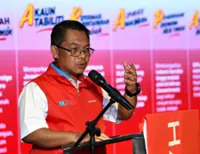
PETALING JAYA: Political parties from both sides of the divide should unite under an independent committee to tackle concerns over the direct entry system in public universities, says MCA president Datuk Seri Dr Wee Ka Siong.
He said such a committee, comprising representatives from the government, opposition and universities, would provide a platform to raise concerns and ensure fair opportunities for local students.
“It cannot be denied that direct entry into universities has caused much concern among STPM students. This is not only raised by MCA but also by DAP’s Raub MP and PKR’s Petaling Jaya MP.
“This issue goes beyond politics and as an MP I am willing to work together because it concerns the future of our next generation,” said the Ayer Hitam MP during an interview on 988’s Morning Up talk show yesterday.
Citing Universiti Kebangsaan Malaysia’s electronic engineering programme, Dr Wee said the number of international students admitted had risen sharply compared with local students.
In 2022, 10 local Chinese students and 10 international students were admitted, he said, but by 2023, international students rose to 23 while local Chinese intake was only 15.
“Last year, the programme expanded to 200 places, with 90 going to international students but only 17 to local Chinese students,” he said.
Dr Wee stressed he was not against other races or foreign students, but warned that local talent should not be sidelined in the pursuit of global excellence.
“Our country faces a severe shortage of engineers, yet places in popular courses are prioritised for foreign students. This is unfair to locals.
“Some claim I am anti-China but that is not true. I care deeply for Malaysian Chinese as these children represent the future of our nation,” he said.
On rising tuition fees, Dr Wee urged the government to increase university funding instead of burdening students.
“I will always push for more allocations but I cannot accept fees being raised 10 to 25 times, especially for locals.
“That is not right. If universities need more funds, that is between them and the Finance Ministry. Students should not bear the cost,” he said.
Dr Wee suggested universities explore revenue through research and development, consultancy and industry collaboration, citing the late Prof Tan Sri Chin Fung Kee, who designed the first Penang Bridge while serving at Universiti Malaya (UM).
Dr Wee also defended STPM top scorer Edward Wong Yi Xian, who scored a perfect CGPA of 4.0 and 99.9% merit score but was rejected from UM’s accounting programme under UPUonline despite being earlier offered a seat through the open channel at more than RM80,000 in fees.
He criticised online claims that Wong was unqualified, calling them unfair and a form of cyberbullying.
According to UM’s Faculty of Business and Economics, STPM candidates must have at least two passes in the Accounting, Mathematics, Economics or Business Studies subjects.
“Wong met these requirements, yet his eligibility was still questioned. Can you say he is unqualified? This is very hurtful to him,” he said.
Dr Wee said the direct entry system, introduced in 2018 after Pakatan Harapan took power in Putrajaya, had only in recent years begun to disadvantage local students.
“I agreed then as it did not affect locals. But in the past two years, the focus of the direct intake has shifted to locals.
“With limited seats, commercial channels shut out poor students. UM’s reputation was built on taxpayer support and public universities must retain top local talent while uplifting underprivileged children.
“They should not become systems where locals pay higher fees just to get in,” he said.