



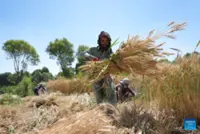
ALOR SETAR: Farmers are urging the government to increase budget allocations to complete the five-season padi planting programme over two years.
Muhamad Rafirdaus Abu Bakar, 49, said only four seasons were completed in the pilot initiative due to funding shortages.
He called for increased subsidies, adequate seed supplies, and support in the upcoming national Budget for the programme carried out in areas under the Muda Agricultural Development Authority (Mada).
“We cannot afford the fifth season without help,” he said, citing high costs, poor weather, limited infrastructure and outdated machinery as major challenges.
Despite setbacks, Rafirdaus, with over 20 years of experience, remains optimistic about the programme’s potential to boost yields and reduce reliance on imported rice.
“If the full five-season cycle can be achieved, it would not only benefit farmers’ income but also reduce dependence on imported rice,” he said.
Despite not completing the full five-season cycle, Mada chairman Dr Ismail Salleh said the programme was still a success, achieving an average yield of 4.9 tonnes per hectare each season.
Previously, the two-season system produced about three tonnes per hectare.
Mada oversees 100,641ha of padi fields.
"The yield is good, but due to the lack of budget, we cannot afford to continue the fifth season," he told a press conference at Mada headquarters on Thursday (Sept 11).
Ismail said the programme would continue this season, starting next week with an additional 600ha of padi fields identified for the programme.
He said Mada was looking to achieve about five to six tonnes per hectare on average for the new season.
Besides implementing the two-year, five-season planting programme, Mada is also targeting higher yields through the Large-Scale Padi Planting Project.
He said Mada remained open to discussions with the state government and relevant stakeholders to ensure that development is carried out in a balanced manner without compromising the nation’s agricultural interests.
On the Federal Government's plan to allow padi land in Kedah to be used for industry and housing, Ismail said the Kedah government should consider converting only low-yield areas.
"We acknowledge the state government’s need to generate revenue through land development, but such initiatives must be carefully planned to avoid jeopardising national food security.
“Development should focus on less strategic areas with lower yields.
“If the areas are already equipped with irrigation systems and farm roads, it would be a huge loss to convert them for other purposes as those investments were made using public funds," he said.
Ismail was commenting on the state government’s proposal to develop more than 15,000ha of padi fields under Mada, which were zoned under the Kedah Structure Plan 2035-2050.
The affected areas include part of Kubang Pasu, Kota Setar and Yan districts.
Ismail said that for the past 50 years, Kedah has lost 8,758ha of padi fields due to land use conversion.
Losing another 15,000ha of padi fields, he said, would significantly impact the nation's rice production.
To offset the potential loss of agricultural land, he said Mada was actively opening up new areas and increasing yields per hectare in existing fields.
"So far, 39 new schemes outside the rice bowl areas have been identified, involving 10,038ha of padi land to be designated as new Mada areas.
"In addition, 13 existing schemes covering 4,127ha have been incorporated through the Mada Plus programme.
"We have submitted the first five schemes, covering 1,500ha, for final approval.
"If everything goes smoothly, Mada’s area could expand from 100,641ha to over 110,000ha in the coming years,” he added.

