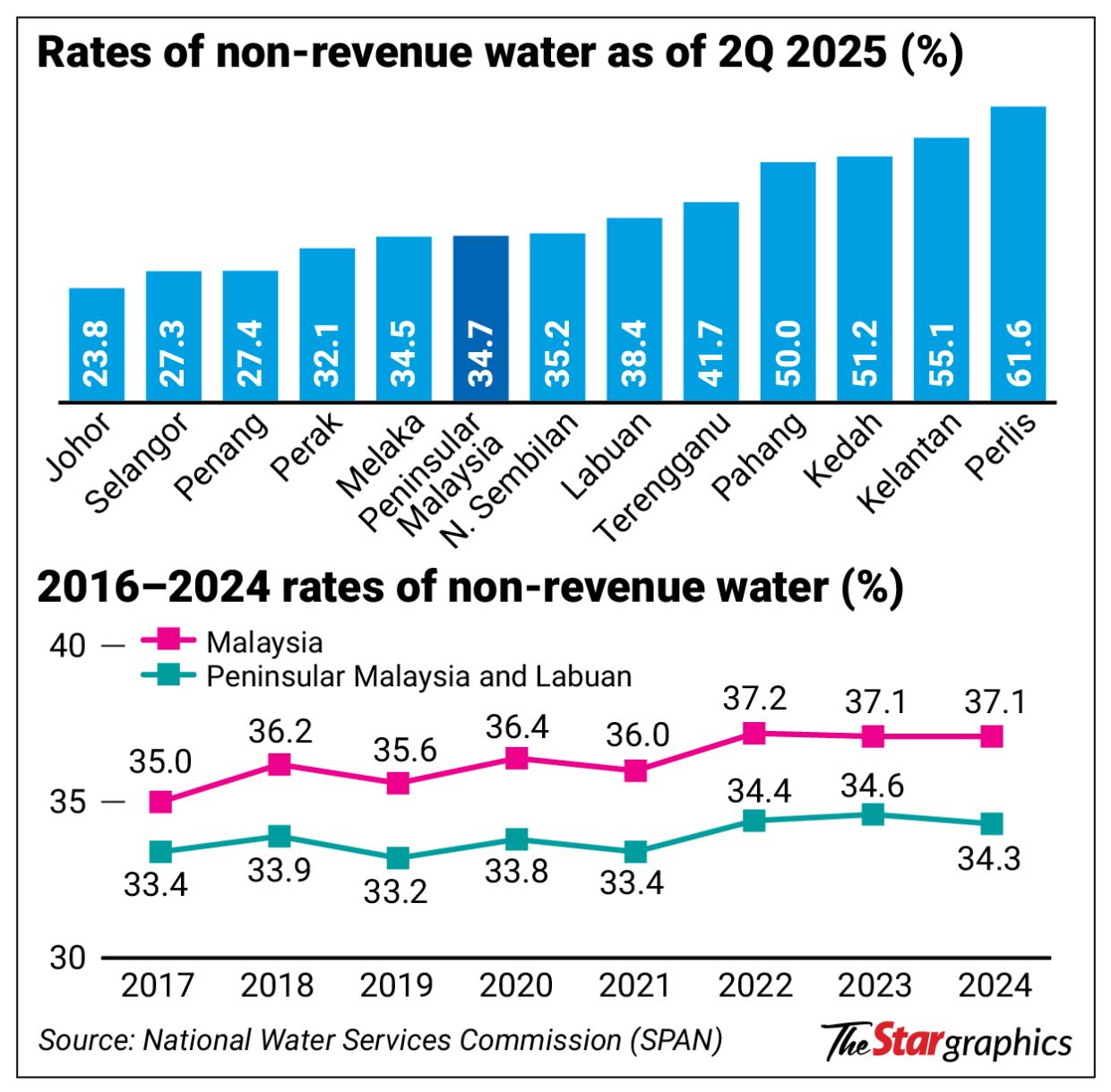
PETALING JAYA: Malaysia’s non-revenue water (NRW) stands at 37.1%, up from 35% in 2017, according to the country’s treated water regulator.
This means that for every 100 units of treated water produced, 37 are lost to leaks, theft or under-billing, said the National Water Services Commission (SPAN).
In Peninsular Malaysia and Labuan, the NRW rate is 34.7% as of mid-2025, with Perlis, Kelantan, Pahang and Kedah recording higher than national rates at 61.6%, 55.1%, 51.2% and 50%, respectively.
ALSO READ : Penang rolls out mammoth plan to stop leaks
SPAN aims to bring the national NRW rate down to below 25% through an aggressive campaign of replacing old pipes, installing smart meters and innovative tech to detect leaks.
Its chairman Datuk Abdul Kadir Mohd Din said as NRW falls, consumers can expect to see fewer unscheduled water cuts and better water pressure at home.
In the economic engines of Selangor, Johor and Penang, consumers can expect to see improvements in NRW rates within five to 10 years.
He added that it will cost between RM800mil and RM1bil to bring down NRW by one percentage point through the replacement of ageing pipes with new ones.
On average, it could cost RM20bil to bring down NRW rates across all states as each state has a different rate, Abdul Kadir said.
“Selangor, Johor and Penang are the leaders in aggressively tackling NRW,” he told The Star.
“If we go aggressively in these three states, the maximum time it will take is 10 years and the minimum is five. Fix these three states and the rest will follow.
“As they are being fixed, we will start seeing results because Selangor is quite aggressive in this. Johor is still very good.
ALSO READ : Study on all data centres water use being done, says SPAN
“Penang is still looking for the most economically viable NRW rate because their rate used to be 15%, but it is now more than 20%.”
According to SPAN’s data, as of June this year, the NRW rates for Selangor, Johor and Penang are 27.3%, 23.8% and 27.4%, respectively.
Bringing down the NRW rate, which on average is 34.7% for Peninsular Malaysia and Labuan and 37.1% across the peninsula, Sabah and Sarawak, is a priority in the 13th Malaysia Plan (13MP), said Abdul Kadir.
Prime Minister Datuk Seri Anwar Ibrahim further emphasised the importance of this goal when he recently said that a stable and dependable water supply is a major draw for investors.
“We still face challenges with water wastage and outdated infrastructure,” Anwar said when opening the Langat Two water treatment plant, which is able to channel and treat 1,130 million litres of water per day from Pahang to Selangor, Kuala Lumpur and Putrajaya.
As NRW rates fall, consumers can expect fewer unscheduled disruptions as water reserve margins increase, said Abdul Kadir.
The reserve margin is the difference between the amount of treated water that is being produced and the amount that is being used by consumers.
SPAN recommends that all water operators in all states maintain a margin of 15% or above, but many states, including Selangor, Kedah, Perlis and Kelantan, have rates below this number.
“When we increase the reserve margin, we minimise water disruptions because we plug the leaks.
“Also, more water goes into houses, so the water pressure into the houses increases,” he said.
Abdul Kadir explained that the target NRW rate for each state will vary, as there is a level where it is no longer economically viable to bring it down any lower.
“If you work and spend money to reduce NRW below a certain low rate, will there be an economic return to consumers? Is that money better spent elsewhere?” he asked.
Abdul Kadir used an example of a lost pencil in an office to illustrate this concept, where the pencil represents one unit of lost treated water.
“I could instruct the senior management of the whole office to look for this pencil.
“But is it worth the time of these people with their high expertise and salaries to be looking for this pencil? Or would it be more economically viable to just go out and buy another pencil and have the senior management spend their time on something more productive?”
Each state and their water operators are currently setting their own economically viable NRW rate, which SPAN will analyse and verify, he added.
“Some states have set these rates and we are in the process of verifying their numbers,” he said.