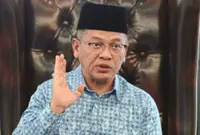
PETALING JAYA: Religious leaders should not be mere preachers within houses of worship but play the more important role of community peacemakers, says Datuk Dr Mohd Na'im Mokhtar.
The Minister in the Prime Minister’s Department (Religious Affairs) said this in his welcoming speech at The Second International Summit of Religious Leaders 2025 held here on Thursday (Aug 28), which was officiated by Prime Minister Datuk Seri Anwar Ibrahim.
The three-day summit was attended by 1,500 participants including religious leaders, religious authorities as well as Islamic scholars from more than 54 countries.
Themed "The Role of Religious Leaders in Resolving Conflicts”, the summit serves as an inclusive and global interfaith dialogue forum.
“Conflict has never yielded benefit. It leaves wounds, sows resentment and destroys hope. Here lies the responsibility of religious leaders not only as preachers within houses of worship, but as peacemakers in the heart of our communities.
“Undeniably, the voice of religion is the one that most gently touches the heart and speaks to the deepest conscience of humanity.
“We must recognise that the voice of religion is the voice that touches the human heart most deeply.
“When spoken with wisdom, it has the power to quell hatred, awaken compassion and revive the fading values of our shared humanity,” said Na’im.
He further said that the participation of religious leaders, politicians and academicians in the summit demonstrated that religious diversity was not a barrier to sitting together to realise unity and harmony in society.
At the same summit, Muslim World League secretary-general Dr Mohammad Abd Karim Al-Issa said that religious authorities should not be tasked with mere abstract preaching.
“Experience has shown that religious leaders have a unique and impactful role in practising what we call 'religious diplomacy' — a creative diplomacy grounded in dialogue, mediation and reconciliation.
“This is because they possess a deep reservoir of community trust stemming from their spiritual status, which enables them to contribute to change, defuse crises, bridge differences and open avenues for peaceful solutions.
“They are duty-bound to be active agents in the making of peace - through their followers and from their spiritual position - by upholding the centrality of human dignity and universal principles we all share.
“What is happening in Gaza - from genocide to painful famine - is a dark stain on the conscience of the international community and a shameful precedent in its human rights record.
“Our world has not witnessed anything like it since the issuance of the Universal Declaration of Human Rights.
“Regrettably, this casts serious doubt on the credibility of international solidarity and the commitment to human rights, thereby threatening the very cohesion of the international community,” said Abd Karim.