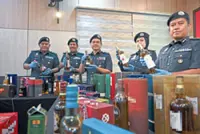
KUALA LUMPUR: Datuk Seri Tiong King Sing (pic) has urged the Royal Malaysian Customs Department to focus on fighting liquor smuggling rather than targeting Malaysians who keep private collections at home.
The issue arose after Deputy Finance Minister Lim Hui Ying told Parliament that individuals storing large amounts of alcohol could potentially breach the Excise Act 1976 if they were unable to prove the bottles were for personal use.
Customs later reinforced this view, advising the public to retain purchase receipts for up to seven years as proof of duty-paid liquor.
The remarks sparked public confusion and backlash, with many questioning whether private collectors were being unfairly criminalised despite no legal limit on the quantity of liquor that can be stored at home.
Tiong, who is the Tourism, Arts and Culture Minister, said the warnings were misplaced and risked eroding public trust.
ALSO READ: Announce liquor storage policy formally, not on social media, MCA Youth tells govt
“Under the Excise Act, it is not an offence to store liquor for personal use, yet Customs is saying it ‘may be against the law,’ which only confuses the public and makes legitimate collectors feel like criminals,” he said in a Facebook post on Wednesday (Aug 27).
He argued that enforcement must be evidence-based.
“Does Customs believe that anyone with a large collection is automatically running an illegal business? That logic is flawed.
"The real focus should be on smugglers, not households,” he added.
Tiong also rejected the call for consumers to keep receipts for seven years, describing it as impractical.
“Bottles already carry duty-paid stamps. The real threat is untaxed, unsafe liquor smuggled into the market – not families with private collections,” he said.
He said collecting liquor is a cultural and social practice among non-Muslim Malaysians.
“Some genuinely collect rare bottles from around the world.
"Customs should not act like a little Napoleon, disturbing people’s lives without strong grounds," he added.
In a Facebook post on Sunday (Aug 24), Lim had sought to clarify the matter, assuring the public that no licence is required to store duty-paid liquor at home as long as it is bought from licensed outlets and kept for personal use or collection, not resale.
She said she had confirmed this with senior officials from the Finance Ministry, Inland Revenue Board and Customs, emphasising that lawful collectors would not be penalised.
Lim added that enforcement action is only necessary where there is clear evidence of illicit trade or smuggling, not when families are storing alcohol for private enjoyment.
Her clarification followed calls from critics, including MCA Youth leaders, for the government to issue formal guidelines through official channels rather than social media, to avoid further public confusion.
The controversy stemmed from a dialogue session with the Northern Region Liquor Dealers Association, where Customs Department assistant director V. Kamalhasan cited Section 34 of the Excise Act.
He was reported to have said that under the law, any premises used for storing liquor must be licensed, and collections growing to 30 or 40 bottles at home, often built up over years through special festival editions, were technically not permitted without a licence.