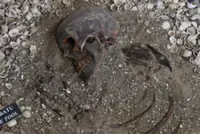
KEPALA BATAS: Penang is about to welcome home some of its oldest residents – 41 Neolithic skeletons that spent more than a century in Europe.
The long-awaited repatriation, set for next week or early September, will mark the return of remains first unearthed at Guar Kepah in the 19th century before being sent to Europe.
Chief Minister Incorporated general manager Datin S. Barathi said the National Heritage Department, together with the Malaysian and Dutch governments, is overseeing the historic exercise.
“Once the remains arrive, we will coordinate their journey to Penang and place them at the Guar Kepah Archaeological Gallery,” she said.
Guar Kepah was the first archaeological site in Malaysia to attract Western researchers, who conducted studies there from 1851 to 1936.
Scientists later uncovered human remains, stone tools, food remnants, beads and pottery shards that offered rare insights into prehistoric life.
For decades, the 41 skeletons were kept at the Naturalis Biodiversity Centre in Leiden, the Netherlands, and are currently stored at the Collection Centre Netherlands in Amersfoort.
Interest in Guar Kepah was reignited in 2017 when archaeologists uncovered another remarkable find, the “Penang Woman”, a 5,000-year-old skeleton preserved in the ancient shell middens.
Barathi said the remains are now under the care of Universiti Sains Malaysia’s (USM) Global Archaeology Research Centre director Prof Dr Stephen Chia Ming Soon and his team.
She added that USM has the expertise and facilities to preserve the remains in a controlled environment, including suitable temperature conditions, before they are moved to the Guar Kepah Archaeological Gallery.
Penang tourism and creative economy committee chairman Wong Hon Wai said the gallery, completed this year, will not only serve as a centre for research and preservation but also boost heritage and archaeological tourism in the state.
“The gallery is developed under an archaeo-edu-tourism concept. It features interactive exhibition spaces, a seminar hall, shell midden sites, administrative facilities, a research laboratory and a storage area for skeletal and artefact conservation.
“Schools and universities are encouraged to plan study trips once the gallery officially opens later this year,” he said.
Wong said the facility will also include a cafe and souvenir kiosks designed to benefit the local economy.
Gazetted as a national heritage site in April, Guar Kepah is estimated to be between 5,000 and 6,000 years old.
Its ancient shell middens, essentially prehistoric refuse heaps, make it unique in Malaysia and one of South-East Asia’s most significant windows into early human civilisation.