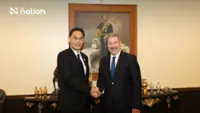
KUALA LUMPUR: The long-standing border dispute between Thailand and Cambodia is expected to be resolved tomorrow following the General Border Committee (GBC) meeting, says Datuk Seri Anwar Ibrahim.
The Prime Minister said the defence ministers of both countries are in Kuala Lumpur to participate in the talks to reach a mutual understanding.
“We hope several coordinated points of agreement, facilitated by Malaysia, can be formalised by Aug 7.
“We pray for a final consensus and resolution because this matter not only affects bilateral ties but also the credibility of Asean.
“All these problems must be resolved by consensus, and I would like to thank both the Cambodian and Thai governments for demonstrating a positive attitude towards achieving a lasting solution,” Anwar said during the Prime Minister’s Question Time in the Dewan Rakyat.
He was responding to a question by Rodiyah Sapiee (GPS-Batang Sadong) who asked the Prime Minister to clarify Malaysia’s role in facilitating the peace negotiations and ceasefire between Thailand and Cambodia.
Anwar thanked Asean member states which had provided support and their mandates to lead the ceasefire agreement, and the Thai and Cambodian governments for their commitment in reaching a resolution.
He also expressed gratitude to all parties, including Opposition MPs, for their support of the Malaysia-led ceasefire.
On July 28, Thailand and Cambodia agreed to an unconditional and immediate ceasefire following a special meeting in Putrajaya, chaired by Anwar.
Cambodian Prime Minister Hun Manet and Thailand’s acting Prime Minister Phumtham Wechayachai agreed to hold the GBC meeting as part of the ceasefire agreement.
On another issue, the Prime Minister said Malaysia stood its ground in trade talks with the United States, successfully defending key national policies during negotiations on tariff issues.
He pointed out that Malaysia remained firm in facing certain demands by the United States, particularly regarding the bumiputra policy, which was viewed as discriminatory and contrary to international trade principles.
“Malaysia must defend this policy, and in the end, it was accepted,” Anwar said.
The Prime Minister also said Malaysia has been engaging with China and Brazil on aircraft procurement, even as the country proceeds with plans to acquire Boeing planes.
He explained that Malaysia Aviation Group (MAG), the parent company of Malaysia Airlines, made the procurement decision after a period of financial recovery, a turnaround made possible through transparent and efficient management, free of political interference.
Anwar said Malaysia’s agreements with Boeing come with specific requirements, including part of the aircraft production to be done locally.
“I wouldn’t agree to any deal unless it is competitively priced. This is about striking a balance,” he said, adding that rising demand for routes to India, China and Japan necessitates MAS to ramp up its fleet capacity.
Investment, Trade and Industry Minister Tengku Datuk Seri Zafrul Abdul Aziz had stated that MAG’s aircraft purchase is a corporate decision using its own funds and not public tax money.
Tengku Zafrul said by taking this approach, Malaysia demonstrated to the United States that “we, too, are significant buyers of their products, which convinced them to reduce the tariffs to 19% from the previous 25%”.