KOTA KINABALU: They are girls with big dreams.
“I want to be a nurse,” said 10-year-old Natasha, flashing a bright smile.
And 13-year-old Zahra, just as confident, declared: “I want to be a soldier.”
Both girls come from families who work in the oil palm sector but the similarity ends there.
Natasha lives in a quiet village in Telupid, 130km away from Sandakan, Sabah’s second largest town.
Her parents own a small piece of land where they grow oil palm. She goes to a nearby government school and is part of Malaysia’s formal education system.
Zahra, however, lives some 400km away in Tawau, which is the third biggest town in Sabah.
Her parents, whose roots trace back to Indonesia and the Philippines, work as labourers on a big plantation.
They hold IMM13 passes, which let them stay in Malaysia but do not give them citizenship, or the right to access public schools.
While Zahra was born here, she is not considered a citizen, so she cannot enrol in a government school.
Luckily, she now attends Grace Training Centre, a community-learning centre run by Calvary Love Foundation that provides basic education for children without legal documents.
“I am happy I get to study here. Now I can read, count and even speak English,” said Zahra during a recent visit by the Tuai Cerita fellowship, a special programme that helps tell the stories of children like Natasha and Zahra.
It aims to raise awareness about child labour in and around Sabah’s oil palm plantations and the reasons behind it.
This initiative is run by local groups ANAK and Global Shepherds, and carried out by Project Liber8 with support from the European Union, International Labour Organisation and Unicef.
The story of Natasha and Zahra is not unique.
In Sabah, thousands of children grow up without legal status or access to basic services.
According to a 2018 government survey, about 33,600 children aged five to 17 were involved in informal or dangerous work at oil palm plantations in Malaysia. Nearly 60% of them, around 19,800, were in Sabah alone.
Unicef Malaysia’s deputy representative Sanja Saranovic said child labour is more than just a violation of rights.
“It shows deeper problems in a system that robs children of their chance at education, safety and a better future,” she said.
Many of these children help their families during weekends, school holidays or harvest seasons. The line between learning and working becomes blurry.
In Beluran, teacher Ravein Raj, fondly known as Cikgu Vin among colleagues and students, said many young children in the area want to learn, but face tough conditions.
“They help with field work or odd jobs to support their families. Getting to school is also tough. Some walk for kilometres. Others skip school because their families cannot afford transport,” he said.
Poverty is not the only problem, he said, citing that perceptions also play a role.
“In many rural areas, plantation workers are admired for being strong and hardworking. That shapes how children view success. For some, becoming a plantation worker seems like the only realistic future,” he said.
In Tawau, a volunteer teacher, who only wants to be called Bu Ana, teaches at CLC Kuari 16, another centre that helps undocumented and stateless children.
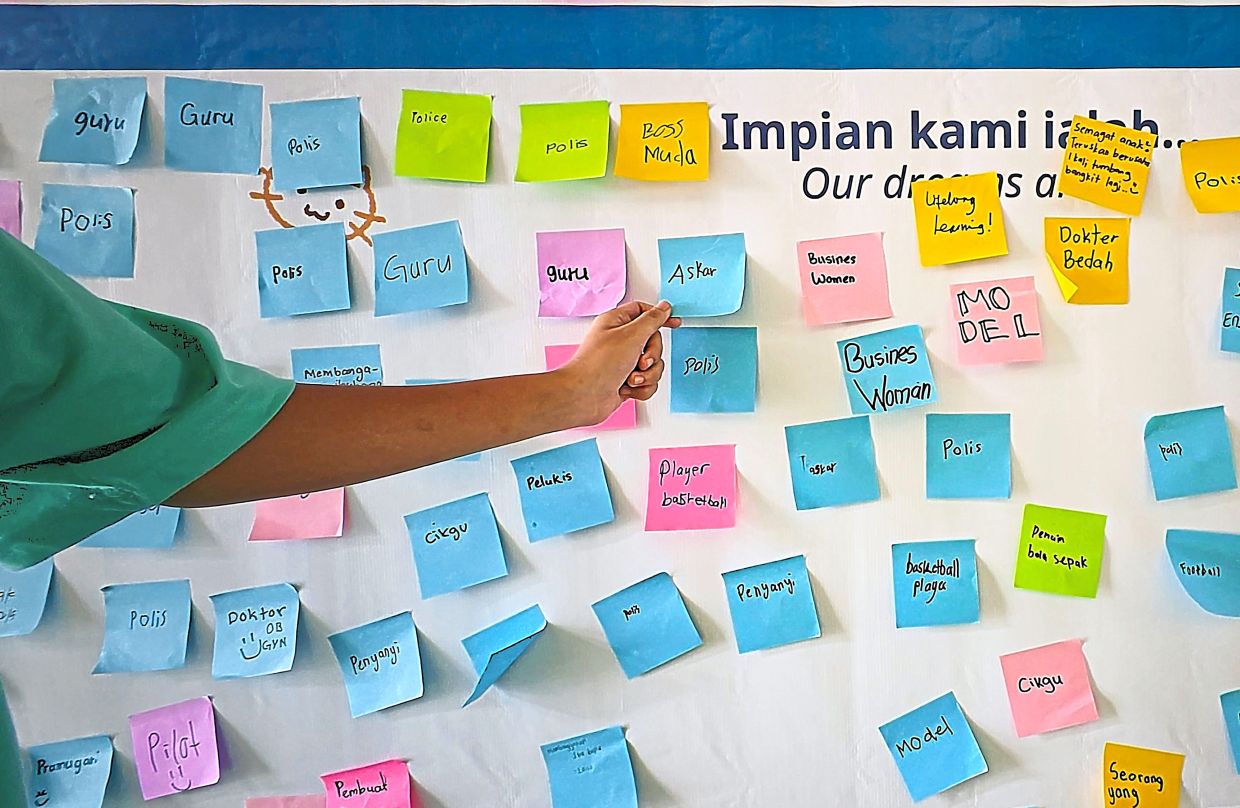
“The children here are full of hope. Some want to be doctors or teachers. They want a better life than the one their parents had,” she said.
Still, their journey is not easy. Most centres like these rely on donations, fees and volunteers.
“Parents struggle to pay for transport, uniforms and basic school items. It’s not that they don’t care about education, they’re just trying to survive,” said Bu Ana.
“Being stateless does not mean you cannot dream. With the right support, these children still have a chance.”
For Natasha, the path to her dream of becoming a nurse is smoother as she has access to formal education.
As for Zahra, she has the motivation but not the legal status in what appears to be an insurmountable system. Her future, thus, remains uncertain.