
PETALING JAYA: Malaysia’s air quality improved significantly yesterday, with only two locations recording unhealthy levels compared to nine areas on Monday, based on the Air Pollutant Index (API) readings, according to the Environment Department (DOE).
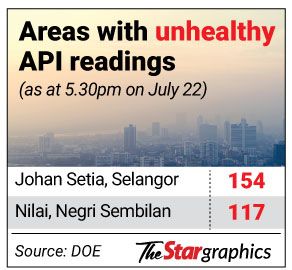
As of 5.30pm yesterday, DOE’s Air Pollutant Index Management System (APIMS) website recorded two locations which are under the “unhealthy” category. They are Johan Setia, in Klang, Selangor, with the highest reading of 154 and Nilai, Negri Sembilan, at 117.
An API reading of 0-50 is categorised as good; 51-100 as moderate; 101-200 as unhealthy; 201-300 as very unhealthy; and anything above 300 is hazardous.
Sixty-five areas across the country saw “moderate” air quality levels with API between 53 and 96, compared to Monday (July 21) when 55 locations were under this category.
The API in Seremban, Negri Sembilan, which was 157 on Monday, improved to 80 by yesterday evening.
At 10am yesterday, Bernama reported that four locations were recorded as having unhealthy air quality based on the API readings.
ALSO READ: Malaysians face dual threats of haze and high UV levels, experts warn
The locations are Seremban (155), Nilai (154), Johan Setia (151) and Balok Baru Kuantan, Pahang (140).
Readings ranging from 101 to 200 could impact vulnerable groups including the elderly, children and those with respiratory issues.
The Melaka Health Department is monitoring cases of asthma, conjunctivitis and upper respiratory tract infections (URTI) following unhealthy API readings recorded in several areas of the state since Sunday.
State Health, Human Resources and Unity Committee chairman Datuk Ngwe Hee Sem said that as of epidemiological week 29 (ending July 19), there has been no significant rise in cases compared to previous weeks.
“Surveillance data from week 23 (June) to week 29 show stable trends, but monitoring will continue as a precaution,” he said outside the Melaka State Legislative Assembly sitting at Seri Negeri yesterday.
ALSO READ: It’s not just about that tan
Ngwe said the state is managing haze-related health risks under the Health Ministry’s Guidelines for Haze-Related Health Management, issued in 2020, and is prepared to act in line with the National Haze Action Plan if conditions worsen.
He urged the public, especially high-risk groups such as children, the elderly and those with chronic illnesses to minimise outdoor exposure, remain indoors when possible, limit physical activity, wear face masks outdoors and stay well-hydrated.
More information on haze-related health precautions is available at www.infosihat.gov.my and www.moh.gov.my.