PETALING JAYA: The Auditor-General has flagged the government’s selective pre-qualification procurement method (Pre-Q) after companies that did not fit the bill and failed to comply with the process still qualified to the next round of the tender process.
The Auditor-General has also recommended the Pre-Qualified Selective Procurement method be discontinued and for the government to revert to the open tender system.
The audit findings involved projects from three ministries: Energy Transition and Water Transformation (Petra), Works, and the Rural and Regional Development.
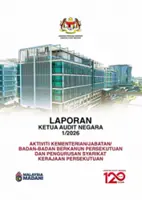
According to the Auditor-General Report Series 2/2025, the Pre-Q Procurement mechanism was introduced by the Finance Ministry for project tenders for 2023 and 2024.
As for the process, companies that pass the first-stage screening process will be invited to proceed with the open tender process at the second stage.
This method is intended to ensure that selected companies are competitive and capable.
The audit found potential for manipulation and a lack of transparency in the selection process. Some companies that didn’t meet the first-stage evaluation criteria, or weren’t even invited, were still selected and evaluated in the second stage. Additionally, the procurement process often exceeded its stipulated duration.
For Petra, 154 companies were invited to bid for 25 projects.
Six companies even passed the first stage without submitting required documents, with three of them later awarded Letters of Acceptance (LOA) for flood mitigation projects in Penang, Pahang and Selangor totalling over RM811mil.
For the Rural and Regional Development Ministry, no list of projects was provided during the first stage of invitation.
“A total of 721 companies participated in the invitation, and 485 companies (67.3%) were approved and certified by the ministry’s Procurement Board between Aug 7 and Oct 20, 2023, for the first stage invitation,” the A-G report said.
The audit found that seven companies that did not have the financial capacity were invited to participate in the second round, up to four times.
One of these companies was awarded the LOA for a RM40.1mil road upgrade works in Tumpat, Kelantan.
The Works Ministry, however, showed full compliance in its first-stage evaluation. Both the ministry and the Sabah Public Works Department (JKR) adhered to the Finance Ministry’s directives, with 113 companies meeting criteria and passing the first stage.
The audit noted that the Petra and the Rural and Regional Development ministries did not comply with the evaluation criteria stipulated by the Finance Ministry.
“Furthermore, this also indicates a lack of transparency and errors in the evaluation of companies at the first stage, which subsequently led to ineligible companies being awarded LOA,” it said.
In its response, Petra said the list of companies for participation in the Pre-Qualification stage was obtained through the Construction Industry Development Board’s (CIDB) Construction Industry Management System (CIMS), based on pre-determined criteria and records of companies that had participated in similar Open Pre-Qualification Tenders.
The Works Ministry, meanwhile, said the Sabah JKR did not have an up-to-date database for the procurement for the 15 work packages under the Pan Borneo Highway Sabah Phase 1B Project.
“The existing database pertained to the Pre-Qualification Tender for the Pan Borneo Highway Sabah Phase 1A Project, which was compiled in 2021.
“However, the data was no longer relevant as the current Pre-Qualification Tender was open to companies from Sabah, Sarawak and Peninsular Malaysia,” said the Works Ministry.
As a proactive measure for future implementation of fast-tracked mega projects, the Works Ministry plans to use the CIDB database as a reference and for checks and balances to ensure the accuracy and currency of company information and to uphold data integrity, the ministry added.
The Rural and Regional Ministry admitted the absence of a complete register of contractors whose previous bids were approved by the Finance Ministry, which would be used as a basis for invitation.
The ministry couldn’t determine the validity of the information in the registry.
The Finance Ministry, on the other hand, stated its commitment to improving the tender process by coming up with a tender guideline for ministries, ensuring that the Electronic Government Procurement Application is used to increase efficiency and a clearer framework for decision-making in the award of projects.
The A-G recommended strategic preliminary screening, proper specification of project types (specific and not complex), clear and transparent Pre-Qualification criteria with maximum timeframes, and the formation of an integrated company database.