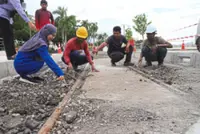
GEORGE TOWN: A 7.4m-long steel trolley track dating back to 1895 will be preserved and transformed into an open-air public exhibit, says Chow Kon Yeow.
The Chief Minister said the public will be able to view the rare heritage piece in its original setting, marked with the words “Barrow Steel”.
He said the initiative is inspired by a practice in China’s Guangzhou city, where historic walkways uncovered during roadworks are preserved under glass panels for public viewing.
“They install thick glass panels over the site, allowing the public to see the original structure while protecting it,” he said during a visit to the discovery site at Jalan Tun Syed Sheh Barakbah, near Fort Cornwallis, yesterday.
Also present were representatives from the National Heritage Department, state government, Penang Island City Council and the George Town Conservation and Development Corporation.
The pre-war trolley track was found during kerb and sidewalk upgrades along the north seafront on June 26.
This is not the first time remnants of the line have come to light as a similar segment was unearthed between 2017 and 2018 within the courtyard of Fort Cornwallis.
Together, the two discoveries have helped reconstruct the likely route of a light railway loop that once served as a military supply line.
Pre-1945 military maps and aerial photographs show the line crossing the Esplanade field, linking the Esplanade’s barracks and storage depots with the port facilities along the eastern shoreline.
While the system appears to have been laid before the Japanese Occupation (1941–1945), it was heavily used during the war to transport ammunition, rations and fuel from ships to military warehouses, including those within the ramparts of Fort Cornwallis.
Chow said the track likely once encircled Fort Cornwallis although only about 7m remain today.
“It is possible that over time, especially during roadworks or upgrades, large sections of the track were removed, leaving only this portion intact.
“We believe the track originally ran around the entire fort and extended into the compound, possibly connecting to Swettenham Pier.
“At the time, goods were delivered by ship and a trolley cart system was likely used to transport these items efficiently from the pier to storage or distribution points within the fort,” he said, adding that the Japanese army might have utilised the tracks primarily to transport goods, firearms and other essential supplies during the war.
Chow also said the preservation efforts will be managed by the department, in collaboration with the state government.
“We are fully open to any proposals or suggestions, especially if the department is willing to fund the conservation work.
“Although the track was discovered in Penang, it is undeniably part of Malaysia’s national history and should be safeguarded through a joint effort,” he said.