



PETALING JAYA: Small businesses earning RM500,000 and below annually in Malaysia can breathe a sigh of relief following the Inland Revenue Board (LHDN) granting them a full exemption from implementing e-invoicing.
However, trade groups say that those still required to adopt the system must use the postponed deadlines wisely and ready themselves for the rollout.
Associated Chinese Chambers of Commerce and Industry of Malaysia treasurer-general Datuk Koong Lin Loong said the exemptions are timely and a welcome relief.
“This is especially for micro-businesses like hawkers, petty traders and family-run businesses whose turnover is below RM500,000 annually,” he said, adding that the postponement for certain income brackets is also sufficient.
“Businesses will now have the time to familiarise themselves with the system. Upskill and find a way to work it out,” Koong said.
On Thursday, the LHDN said taxpayers with an annual income or sales below RM500,000 are exempted from implementing the e-invoice system.
It also said the implementation of e-invoicing for those earning between RM1mil and RM5mil has been postponed to Jan 1, 2026, while its implementation for those earning up to RM1mil is postponed to July 1, 2026.
The e-invoicing initiative began in August 2024 for companies with an annual turnover or revenue of more than RM100mil.
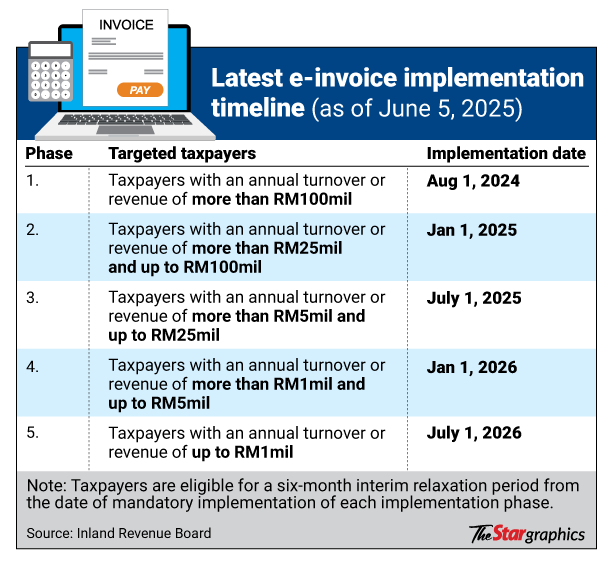
The second phase started on Jan 1 this year for businesses with annual sales of between RM25mil and RM100mil.
The third phase of the full implementation of e-invoicing was initially set to begin on July 1, involving all types of businesses.
According to information from the LHDN’s website, e-invoicing will enable near real-time validation and storage of transactions, catering to business-to-business, business-to-consumer and business-to-government transactions.

“It allows small and medium enterprises (SMEs) to better understand compliance requirements, invest in suitable systems and train their staff without the pressure of a looming deadline.
“The revised timelines provide SMEs with a more realistic window for preparation,” he said.
He said the additional time must be used effectively.
“It is important that the government, particularly the Inland Revenue Board and related agencies, work closely with SMEs to offer technical guidance and awareness programmes across the country,” he said.
“Dedicated grants or financial support schemes for micro and small and medium enterprises can be introduced to help them adopt the necessary systems and technologies for e-invoicing,” he added.
Small and Medium Enterprises Association (Samenta) president Datuk William Ng said the exemption for those earning below RM500,000 annually will spare traders, hawkers and family-run shops from compliance burdens.
“The postponement of e-invoicing requirements for selected income brackets also gives SMEs the breathing space they need to prepare, upskill and adapt,” he said.
Meanwhile, SME Association of Malaysia president Chin Chee Seong proposed for the e-invoicing exemption to also include those earning RM1mil annually and below.
“At least here, you can cover a bigger category of SMEs. If there is such a move, do inform us early,” he said, noting how some businesses, who are now exempted, had previously already prepared for the e-invoicing systems and features.
