
In a world where trade alliances shape global power dynamics, the economic bond between China and Malaysia stands as a chronicle of resilience, reinvention and rising ambition.
What began centuries ago with silk and spices has blossomed into a powerhouse partnership spanning infrastructure, digital innovation and strategic investment.
Long before modern trade agreements, merchant ships from the Ming Dynasty anchored off the coast of Melaka, their hulls heavy with silk, porcelain and tea.
In return, Malaysia offered tin, spices and other precious commodities. These 15th-century exchanges during the reign of the Melaka Sultanate laid the foundations for a relationship that would eventually span not only oceans but centuries.
Under British colonial rule, the connection between Malaya and China continued indirectly.
Tin, rubber and palm oil from South-East Asia fed into global markets, including China’s, through colonial trade routes.
Yet it was not until 1957 – when Malaysia gained independence – that the path was cleared for direct diplomacy.
In 1974, Malaysia made history as the first Asean country to establish formal diplomatic ties with the People’s Republic of China, opening the doors to decades of economic synergy.
The momentum accelerated in the 1980s and 1990s while Malaysia embraced an export-driven economic strategy.
Their economies became complementary forces – Malaysia exported palm oil, petroleum products, electronic components and rubber, while China supplied industrial machinery, steel and consumer goods.
Key to that transformation was China’s accession to the World Trade Organization in 2001.
The move catalysed trade flows across Asia and Malaysia was primed to benefit.
Lower tariffs, greater market access and a surge in Chinese demand made for a golden age of commerce.
The Asean-China Free Trade Agreement, signed in 2002 and implemented in full by 2010, turbocharged the momentum.
With the elimination or reduction of tariffs on over 90% of goods, China overtook the United States to become Malaysia’s largest trading partner by 2009 – a title it continues to hold today.
By 2022, China accounted for 17.1% of Malaysia’s total trade, worth RM487.13bil, according to data from the Statistics Department.
Exports to China rose 9.4% to RM210.62bil, while imports increased 4.7% to RM276.5bil.
In 2024, China continued to be Malaysia’s largest trading partner for the 16th consecutive year.
Trade rebounded by 7.6% to RM484.12bil from the preceding year, representing 16.8% share of Malaysia’s total trade.
Although exports dropped to RM187.67bil as a result of weaker demand for electrical and electronic (E&E) products as well as metalliferous ores and metal scrap, the impact of the contraction was cushioned by robust exports of paper and pulp products, rubber products as well as optical and scientific equipment.
Imports from China increased by 14.8% to RM296.45bil with major imports comprising E&E products, machinery, equipment and parts as well as chemicals and chemical products.
But the partnership has moved beyond just goods.
When Chinese President Xi Jinping announced the Belt and Road Initiative in 2013, Malaysia signed on as a partner.
Strategically located in South-East Asia, Malaysia became a crucial node in China’s grand vision of global connectivity.
The crown jewel of this collaboration is the East Coast Rail Link (ECRL), a 665km-long project connecting the western port of Klang to the eastern town of Kota Baru.
Slated for completion in 2027, the ECRL is expected to reduce travel time by half, lower logistics costs and unlock untapped economic potential along its route.
Once operational, it could transform Malaysia into a regional logistics hub, connecting industrial parks, ports and towns across Peninsular Malaysia.
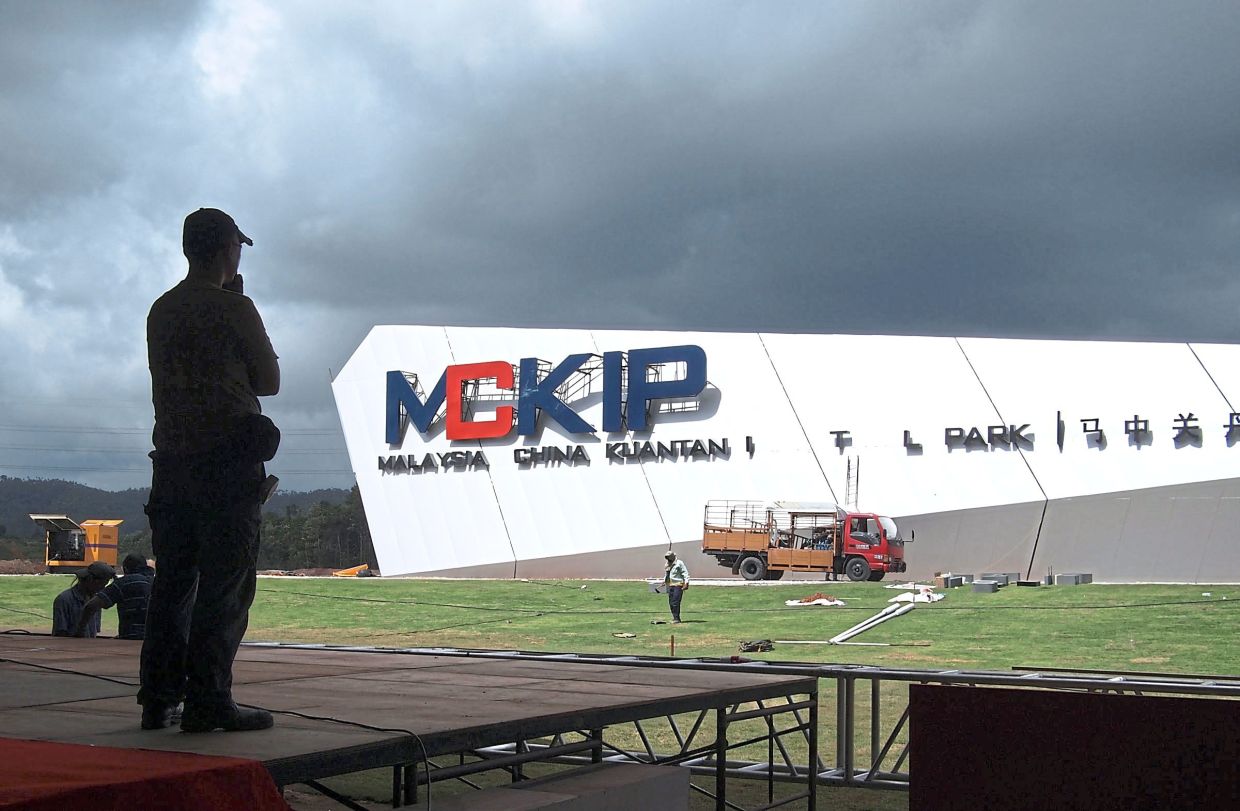
In Pahang, the Malaysia-China Kuantan Industrial Park (MCKIP) adds another layer to the cooperation.
The park has attracted billions in investment and is Malaysia’s first national-level bilateral industrial park with a twin project in Qinzhou, China.
Phase 3 of the park is currently in progress, with the earthworks and infrastructure upgrades scheduled for completion by July 10 this year. This project is expected to attract RM1.5bil in investments by 2027.
MCKIP symbolises a shift towards deeper industrial integration, especially in manufacturing and steel processing.
Trade agreements continue to strengthen these ties.
The Regional Comprehensive Economic Partnership (RCEP), which came into effect in 2022, links Malaysia and China within the world’s largest free trade bloc – encompassing 15 Asia-Pacific nations and nearly a third of the global GDP.
Under RCEP, supply chains are being streamlined, and trade barriers lowered, fuelling further growth.
Meanwhile, exports are evolving. Malaysia continues to send electronic components, liquefied natural gas, agricultural goods and palm oil to China, while importing advanced machinery, semiconductors, steel, and consumer electronics. The flow of goods is now matched by an exchange of innovation.
Looking ahead, the future of China-Malaysia economic relations lies not just in trade but in transformation.
The digital economy is fast becoming the next frontier.
With Malaysia’s booming fintech sector and China’s tech prowess, collaborations in artificial intelligence, 5G, cloud computing and e-commerce are gaining pace.
Green growth is also on the agenda. As both countries pivot towards sustainability, joint ventures in solar energy, electric vehicles and circular economy practices are taking root.
Malaysia’s National Energy Transition Roadmap, launched in 2023, aligns neatly with China’s push for carbon neutrality by 2060.
The road ahead is not without challenges. Geopolitical tensions between China and the United States loom large, threatening global supply chains.
Economic uncertainties – from currency fluctuations to a tariff tit-for-tat – could test the resilience of this partnership.
And as the Belt and Road Initiative evolves, scrutiny over debt sustainability and environmental impact will remain intense. Yet, if history is any indication, Malaysia and China will continue to adapt – and thrive.
From humble spice trades in the 1400s to high-tech innovation corridors in the 2020s, this is a partnership defined not just by trade, but by trust and tenacity.
As the world’s economic centre of gravity tilts towards Asia, the story of Malaysia and China is far from over.
In fact, the next chapter may be the most exciting yet.
For more stories, click here.