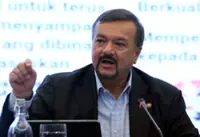
PUTRAJAYA: Malaysia’s diversified economy will be its strength in facing the uncertainties in the global economy, especially with US President Donald Trump’s return to power, says Datuk Seri Amir Hamzah Azizan (pic).
“I think the geopolitical environment in the world is much choppier than in the past. The world has leaned to right-wing politics for a while now.
“Right-wing politics tend to be much more insular than centrist,” the Finance Minister II said in an exclusive interview with The Star.

“Mr Trump has come in and he wants to put America first. That we all understand. It is part and parcel of his election campaign, and it is manifesting itself with a lot more protectionism, a lot more tariffs.
“Whether it’s the right thing to do or not, that’s a problem that the US has to figure out, but the consequences will be felt on a global scale.
“We have seen tariffs being applied to China, Mexico and Canada, and so on, and there are blanket things that are being applied for some segments of industries,” he added.
Trump imposed 25% tariffs on imports from Mexico and Canada as of Tuesday, along with fresh duties on Chinese goods, triggering a trade war.
Amir Hamzah, however, said Malaysia’s strength as an open trading nation would help it navigate any potential headwinds.
Malaysia is not solely dependent on a single market for its exports and its largest trading partners, China, the US and the European Union collectively make up less than 50% of its total trade.
Trade with the US, Malaysia’s third largest trading partner since 2015, rebounded by 29.9% to RM324.91bil in 2024. It made up for 11.3% of Malaysia’s total trade.
According to Matrade, exports to the US in 2024 soared to a new record high, growing 23.2% to RM198.65bil, mostly thanks to electrical and electronics products (E&E), machinery, equipment and parts as well as rubber products
“If things are changing, we have buffers that come in because we have that diversification. If you look at what the government has been doing, it is actually expanding the reach.
“That’s why there have been a lot of business trips to open up new markets for Malaysia and attract new investors.
“If we look at our E&E and semiconductors space, yes we are material. We occupy 16% of the total global E&E space.
“A lot of the semiconductor players in Malaysia are very US-centric, or European-centric, so effectively, tariffs on these will negate back,” Amir Hamzah said.
Under the Ekonomi Madani Framework, Malaysia is also looking at spurring domestic direct investments (DDI) and building local capabilities in addition to foreign direct investments.
He said Malaysian companies were encouraged to become primary vendors to multinational companies.
Although this may lead to some co-dependency, it will also create local players who can take on global market space.
With this, even products and space will also be diversified instead of just markets.
On the impact of the trade war, he said that as long as Malaysia is able to induce counter-actions and investments and rebuild in different areas, it will be able to navigate through the situation, although there may be choppy periods.
“The most important thing is not to sit down and let the world leap ahead in front of us, it is actually doing something about it,” he said.
The Finance Ministry’s GEAR-uP programme that was activated last year – with six leading government-linked investment companies (GLICs) collectively pledging to invest RM120bil in DDI over the next five years – will also come into play.
“What is happening now is that Khazanah Nasional Bhd, Permodalan Nasional Bhd, Retirement Fund Inc (KWAP) and the Employees Provident Fund (EPF) are working through segments that they believe that they have the capacity to activate,” he said, adding that Khazanah’s Jelawang Capital was one example.
The RakanKKM programme with the Health Ministry (KKM) and EPF is another example whereby KKM’s under-capitalised assets are optimised with a business model and capital injection to generate revenue for both government and investors.