
PETALING JAYA: All school staff, students and parents should be trained in the basics of performing first aid including choking response techniques, say interest groups.
Since they are the first responders in school and home emergencies, equipping them with proper first-aid knowledge ensures they can act swiftly and effectively when the need arises.
The call was made following the tragic death of Mohammad Fahmi Hafiz Mohammad Fakhruddin, a pupil in SK Sungai Dua in Butterworth, Penang, who choked on gummy candy in his school on Friday.
Consultant paediatrician and child-disability activist Datuk Dr Amar Singh HSS said first-aid training should be part of the national teacher training curriculum.
“Paediatric first aid for younger children will empower teachers in dealing with common injuries, contact emergency services and perform CPR (cardiopulmonary resuscitation) when needed.
“Health NGOs can offer certified courses specifically designed for teachers.
“This training should be ongoing with periodic refreshers.
“Older students should be offered training in first aid,” he said in an interview.
While young children under five are known to be at risk of choking from food and small objects, Dr Amar has observed a rise in choking incidents among school-aged children.
“Choking hazards are not limited to hard or sticky foods like candy and nuts.
“They also include non-food items such as small batteries, toy parts and balloons,” he said while highlighting the importance of training parents and teachers in choking prevention and emergency response.
“Recognising signs of choking like a child turning pale or blue and appearing panicked is crucial,” he added.
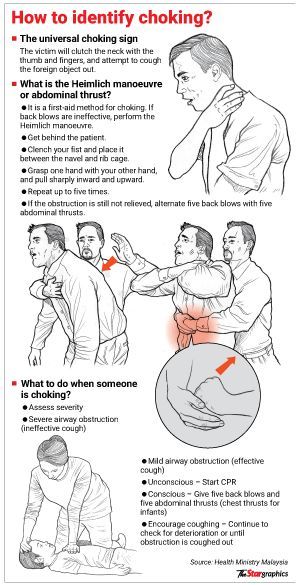
Dr Amar said there are many online training guides and local NGOs offering instruction on first aid techniques such as ‘back blows’ and ‘abdominal thrusts’.
“Having these skills can be lifesaving,” he said while noting the different approaches for conscious and unconscious children.
Dr Amar also called on the people to identify potentially dangerous food items and work with the government to ban them.
The Alliance for a Safe Community chairman Tan Sri Lee Lam Thye said first-aid skills are not difficult to learn.
“A short session can provide essential life-saving knowledge.
“Critical life-saving skills such as CPR and choking management should be a fundamental requirement for teachers and administrative staff in schools,” he said.
Lee suggested integrating basic first-aid and CPR training into professional development programmes for teachers and administrative staff.
He also called for teaching first aid to secondary school students during co-curricular activities or physical education classes and offering voluntary training sessions for parents.
“Awareness of the importance of first-aid training among parents and teachers is still low.
“Many recognise its benefits but don’t prioritise formal training due to time constraints and the misconception that only medical professionals should handle emergencies,” he said.
The National Union of Teaching Profession secretary-general Fouzi Singon called for improved first-aid training in schools, highlighting the gap between theoretical knowledge and practical application in emergencies.
“First aid is learned by teachers and students.
“However, applying these skills in real-life situations requires courage and expertise, which are often lacking,” he said.
Fouzi also highlighted the need for greater awareness of potential school emergencies, noting that they are often trivialised until a tragedy occurs.
“First-aid skills can be taught through media and social media advertisements, as well as during official school assemblies to school staff and students.
“This widespread approach can help ensure the people are prepared during an emergency,” he added.
Fouzi also called for the implementation of Occupational Safety and Health Administration practices in schools.
Parent Action Group for Education chairman Datin Noor Azimah Abdul Rahim concurred, saying that all school staff, students and parents should be trained in first aid and choking response techniques.
“Teachers, especially school security guards, should get basic first-aid training.
“Even canteen operators should know how to detect choking and perform the Heimlich manoeuvre,” she said.
Noor Azimah said secondary schools, particularly, have access to resources like the Red Crescent Society or St John’s Ambulance to train everyone.
“While the Heimlich manoeuvre can be found on YouTube, ensuring it is done correctly is critical,” she said.
Noor Azimah also suggested to the Education Ministry to conduct a comprehensive study on student and school safety, drawing from best practices in other countries.
“Developing a robust school safety and first aid policy is essential,” she added.