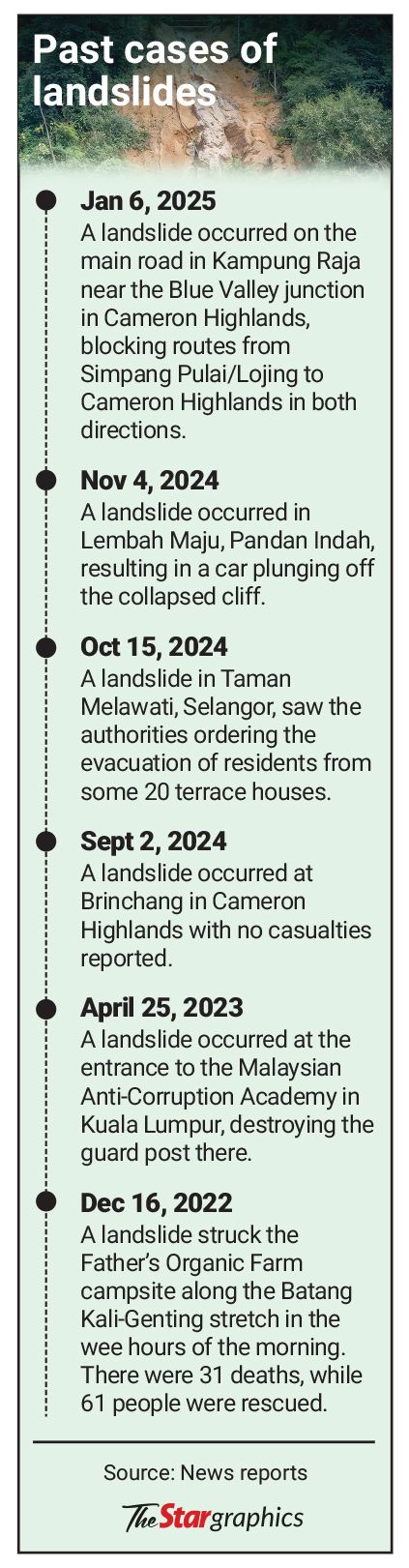
PETALING JAYA: Landslides happen because of a variety of factors that could affect the ground’s stability, according to an expert.
Universiti Teknologi Malaysia deputy vice-chancellor (development) Prof Dr Edy Tonnizam Mohamad said landslides occur when the force of gravity exceeds the equilibrium.
“This refers to forces that affect stability, including volume, friction angle, plasticity, liquidity and many other parameters.
“Rain could increase water pressure in soil, reducing stability and increasing the probability of slides,” he said when contacted.
Apart from landslide risks during wet weather conditions, he said there is also the risk of groundwater levels increasing, as well as floods.
Groundwater refers to water found in cracks and spaces in soil, sand and rock.
“This could result in low lying areas being more prone to floods,” he said.
Meanwhile, an international weather centre said La Nina conditions are already present. La Nina typically brings about wetter weather conditions.
In an advisory uploaded on Jan 9, the Climate Prediction Centre said La Nina conditions are expected to persist until April this year.
Climatologist Prof Datuk Dr Azizan Abu Samah said Malaysia could expect between 10% and 20% more rain during La Nina.
“Since we are at the tail end of the northeast monsoon, the risk of floods has decreased for Malaysia as the monsoon trough is already located south.
“With La Nina, we also have strengthening easterly winds and can expect the southwest monsoon to onset later than usual,” he said.
Azizan, who is a senior research fellow at Universiti Malaya’s Institute of Ocean and Earth Sciences, said with La Nina, it could bring about more rain during the southwest monsoon season.
The southwest monsoon, which is a typically drier season for the country, usually begins in early May and lasts until September before transitioning to the intermonsoon period.
“Also, increased coastal erosion could be expected due to higher and stronger waves due to above average easterly winds associated with the La Nina,” he said.
The previous La Nina episode was in 2020 and ended in early 2023. It was supposed to only last a year.
During that episode, the Klang Valley experienced major flooding in December 2021.
Three days of continuous downpour in the third week of that month inundated much of the Klang Valley, leading to 48 deaths.
In addition, thousands of people were evacuated with houses and furniture damaged in several districts in Selangor, Kuala Lumpur and parts of Pahang.
In March 2022, flash floods hit the Klang Valley, paralysing parts of Kuala Lumpur and inundating various roads and highways.
Baling in Kedah also experienced major floods in July 2022, displacing hundreds of people.