

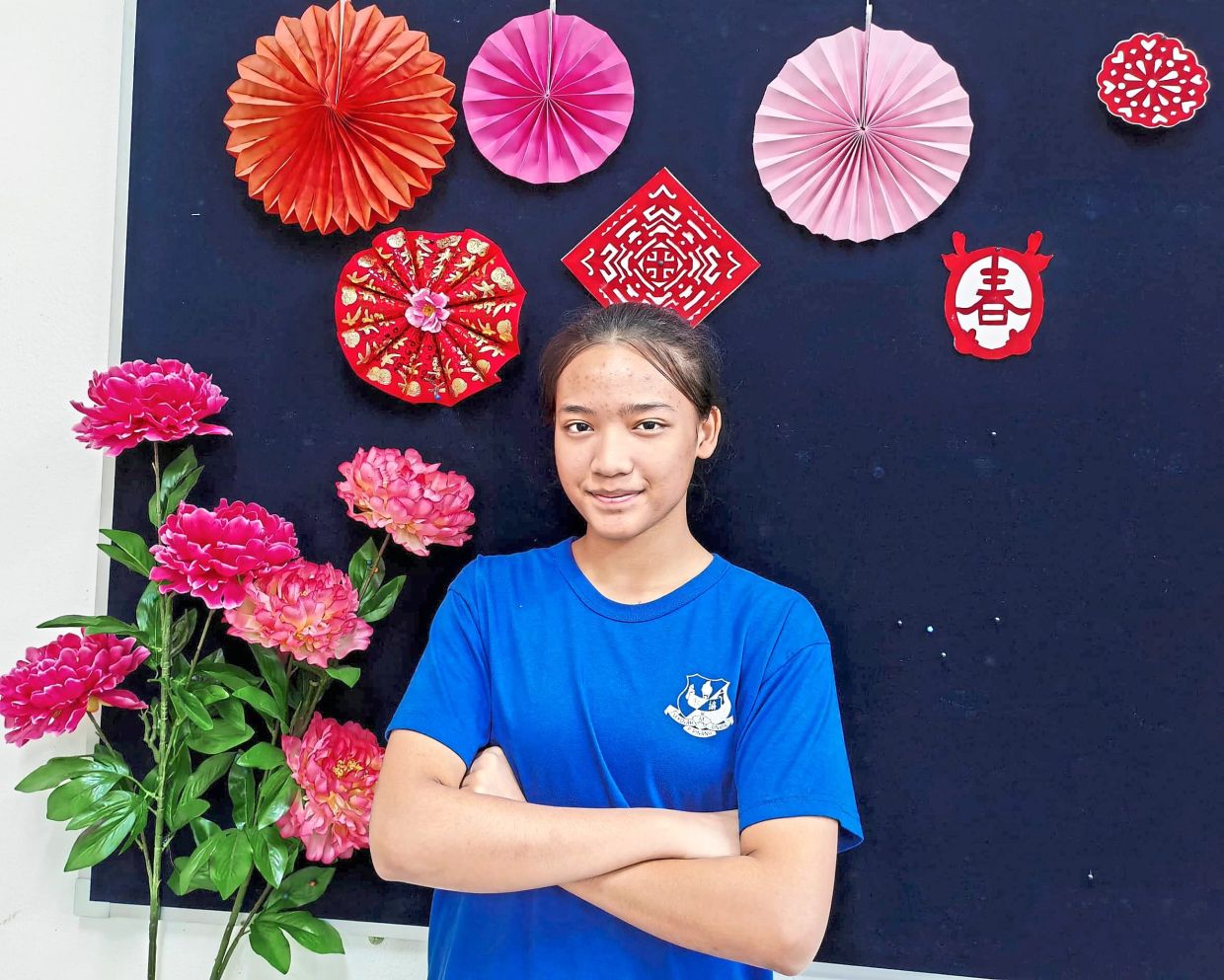
GEORGE TOWN: Long hours, hard work and parental sacrifice have helped Qaleeda Izz’dika Mohd Rosidi become a model pupil at SJKC Union in Penang.
Most essential to her success, however, was the support of her teachers and friends at her Chinese primary school, said Qaleeda, now a Form Two student at SMJK Union.
“When I was in primary school, I did go through a lot of struggles in learning Mandarin.
“The main takeaway for me in my initial challenging experience in Chinese school is that I had to buy many workbooks and go for tuition classes.
“But I would not have made it if not for the support of my parents, teachers and friends who encouraged me a lot throughout this journey,” Qaleeda told Media in Arms.
According to data from Dong Jiao Zong (United Chinese School Committees Association and The United Chinese School Teachers’ Association of Malaysia) and the Education Ministry, non-Chinese pupils – comprising mainly Malay, Indian, Orang Asli and Orang Asal children – currently make up approximately 20% of the total enrolment in Chinese primary schools nationwide.
This indicates that the trend of non-Chinese pupils attending Chinese primary schools is on the rise. However, for non-Chinese students, entering a Chinese primary school is akin to entering a “foreign” environment.

They need to start from scratch to learn and adapt, whether in terms of language or culture. Especially since Chinese is not their mother tongue, obstacles in language learning and communication issues with classmates are inevitable challenges.
While these students would usually need more guidance and attention, it has not increased their workload, said many Chinese school teachers.
The key lies in students’ learning abilities and attitude, said Ooi Sin Ee, the head of Chinese Language Subject of SJKC Union.

A Chinese language teacher at the school, Choo Mooi Lin, said one classroom strategy to help “weaker” pupils at SJKC Union is to seat them next to those with stronger learning abilities.
“The ‘stronger’ students will act as peer tutors and assist their classmates during lessons and in their homework,” she said.
At the same time, it is important to nurture the struggling non-Chinese pupils’ confidence, she said.
“We need to help them build their confidence, especially for pupils who might be learning at a slower pace,” she said.
Qaleeda is one of the few non-Chinese students from Chinese primary school who had gone on to a Chinese secondary school and continued to learn Mandarin.
“To improve, you just have to read more and listen more. You can also listen to Chinese songs and watch Chinese movies.
“I am happy that I am still studying the Chinese language in secondary school. I really hope that I can achieve good results in the SPM examination,” said Qaleeda.
This is Part 3 of Media in Arms’ special report series ‘SJKC: Reality for Non-Chinese students’.
For more on the experience of non-Chinese students in Chinese schools, go to TheStar.com.my.
Media in Arms is a media collaboration comprising five mainstream media – Chinese newspaper Sin Chew Daily, Malay daily Sinar Harian, local news broadcaster Astro Awani, Tamil newspaper Malaysia Nanban and The Star – which got together in February 2022 to share resources and collaborate on diversified news content.
