

SOREN Monroe-Anderson was only 20 when he first tried to sell his drones to the US military. He and a friend were building them for Ukrainian forces in his parents’ garage, assembling parts by hand and shipping what they could to the front lines.
The Pentagon was unimpressed.
“‘You can’t just waltz into the Pentagon and sell weapon systems to the Department of Defence,’” recalled his friend and co-founder, Olaf Hichwa, quoting a senior defence official’s blunt response.
Two years on, that door has swung open.
Monroe-Anderson, now 22, and Hichwa, who has just turned 24, are supplying drones to the US Army.
Their startup, Neros, founded in 2023, has been selected as one of three American manufacturers chosen for the first phase of a new army programme buying low-cost, expendable drones designed for modern combat.
The programme, called Purpose-Built Attritable Systems, is still small by Pentagon standards, but politically and strategically significant.
The Trump administration has budgeted more than US$36mil for it in 2026, as military leaders scramble to close a widening gap with adversaries that can mass-produce cheap drones at scale.
The army ultimately wants to buy at least one million drones over the next two to three years, Army Secretary Daniel Driscoll has said.
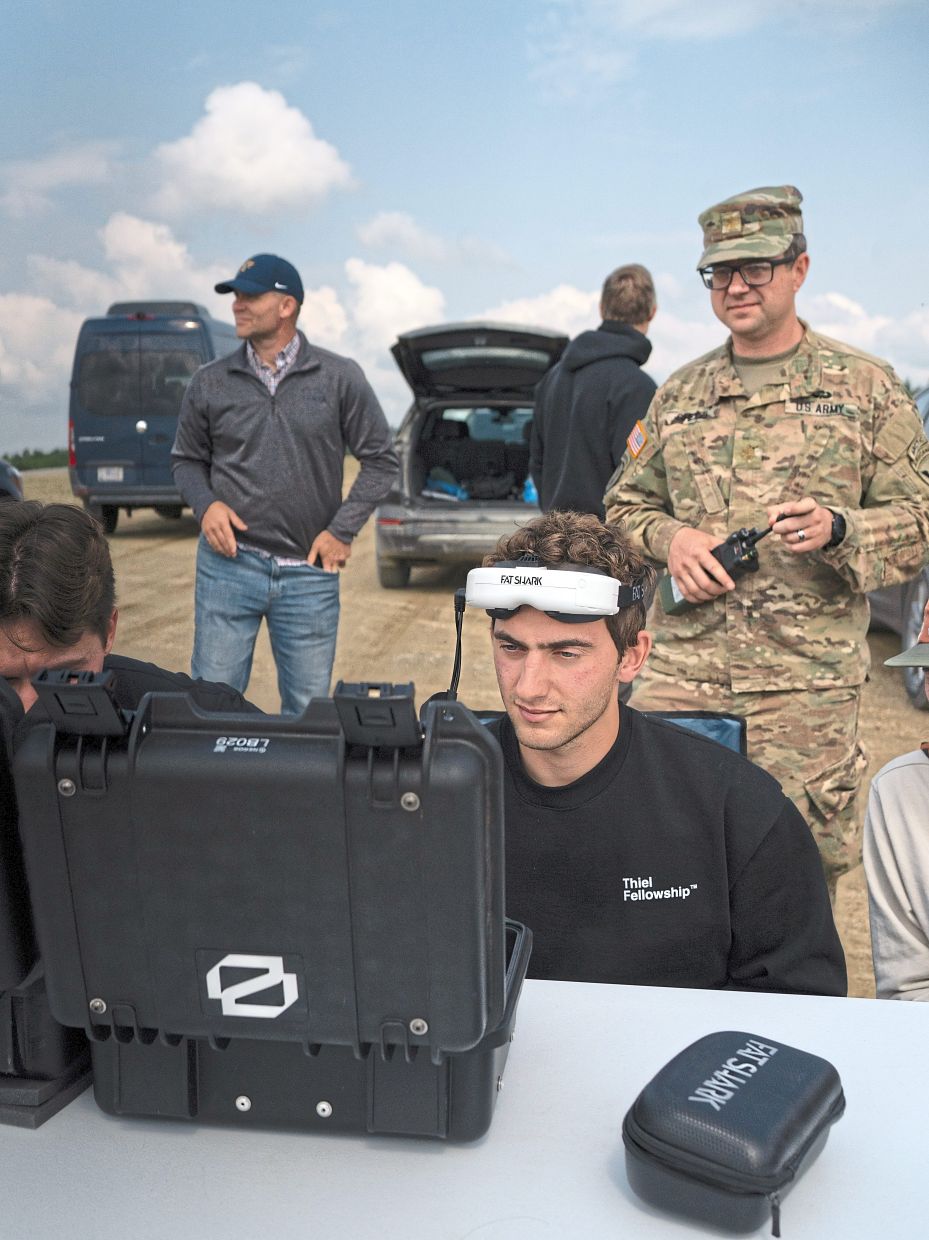
For Neros, the selection caps a dizzying rise. The company has raised US$121mil in total venture funding, including a US$75mil round led by Sequoia Capital, secured a US$17mil Marine Corps contract for thousands of drones, and won an international coalition deal to supply 6,000 drones to Ukraine.
The sudden attention has turned Monroe-Anderson and Hichwa into something close to folk heroes inside parts of the Pentagon.
At the Defence Innovation Unit – an experimental arm of the military with roots in Silicon Valley – some specialists have taken to calling them simply “the boys”.
That familiarity was on display at a fly-off in Alaska last summer, where officials crowded around Monroe-Anderson as he piloted a drone straight through electronic interference that failed to knock it out of the sky.
A Neros Archer drone was also among those buzzing around Defence Secretary Pete Hegseth in July, when he recorded a video announcing policy changes aimed at jump-starting domestic drone production.
In May, Major Steven Atkinson of the Marine Corps Warfighting Lab described how hard it had been to find American-made drones similar to the first-person-view models widely used in Ukraine – and priced under US$2,000 per unit.
He found none, until Neros.
“They were pretty young, but they did FPVs,” Atkinson said, referring to drones flown by pilots wearing goggles that stream live video from onboard cameras. “What they have been able to accomplish is unheard-of.”
The founders’ expertise comes not from defence contracting or engineering degrees, but from competitive drone racing.
Monroe-Anderson, who grew up in New Hampshire, and Hichwa, raised in Maryland, spent their teenage years building drones from kits and components ordered almost entirely from China.
They skipped much of school to race. Neither went to university.
That background gave them an edge in speed, agility and design, but also posed challenges. Racing drones demand skill to fly, while the military increasingly wants systems that can be used quickly by minimally trained soldiers.
Neros typically trains troops for five days on its Archer drones. By contrast, DJI, the Chinese company that dominates more than 75% of the global commercial drone market, is known for aircraft that can be flown straight out of the box.
There is also the problem of scale.
At Neros’ factory in El Segundo, California – an aerospace hub just south of Los Angeles – about 20 technicians assemble roughly 2,000 drones a month, largely by hand.
Making them cheaply, and without Chinese parts, has been even harder.
Nearly every component the founders once relied on – motors, propellers, batteries, radios and cameras – came from Shenzhen.
To qualify for US military contracts, Neros has had to build an entirely American supply chain and prove its drones contain no critical Chinese components.
Their motivation dates back to Russia’s invasion of Ukraine, which transformed a teenage hobby into a battlefield technology. Ukrainian forces began blunting Russian advances with simple quadcopters rigged to drop explosives.
In mid-2023, Hichwa was working at an artificial intelligence startup in Palo Alto when Monroe-Anderson showed up, urging him to build drones again. Monroe-Anderson, who had put off college, was fixated on helping Ukraine.
They spoke by phone with Ukrainian soldiers Monroe-Anderson had met online, built dozens of snap-together drones, and later travelled to Kyiv to hand them out and collect feedback.
There, Deputy Prime Minister Mykhailo Fedorov told them bluntly that supplying Ukraine meant producing at least 5,000 drones a month.
The message landed hard. Russia and China were producing millions of drones annually. The United States was barely making 100,000.
They set up shop in El Segundo, drawing interest from investors and eventually Peter Thiel, who awarded Monroe-Anderson a Thiel Fellowship.
Senior talent followed, including chief operating officer Sean Wood, a SpaceX veteran of 12 years.
Neros now employs 80 people – almost all older than its founders.
Yet the gap remains stark. Last year, Hichwa travelled to Shenzhen to visit the same suppliers who once shipped him parts as a teenage racer. One factory now produces about 1,000 drones a day.
“We’re barely scraping 2,000 a month,” he said. “They’re doing that in two days.” — ©2025 The New York Times Company
This article originally appeared in The New York Times
