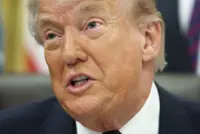
WITH headline-grabbing posts on social media, combative interactions with reporters and speeches full of partisan red meat, US president Donald Trump can project round-the-clock energy, virility and physical stamina. Now at the end of his eighth decade, Trump and the people around him still talk about him as if he is the Energizer Bunny of presidential politics.
The reality is more complicated: Trump, 79, is the oldest person to be elected to the presidency, and he is ageing. To pre-empt any criticism about his age, he often compares himself to former president Joe Biden, who at 82 was the oldest person to hold the office, and whose aides took measures to shield his growing frailty from the public, including by tightly managing his appearances.
Trump remains almost omnipresent in American life. He appears before the news media and takes questions far more often than Biden did. Foreign leaders, chief executives, donors and others have regular access to Trump and see him in action.
Still, nearly a year into his second term, Americans see Trump less than they used to, according to a New York Times analysis of his schedule. Trump has fewer public events on his schedule and is travelling domestically much less than he did by this point during his first year in office, in 2017, although he is taking more foreign trips.
He also keeps a shorter public schedule than he used to. Most of his public appearances fall between noon and 5pm, on average.
And when he is in public, occasionally, his battery shows signs of wear.
During an Oval Office event that began around noon Nov 6, Trump sat behind his desk for about 20 minutes as executives standing around him talked about weight-loss drugs.
At one point, Trump’s eyelids drooped until his eyes were almost closed, and he appeared to doze on and off for several seconds. At another point, he opened his eyes and looked toward a line of journalists watching him. He stood up only after a guest who was standing near him fainted and collapsed.
Trump has prompted additional questions about his health by sharing news about medical procedures he has had, but not details about them. While in Asia, Trump revealed that he had undergone magnetic resonance imaging at Walter Reed National Military Medical Center in early October.
In response to a list of questions about Trump’s health, including about the results of his MRI and whether or not he was falling asleep in the Oval Office, Karoline Leavitt, the White House press secretary, praised the president’s energy and pointed to Biden.
“Unlike the Biden White House, who covered up Joe Biden’s cognitive decline and hid him from the press, President Trump and his entire team have been open and transparent about the president’s health, which remains exceptional,” Leavitt said in a statement.
After this article published, Trump called it a “hit piece” in a post on social media.
“There will be a day when I run low on Energy, it happens to everyone,” Trump wrote, “but with a PERFECT PHYSICAL EXAM AND A COMPREHENSIVE COGNITIVE TEST (“That was aced”) JUST RECENTLY TAKEN, it certainly is not now!”
No health rulebook
Presidents, in general, try to paint the best picture possible of their health. Matthew Dallek, a political historian at George Washington University, said that Trump was following examples set by his predecessors.
“The people around him are similar to Biden’s aides,” Dallek said. “They would talk as if we’re living in a little bit of a fantasy world. Trump, in that way, with the help of his aides and his doctors have created this fiction about his health to hide the hard, cold truth that he is 79 and one of the oldest people to ever occupy the Oval Office.”
Like any other medical patient – and any other president – what Trump chooses to reveal to the public about his health is up to him.
With no official template for releasing health information, physicians sometimes rely on summaries of medical tests without going into detail.
Dr Jeffrey Kuhlman, who served as a White House physician from 2000 to 2013 and wrote a book about presidential health care, said that Trump’s schedule contrasts with those held by George W. Bush, who was 54 when he took office, and Barack Obama, who was 47. Both built exercise into their daily schedules.
“They show him as effective,” Kuhlman said of Trump’s aides, “but every time he’s in the Oval Office, he’s sedentary.”
Kuhlman added that it is “commendable” that, at his age, Trump still boards Air Force One using a long flight of stairs, “but you don’t know what he does as soon as he walks in the door.”
There is one thing Trump is doing more of in his second term though: talking about the afterlife. He has brought up heaven – and the question of whether he would get in – half a dozen times since taking office for the second time. — ©2025 The New York Times Company
This article was first published in The New York Times.