


From Fuzhou to Sibu


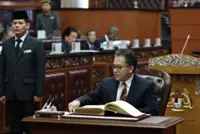
The Malaysian delegation led by Awang Bemee on a tour of Fuzhou. — Photos: Asean-China Centre/Parlimen MalaysiaFacebook

WHEN the President of our Senate, Datuk Awang Bemee Awang Ali Basah, invited me to accompany him to China to participate in the Asean-China Week 2025 in Fuzhou City last month, I accepted without hesitation.

China is a country I have traversed across extensively. Having visited 25 of its cities previously, this latest trip brings my tally to 27 cities over the 20 years since I first became a member of the Dewan Rakyat. Yet, every journey there strikes a chord deeper than mere diplomacy. My maternal ancestry traces back to the Teochew people of Shantou City in Guangdong Province, a cultural tether that offers me a unique perspective each time I walk on Chinese soil and retrace the steps of my family’s past.


Fuzhou City, in Fujian Province, is a historical bastion, renowned as a gateway to the ancient Maritime Silk Road. It was here, at Taiping Port, that the legendary navigator Admiral Zheng He anchored his fleet. This location served as his final staging ground to recruit sailors and replenish supplies before embarking on his seven major expeditions – voyages that eventually brought him to Melaka, weaving the first threads of friendship between China and our region.

However, the connection between Malaysia and Fuzhou extends far beyond ancient mariners. It is also deeply etched into the fabric of Sarawak. During the visit, I was struck by the profound link between the Senate President and our hosts. Awang, who hails from Sibu, represents this bond vividly; Sibu is famously known as “New Foochow”. This connection dates back to 1901, when the mass migration of Foochow people began. Driven by famine and unrest, over a thousand migrants left Fuzhou for Borneo under an agreement with then Sarawak colonial ruler, Rajah Charles Brooke.

Fuzhou City is a historical bastion, renowned as a gateway to the ancient Maritime Silk Road. It has close ties with Sibu, Sarawak.Fuzhou City is a historical bastion, renowned as a gateway to the ancient Maritime Silk Road. It has close ties with Sibu, Sarawak.

Our participation in the Asean-China Week, organised by the Beijing-based Asean-China Centre (ACC), was strategically vital for Malaysia, given our pivotal role as the Asean Chair this year.

Both the Senate President and I participated in key events, allowing us to articulate Malaysia’s strategy of “active neutrality” and balanced diplomacy in a period of complex global competition. While the President delivered a keynote address, I utilised the High-Level Thematic Dialogues to underscore Asean’s commitment to steady engagement with China, a partnership that complements our parallel ties with other global powers.

This balance was evident at the recent 47th Asean Summit in Kuala Lumpur, where Asean leaders interacted constructively with both US president Donald Trump and China’s premier Li Qiang.

The writer speaking at the High-Level Thematic Dialogues of Asean–China Week 2025. — Asean-China CentreThe writer speaking at the High-Level Thematic Dialogues of Asean–China Week 2025. — Asean-China Centre

Through our Parliament’s participation, we fulfilled Malaysia’s regional leadership responsibilities as the Asean Chair and the country coordinator for Asean-China Dialogue Relations.

Crucially, the conference focused on high-value cooperation. The economic realities speak for themselves: China has remained Malaysia’s largest trading partner for 15 consecutive years.

Today, the nature of our engagement has been fundamentally rewritten. The modern cargo that Fuzhou deals in is no longer just physical goods, but intellectual capital and technological innovation, powered by the newly upgraded Asean-China Free Trade Area (ACFTA 3.0) protocol which formalises cooperation in the Digital and Green Economies.

It came as no surprise that a specific topic dominated the discourse on the margins of the conference. Many delegates sought my perspective on the Agreement on Reciprocal Trade (ART) between Malaysia and the United States. The crux of the matter was simple: would this new accord disrupt the equilibrium of our special and enduring relationship with China?

Beyond the metrics of trade, our delegation visited neighbouring Ningde Prefecture, a region pivotal to Chinese president Xi Jinping’s early political career as its CCP Secretary from 1988 to 1990. Our stop at the Poverty Alleviation Centre revealed a remarkable history. In the late 1980s, Ningde was one of China’s poorest enclaves, a condition Xi himself described as “almost a world to itself”.

Three decades on, Ningde has been fundamentally reborn and successfully lifted out of poverty. This transformation was driven by two key philosophies encapsulated in Xi’s influential book, Up and Out of Poverty, a copy of which was presented to me by the Centre. These tenets include an unyielding spirit of tenacity and, most compellingly, the courage of the “weak hatchling bird” to “fly first”, principles championing self-reliance and the shedding of the poverty mindset.

In my many years of travelling between the East and the West, a reality has become increasingly clear. It is here in Asia that the drive for social mobility feels most palpable whereas in the West, the gap between the elite minority and the struggling majority has widened alarmingly.

While Western nations work to simply maintain established welfare systems, Asian governments are mobilising resources on an unprecedented scale to actively uplift the vulnerable. It is in our region and places such as Ningde that I witness the most concerted, state-led efforts to fundamentally close the divide between the rich and the poor.

For Malaysia, as we strive to uplift our B40 communities and eradicate hardcore poverty, the lessons from Ningde are invaluable. The core takeaway is that sustainable capacity building must be prioritised over mere financial aid.

The “Ningde Model” provides actionable strategies we can adapt to bridge the socioeconomic gap in Malaysia, complementing national initiatives like the People’s Income Initiative (IPR).

During our call on Zhou Zuyi, Secretary of the Fujian Provincial CCP Committee, we warmly discussed Fuzhou’s deep connection to Sibu, recalling Xi’s visit to Sibu in April 1992 as the Secretary of the CCP of Fuzhou City – a moment our Senate President witnessed himself as a young man.

This shared memory led to a lighthearted reflection on the progress both our nations have made, noting that both men have now become “presidents” in their respective capacities.

Today, the link between the “New Foochow” in Malaysia and the old Fuzhou is no longer merely sentimental. It has transformed into a dynamic, forward-looking economic partnership.

Our long and historical ties with China have endured through time and evolved with purpose. These bonds are built upon the bravery of migrants who cleared the jungles of Sibu, the heritage of families like my own Teochew ancestors, and the strategic foresight of modern leadership.

We are moving from the era of Zheng He’s wooden ships to an era defined by digital highways, green energy grids and shared security frameworks.

Still, we must also look beyond the cold logic of trade figures and strategic pacts. We must channel the spirit I witnessed in Ningde, that is the quiet, relentless courage of Di Shui Chuan Shi, or “water droplets drilling through rock” – to uplift the most vulnerable among us.

Our path forward with China depends on weaving the quintessential Asian values of peace, trust, and openness into every policy decision we make.

Drawing from what I have learned on each journey to the Middle Kingdom, we must ensure that our shared future is defined not just by economic resilience, but more significantly, by the strength of our human connections.

Senator Datuk Nur Jazlan Mohamed is a politician from Umno and has been serving as the deputy president of the Senate, Parliament of Malaysia, since June 2023. He was the deputy Home Affairs minister from 2015 to 2018. The views expressed here are solely the writer’s own.


Follow us on our official WhatsApp channel for breaking news alerts and key updates!
Nur Jazlan Mohamed , Fuzhou , Sibu

Next In Focus

Of own goals and fouls
Coping concerns
Systemic change is key to end GBV�
Working past 100��
Up the fight to end violence against women
Tired and sleepy: Trump faces realities of ageing in office
When silence isn’t golden
Al-Sharaa’s long road to the White House
China’s quest for longer life
The killing that drew in the tourists

Others Also Read