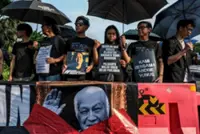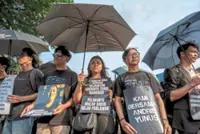
FOR INDONESIA’S Generation Z, born in the late 1990s and early 2000s, life under the iron rule of the late president Soeharto is a condition they did not have to experience directly, as the strongman stepped down in 1998 after 32 years in power.
Yet, memories of Soeharto's heavy-handedness in governing the country have been passed down to these twenty-something youths during their formative years. Thus, for many Indonesian Gen Zers, Soeharto continues to loom large.
“I was born during the chaotic year of 1998,” 27-year-old copywriter Kenny Andriana from Bandung, West Java, tells The Jakarta Post. “Even though I didn’t live through Soeharto’s regime, his presence can be felt all over my family history, or rather, the parts that were erased.”
Kenny’s family is of Chinese descent. His grandfather, who bragged his family’s Chinese heritage, dropped the Chinese names of his children in the wake of anti-communist pogroms in 1965, which were launched by Soeharto to obliterate the remnants of the Indonesian Communist Party (PKI).
Historians assigned by Soeharto to write an official account of the coup blamed the Chinese Communist Party for assisting in the plot to take over the government, and as a result many Indonesians of Chinese descent were suspected to have been communist themselves.
Kenny learned that his grandparents had to make the difficult decision to erase some parts of their family history to allow for the younger members in the family to lead safer lives in the future.
“All the grandchildren, including me, ended up with no connection to our Chinese heritage,” he says.
“So aside from the obvious crimes that Soeharto committed, the national hero plan hurt on a personal level because he was also responsible for the trauma experienced by me and my family."
The anti-communist putsch was one of atrocities that human rights groups have accused Soeharto of committing throughout his three decades in power. Other human rights violations included the “mysterious killings” and disappearance of thugs and criminals in the early 1980s, the occupation of then East Timor and the kidnappings of activists in 1998.
In 2023, the administration of then-president Joko “Jokowi” Widodo recognised these events as gross human rights violations.
For 23-year-old Jakarta resident Jia, there was nothing about Soeharto's crime that she learned from history books in her high school years, yet she is determined to learn about that dark chapter from other sources.
“I don’t even remember learning much about Soeharto in school,” she tells the Post. “Maybe a couple of times, about how the economy was supposedly better back then. But the repression, the missing activists, and the rapes in 1998 were never discussed.”
Jia eventually learned of the country’s unsavory history through her parents, and from books like Laut Bercerita (The Sea Speaks His Name) by journalist Leila S. Chudori, which opened her eyes to the atrocities committed during the Soeharto regime.
“I sympathise with the victims of the Soeharto regime,” Jia says, scoffing at the decision to make him a national hero. “How could someone who approved of violence be called a hero? It makes no sense.”
As for many other Gen Zers, they learned about Soeharto, just like most other subjects, from information readily available on the internet and social media.
“I primarily learned about Soeharto from digital sources,” says 19-year-old university student Fahrani, also from Bandung. “We know his regime built infrastructure, but we also know it silenced dissent and violated human rights. A hero should stand with the people, not suppress them.”
Fahrani says she is not alone in questioning the merit of Soeharto's legacy.
“When we talk about it,” Fahrani says, referring to conversations she had with her friends of similar ages, “we all agree this is something that we are really against.”
Historian Andi Achdian of the Jakarta-based National University (UNAS) says granting national hero status to Soeharto is tantamount to a rewriting of history and marked what he called a "worrying shift".
“By granting Soeharto the national hero title, the government is effectively closing the book on past human rights violations and rewriting history from a perspective that justified the New Order era. This is a reversal of whatever the reformasi (reform movement) has achieved,” he tells the Post, referring to the decades after 1998 when Indonesia underwent a democratic transition.
Andi deems the plan to rehabilitate the name of Soeharto as tied to the government intention to roll out a new version of Indonesian history, which human rights groups have denounced for attempting to sanitise Indonesia’s darker chapters, including the New Order era under Soeharto.
“This shows that, while Soeharto is long dead, his political presence lives on,” Andi says. “It is being revived by politicians and oligarchs seeking to legitimise their power and wealth.” — The Jakarta Post/ANN