
JASMIN Ordonez gazes out from a wooden boat as it glides through a narrow canal linking the chinampas – floating island farms first built by the Aztecs thousands of years ago.
“Let’s close our eyes and ask our Mother Water for permission to sail in peace,” she says, her voice calm amid the chaos of Mexico City just a few kilometres away.
Ordonez owns one of these chinampas, created long ago with mud dredged from the lakebeds that once covered the valley.
When her boat docks at her small island, she proudly points to her rows of corn and leafy greens.
Her ancestors farmed chinampas too, but she had to buy hers – women, she explains, rarely inherit land.
“My grandmother didn’t get any land. Back then, most was left in the hands of men,” she says.
Beside her stands Cassandra Garduno, nodding in agreement. She, too, had to purchase her own plot after being left out of family inheritance.
Today, both women belong to a growing movement determined to bring life back to Xochimilco’s wetlands – a fragile ecosystem under siege from pollution, tourism and unchecked urban sprawl.
They are part of a small but determined group of women buying and reviving chinampas through sustainable farming.
But it hasn’t been easy breaking into what remains a male-dominated world.
In the boroughs of Xochimilco and San Gregorio Atlapulco, few women are seen working the land.
“People believe only men have the physical strength to farm chinampas,” says Garduno, laughing as she wipes mud from her pale pink shirt and matching boots.
She knows the older male farmers snicker at her outfit. But she takes it in stride.
Garduno returned to San Gregorio in 2021 after years away. A university graduate, she had spent time in Ecuador helping protect manta rays and sharks.
But when she came home, she was shocked by the sight before her – low water levels, murky canals and abandoned chinampas overtaken by weeds.
“That’s when I realised: you are part of this space. And part of your responsibility is to safeguard it,” she says.
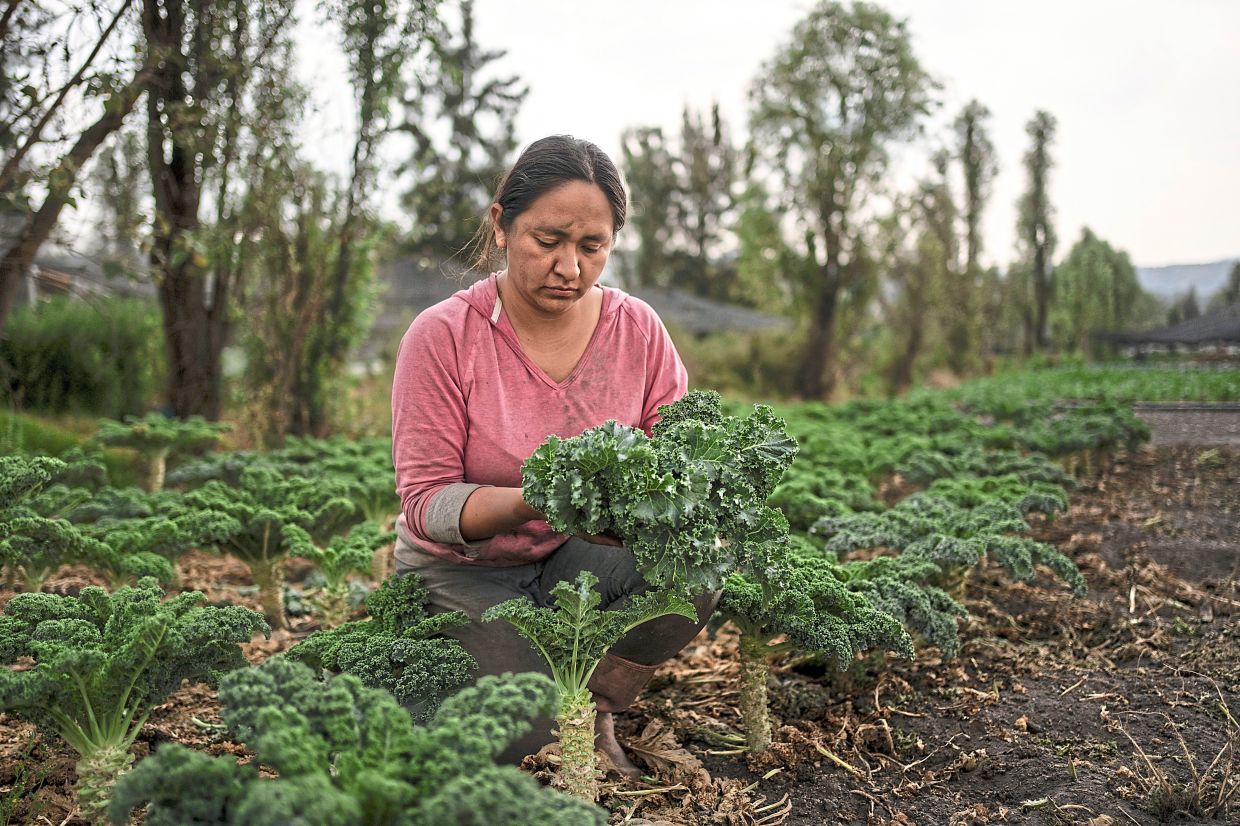
Garduno spent a year saving before buying a chinampa of her own, only to find it littered with rubbish such as armchairs, televisions and beer bottles.
She cleared out the waste, reopened clogged canals and began planting again.
Her efforts were met with scepticism.
“The neighbours said, ‘Let’s see, this girl’s never been down here. Nobody knows her. And now she’s doing whatever she wants,’” she recalls.
But Garduno wasn’t a novice. As a child, she had played in her grandfather’s chinampa – “a paradise” filled with flowers – and absorbed its rhythms.
She knew the secrets of the land: that canal mud makes the best fertiliser, enriched by volcanic ash from the mountains surrounding Mexico City; that planting different crops together helps protect against frost; that flowers attract insects away from the vegetables.
“Chinampas can have up to eight crop rotations a year, whereas other systems might manage two or three,” she explains.
That productivity is one reason the United Nations’ Food and Agriculture Organisation recognises chinampas as one of the most efficient agricultural systems in the world.
Today, Garduno’s farm is a mosaic of colour – from the pale green of broccoli to the brilliant yellow of marigolds.
She now works with Mexico’s National Autonomous University (Unam), helping other farmers abandon agrochemicals and return to traditional practices that sustain both crops and nature.
Kneeling by a planting bed, Garduno advises Ordonez to raise it slightly to prevent flooding during heavy rains.
Ordonez nods. She bought her chinampa three years ago and hopes to earn the Etiqueta Chinampera, a sustainability certification awarded by Unam to producers who farm using traditional, chemical-free methods. The label allows their produce to fetch better prices.
So far, 16 farmers – four of them women – have received the certification, says Diana Laura Vazquez Mendoza of Unam’s Institute of Biology.
The programme, she adds, encourages women to “take back their chinampas and produce”.
In participating farms, filters made from aquatic plants are installed to purify the canal water and block invasive carp and tilapia.
These species, introduced in the 1980s, have devastated the local ecosystem – especially the axolotl, a salamander-like creature that is sacred to the Aztecs and now critically endangered.
Pollution is worsening the problem. Wastewater from nearby treatment plants and chemicals from industrial farming flow into the canals.
A study by biologist Luis Bojorquez Castro of the Autonomous Metropolitan University found heavy metals such as iron, cadmium and lead, as well as oils, detergents and pesticides.
“Look at the clarity of the water,” Ordonez says proudly, dipping her hand into a canal near her biofilter.
“Caring for the water is everything.”
The wetlands of Xochimilco are the last remnants of Lake Texcoco, the site of the Aztec capital, Tenochtitlan.
Once sprawling across the Valley of Mexico, the lakes have shrunk to just 3% of their original size.
Yet, this patch of green still plays a vital role: it helps stabilise the city’s temperature, reduce flooding and store carbon dioxide.
If Xochimilco were lost, the capital’s average temperature could rise by up to 2°C, warns biologist Luis Zambrano.
The wetlands are also home to herons, frogs and hundreds of bird species. But a Sunday stroll through the area shows how much has changed.
Many chinampas have been converted into football pitches or rented out for raucous parties aboard brightly-painted trajineras.
As dusk falls, Garduno drives home along a dirt road, pointing to a cluster of red-headed birds over the lagoon.
“This is still the paradise I remember from my grandfather’s time,” she says.
She hopes that within a decade, many more women will reclaim the chinampas.
“From the shared labour of women and men,” she says, “we can preserve what we have left – for as long as possible”. — AP