
ON a crisp October morning in 1825, Governor DeWitt Clinton of New York stood aboard a ceremonial boat at the head of a grand flotilla, ready to inaugurate one of the most ambitious public works in American history – the Erie Canal.
Stretching nearly 580km from Buffalo on Lake Erie’s eastern shore to Albany on the Hudson River, the canal linked the Great Lakes to the Atlantic and transformed the young United States.
Clinton’s vessel was called the Seneca Chief, in reference to the indigenous nation that, together with the rest of the Haudenosaunee (Iroquois) Confederacy, had long dominated western and central New York.
Further back in the procession was a second vessel named Noah’s Ark. Unlike the Seneca Chief, it actually carried members of the Seneca nation – along with live eagles, deer and even a bear – in what was essentially a demeaning sideshow.
As New York prepares to mark the bicentennial of the Erie Canal on Oct 26, organisers are striving to strike a balance between celebration and reflection, acknowledging the enormous cost borne by the indigenous people whose lands made the canal possible.

Progress and loss
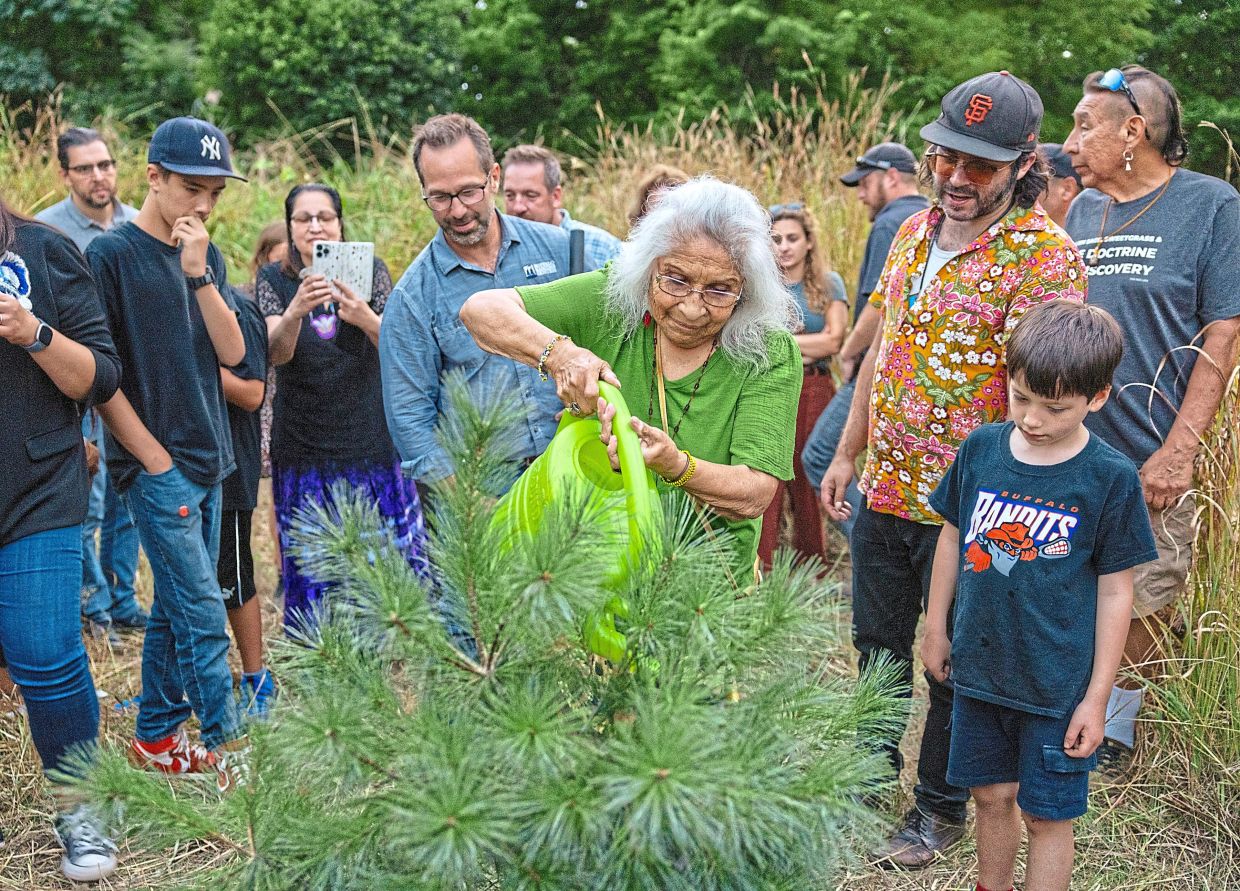
To honour the Haudenosaunee, eastern white pines – a traditional symbol of peace – will be planted between Buffalo and New York City.
The gesture recognises how the canal’s construction, and the wave of white settlement that followed, upended the lives of the Haudenosaunee nations, whose ancestral territory stretched across nearly the entire canal route.
That harm was deep and lasting. The state acquired much of the canal land through coercive negotiations, and after the canal opened, its success only fuelled further dispossession as settlers demanded more land.
“For so long, the standard story about the Erie Canal has been that it’s a great engineering marvel and an engine of progress,” said Terry Abrams, past president of the Tonawanda Reservation Historical Society.
“But that came at a cost – and that cost was borne by the Seneca and other Haudenosaunee people. It’s just part of the whole story.”
The canal indeed transformed the American economy, allowing goods to move easily between New York City and the Great Lakes ports like Chicago.
It opened the interior for trade and migration, making New York the nation’s commercial powerhouse.
But the lands it cut through had belonged to the Senecas, Cayugas, Onondagas, Oneidas, Tuscaroras and Mohawks – the six nations of the Haudenosaunee Confederacy.
In the decades before the canal opened, they had already lost vast territories through dubious treaties and fraudulent sales, many orchestrated by the very men who later championed the canal.
“We as Haudenosaunee people were right in the way, all across the state,” said Melissa Parker Leonard, who traces her Seneca ancestry to the 18th century and runs the advocacy group 7th Gen Cultural Resources.
“When the canal opened, it was like the last step to really remove us.”

Re-examining the past
The bicentennial arrives amid a national battle over how to frame historical injustices.
Several US states have passed laws restricting how educators discuss racism and other systemic wrongs.
And the Trump administration recently ordered a review of Smithsonian Institution exhibits to ensure they do not contain what it called “divisive or partisan narratives”.
Against this backdrop, New York is taking deliberate steps in the opposite direction.
In May, Governor Kathy Hochul formally apologised to the Senecas for the “historic atrocities” committed at the Thomas Indian School, a state-run boarding school 50km south of Buffalo where at least 2,500 indigenous children were once forced to attend.
The canal’s bicentennial events aim to continue that reckoning.
Museums, cultural centres and historical societies along the waterway are amplifying indigenous voices.
The Erie Canal Museum in Syracuse will host Haudenosaunee speakers, while exhibits across the state explore how “progress” for some meant destruction for others.
When a replica of the Seneca Chief launched from Buffalo last month for a commemorative voyage to New York City, the first speaker wasn’t a politician or wealthy donor but Joe Stahlman, a historian of Tuscarora descent.
“Two hundred years can seem like a long time,” Stahlman said, addressing the crowd gathered along the waterfront. “It’s right that we pause to reflect on what that means to us.”
Tensions over tone
Not everyone is pleased with the more sombre tone.
Mark Poloncarz, the Erie County executive, criticised a local exhibit titled Waterway of Change at the Buffalo History Museum, calling it “pretty negative” for focusing too heavily on the suffering of the Haudenosaunee rather than celebrating the canal’s achievements.
“I think we need to celebrate our history and also identify some of the issues in our history,” Poloncarz said. “But it is a day to celebrate it.”
That celebration in Buffalo has been spearheaded by the Buffalo Maritime Centre, a non-profit organisation devoted to the region’s maritime heritage.
Its volunteers – more than 200 of them, most with no boatbuilding experience – spent four years constructing a working replica of the Seneca Chief.
The vessel set off from Buffalo Harbour before hundreds of cheering spectators and will travel down the canal and Hudson River to arrive in New York City on the official bicentennial date.
Balancing the story
Brian Trzeciak, the Maritime Centre’s executive director, said the group had worked closely with Seneca partners to ensure the commemoration told the full story.
“The Erie Canal was a great accomplishment; it made New York State what it is,” he said.
“However, you have to talk about what led up to that – and you have to balance it out.”
The collaboration produced one of the most symbolic gestures of the bicentennial: the planting of 28 eastern white pines along the canal’s route.
For the Haudenosaunee, the white pine – known as the Tree of Peace – represents unity and reconciliation. According to tradition, the confederacy’s founders buried their weapons beneath such a tree to mark the beginning of peace among their nations.
Each pine will be planted near a key canal site, creating a living monument to both the ingenuity that built the canal and the communities displaced by it.
White pines can live for more than 200 years, meaning the saplings planted in 2025 could still be standing at the canal’s 400th anniversary – a silent reminder of both achievement and loss.
The hope, organisers say, is not to diminish the canal’s importance but to widen its narrative.
“It’s not about rewriting history,” Abrams said.
“It’s about finishing it.” — ©2025 The New York Times Company
This article originally appeared in The New York Times