
WHEN Patricia Elago Zetty’s 13-year-old son went missing in Colombia’s conflict-ridden southwest, she didn’t hesitate.
Elago and five fellow members of the Indigenous Guard trekked across the mountains to confront the guerillas they believed had taken him and another boy to swell their ranks.
At the camp, around 30 fighters stopped the unarmed group at gunpoint.
After tense negotiations, the commander agreed to “verify” if the children were there.
An hour later, five guerillas appeared with Elago’s son Stiven and the other boy.
“When I saw him, it felt like my soul returned to my body,” she said.
Stiven hugged her and whispered: “Mum, I never thought you’d risk so much.”
Rescues like Elago’s have become more frequent for the Indigenous Guard of the Nasa people, formed in 2001 to defend their lands from armed groups and environmental destruction.
Children targeted
Since 2020, as armed groups tightened their hold on Nasa territory to expand coca and marijuana crops, recruitment of children has surged. Guerillas offer cash, food or protection to lure impoverished families’ sons and daughters.
Colombia has endured more than half a century of conflict, fuelled by inequality, land disputes and the drug trade.
The 2016 peace deal disarmed the FARC, the largest rebel group, but violence never ended. Dissident FARC factions, the long-standing ELN guerillas and the Clan del Golfo cartel still battle for territory and recruit minors.
Two ex-FARC fighters were gunned down near Caldono recently, while several teenagers disappeared. Families fear they, too, were taken.
For the Nasa, coca leaves are sacred – chewed for stamina and used in rituals. Their exploitation for cocaine is seen as a desecration of culture that also drives violence.
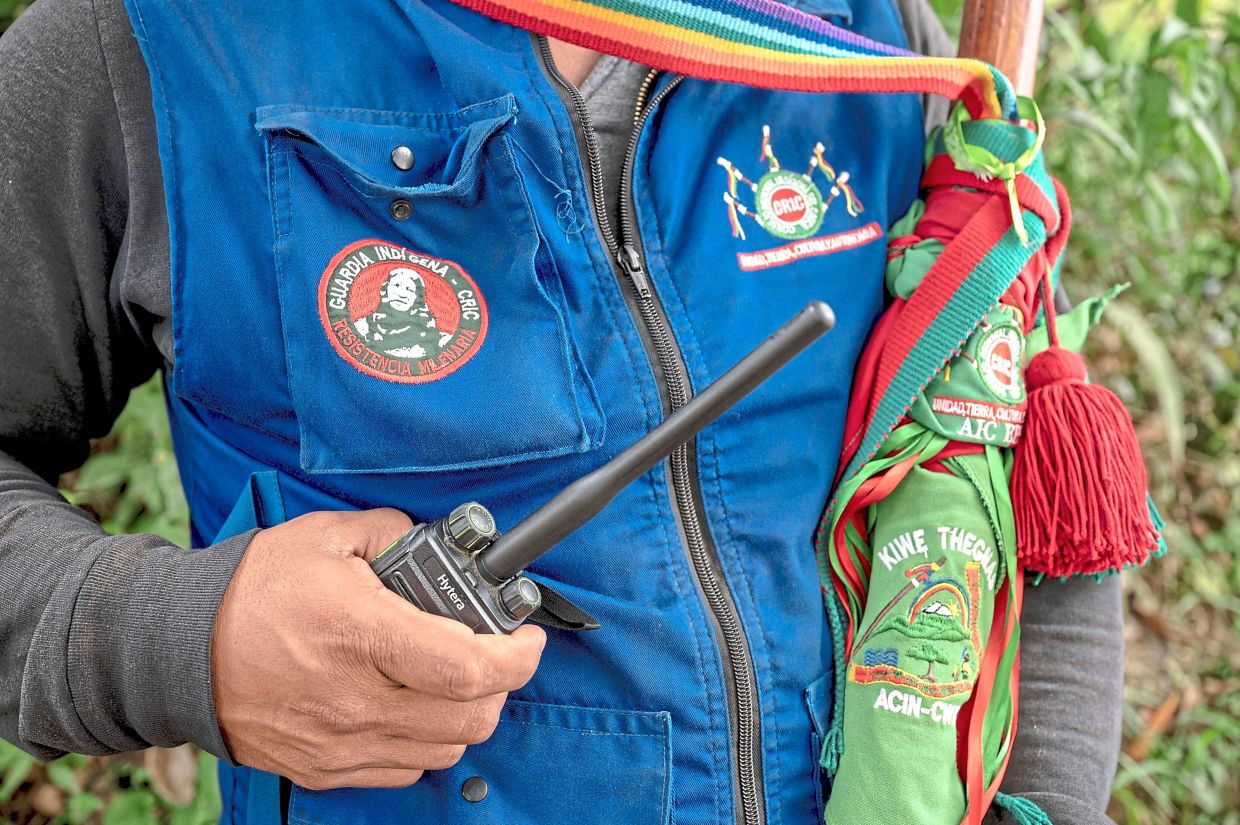
Guard members carry bastones de autoridad – staffs symbolising responsibility and leadership, often decorated in red and green, colours of blood and earth.
Elago fixed a photo of Stiven to hers.
“They carry guns, we carry staffs. The staff represents our life, our courage,” she said.
More than 40 guards have been killed since the peace accord, according to Colombia’s Indigenous Council of Cauca.
Facing armed groups
Elago recalls rebels telling her that Stiven joined voluntarily, which enraged her.
“You talk about respecting indigenous people, but you’re killing our youth. What respect is that?” she demanded.
One fighter warned her: “Take care, mamma. You already smell like formaldehyde.”
Eduwin Calambas Fernandez, a guard coordinator in northern Cauca, said not all rescues succeed.
In 2023, he tried to recover two teenagers recruited through Facebook. Both refused to leave.
Armed groups now say anyone 14 or older is too old to return.
Children are lured with promises of money, beauty treatments or food, said the Indigenous Councils Association of Northern Cauca (Acin).
Once inside camps, they suffer indoctrination, abuse and, for girls especially, sexual violence.
“Once in, it is very difficult to leave,” said Scott Campbell, the UN’s human rights chief in Colombia.
Acin has documented 915 cases of indigenous children recruited since 2016, some as young as nine.
At least 79 were taken between January and June this year. Colombia’s ombudsman confirmed 409 cases of recruitment in 2024, most in Cauca.
Campbell called the government’s response “ineffective and untimely”, with little state presence in rural areas.
Acin says armed groups fill the void by providing roads and basic services.
The Family Welfare Institute insists it supports indigenous-led projects and says 251 children left armed groups in the first half of 2025.
Life under threat
In a small school in Manuelico, reachable only by winding mountain roads, teacher Luz Adriana Diaz watches pupils arrive under the shadow of coca fields guarded by fighters. Banners of the violent Dagoberto Ramos front hang nearby.
“Since 2020, it’s been very sad – threats, recruitment, killings... living in the middle of violence,” said Diaz, who has taught in Caldono for 14 years. “We work with them breathing down our necks.”
The guard now patrols outside her classrooms to deter recruiters. Still, several former pupils – some just 11 – have joined armed groups.
One young woman, who joined at 16 to escape family problems, said she was tasked with cooking, cleaning weapons and managing supplies.
She fled when a new commander threatened harsher discipline.
Now she works with families to warn children of the risks: “I tell parents they need to build trust with their kids.”
Fernandez, another survivor, was 12 when fighters came for her. Terrified, she joined the FARC and endured rape, abuse and starvation.
She escaped years later, hiding in a civilian home before fleeing.
Now a mother of three, she fears her 12-year-old son may be next.
“Young people are so easily fooled... shown a bit of money or a phone and they think that’s life. Then they’re sent into combat zones where so many children die.” — AP