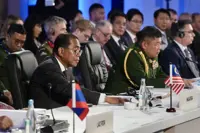
AFTER years of deadlock, Indonesia initiated the resumption of negotiations for a code of conduct (CoC) for conflicting parties in the South China Sea. This now gives Asean and China a formal forum in which tensions can be defused in the resources-rich sea. Both sides have committed to keeping the conflict at a manageable level because the South China Sea is one of the world’s busiest sea lanes.
In fact, stability in the area is one of the key conditions to maintaining a conducive situation in the Asia-Pacific region. Everyone is a loser if open and armed conflicts erupt in the region no matter how powerful they are militarily and economically.
In a press statement delivered last week after a two-day Asean foreign ministers’ meeting, Indonesia has taken the initiative to host a meeting between Asean and China next month. The foreign ministers also expressed their concern over recent developments, serious incidents and land reclamations by China, “which have eroded trust and confidence, increased tensions and may undermine peace, security and stability in the region”.
The top envoys also reiterated the regional grouping’s commitment to the “universally recognised principles of international law, including the 1982 United Nations Convention on the Law of the Sea [Unclos]”. China will certainly oppose the idea of Unclos being used as the basis for negotiation, although it is an official product of the UN.
In July 2016, the Permanent Court of Arbitration at The Hague ruled that there was no legal basis for China’s claim over the South China Sea, although Beijing refused to recognise the UN organ’s binding verdict. Brunei, Malaysia, the Philippines, Vietnam and also Taiwan are claimants to the sea. Indonesia is not a claimant but is also facing problems with China because the communist country put the Natuna waters in its nine-dash line map. (China uses an imaginary nine-dash line to cover most parts of the South China Sea, per its historic claim.)
The UN recognises Indonesia’s exclusive economic zone rights for the waters. But China said its fishermen have used Natuna waters as their fishing ground for centuries. In December 2021, China reportedly demanded Indonesia stop drilling for oil and natural gas there.
The CoC discussion was mandated by the Declaration of Conduct (DoC) agreed upon by Asean and China during the Asean summit in Phnom Penh in November 2002. Both China and Asean decided then to adopt “a code of conduct in the South China Sea that would further promote peace and stability in the region and agree to work, based on consensus, toward the eventual attainment of this objective”.
The aim was to have a code of conduct, although nonbinding, to promote peace and stability in the region.
At that time the two parties agreed “to the purposes and principles of the UN Charter, the 1982 UN Convention on the Law of the Sea”, and “other universally recognised principles of international law which shall serve as the norms governing state-to-state relations”.
There was optimism at that time that the two parties could resolve their conflict by sticking to all prevailing laws. But it turned out that it was just a false hope.
Indonesia’s initiative to revive the discussion on the CoC deserves support and strong political will from both sides because at least there will be a basic foundation for negating security stability in the region. It is in the interest of China and Asean to create a conducive situation in the South China Sea. – The Jakarta Post/Asia News Network
Already a subscriber? Log in
Get 20% OFF The Star Digital Access
Cancel anytime. Ad-free. Unlimited access with perks.