WHILE the new preschool curriculum rolled out by the Education Ministry this year covers six core areas of learning, it lacks explicit guidance on helping children navigate a digital-first world, say experts.
They stress that preschools and parents play a critical role in shaping children’s digital habits from an early age.
The “sweet spot”, they suggest, lies in providing guided, developmentally appropriate interaction rather than shielding children from early digital exposure.
Their concerns follow the introduction of the new preschool curriculum at the start of the current school session.
Education Minister Fadhlina Sidek, in a Facebook post on Jan 5, said the six key learning areas in the new curriculum support holistic early childhood development.
They are socio-emotional development; physical development and personal well-being; language and literacy; spirituality, values and citizenship; creativity and aesthetics; and cognitive development.
These areas, the experts point out, do not explicitly include digital literacy.
According to Dr Wo Su Woan, a senior lecturer at the Sunway University School of Psychology, countries like Finland, Singapore and South Korea have already embedded digital literacy into early childhood education, recognising that technology habits form as early as age three.
“Well-designed digital activities in preschool can actually bolster social-emotional learning, cognitive development and problem-solving,” she told StarEdu.

Malaysia, she added, is well positioned to follow suit.
Wo stressed that the aim is not to accelerate digital learning, but to integrate it thoughtfully in ways that complement children’s holistic development.
“If we wait too long, we risk falling behind. If we move too fast without guidance, we risk doing harm,” she cautioned.
Clear boundaries
Beyond preschool, the home environment is crucial in forming healthy digital habits among children.
Many Malaysian parents view technology as a constant negotiation, noted Parent Action Group for Education Malaysia chairman Datin Noor Azimah Abdul Rahim.
“They value books, handwriting and hands-on play, but feel pressure from the digital environment children are growing up in.
“The balance often comes from intentional trade-offs – screens allowed, but not at the expense of sleep, outdoor play, conversation or fine-motor development,” she said.
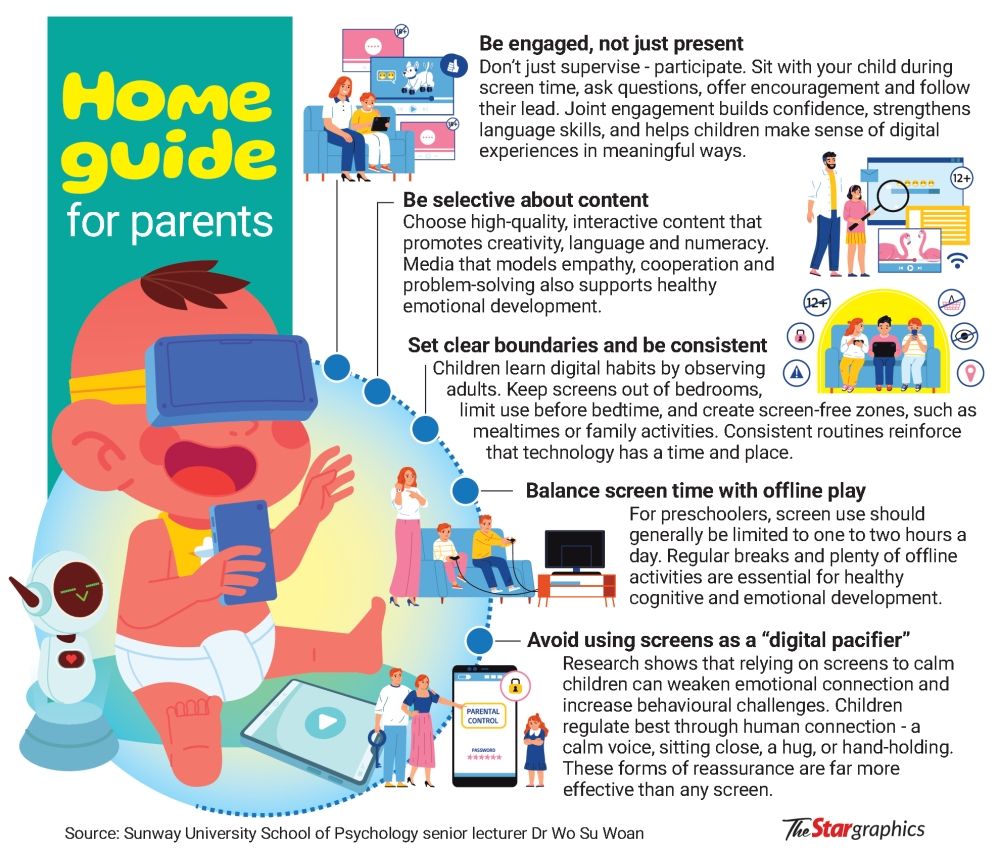
What parents need most, Noor Azimah stressed, are clear boundaries around screen use and a “shared language” they can use with children – such as framing screens as tools rather than toys.
“Parents consistently say they need practical, realistic guidance, not ideals that don’t fit real life. What they find least helpful are vague slogans or one-size-fits-all rules that ignore family circumstances,” she added.

Building on this, Wo said a common misconception among parents is that digital literacy requires more screen time, or that no screen time at all is best for children.
“In reality, meaningful digital learning in early childhood involves minimal, guided use, with a strong focus on ethics, safety and developmental balance,” she emphasised.
Offline strategies
Offering practical examples, Wo said digital awareness can be built through everyday, non-digital activities.
These include role-playing how to ask permission before using a phone, identifying digital devices in the environment, or talking about feelings when a video ends.
Such approaches, she explained, help children develop healthy attitudes and habits around technology long before they become active users.
Agreeing, Suka Society child protection officer Sarah Teo said digital safety and media awareness are most effective when grounded in stories, songs and play rather than screen-based instruction.
Suka Society is a non-governmental organisation set up to protect and preserve the best interests of children.
Even among children as young as six, Teo said, these concepts can be understood when delivered in simple, age-appropriate ways.
“One example is the #TalkPANTS campaign by the National Society for the Prevention of Cruelty to Children in the United Kingdom, which we have adapted as a reference in our work,” she said.
The campaign helps parents, carers and teachers explain the Underwear Rule to children aged four to eight through songs.
“Although the campaign primarily focuses on physical safety and consent, the same principles apply online,” Teo said, adding that these lessons later translate naturally into digital contexts, such as understanding what should not be shared online and when to seek help.
This, she said, reinforces that digital safety is fundamentally about values and behaviour, not technology alone.
Long-term payoff
Building digital literacy and cognitive self-regulation from the preschool years offers significant long-term benefits, Wo said, spanning academic, social, emotional and professional development.
“Early, age-appropriate digital guidance helps children move from passive content consumers to engaged and empowered digital users,” she explained.
Children who learn to manage screen use with adult support also tend to develop stronger self-regulation, empathy and relational security – factors shown to protect long-term mental health and well-being, she added.
Citing the United Nations Children’s Fund Global Kids Online project, Wo noted that digital literacy is also a form of rights-based empowerment.
The project is an international research initiative that aims to generate and sustain a rigorous cross-national evidence base around children’s use of the Internet by creating a global network of researchers and experts.
“Children who are taught to navigate digital environments safely and ethically are more likely to engage meaningfully with their communities and protect their privacy, identity and voice online,” she said.
Beyond academics, early digital literacy enhances future employability, preparing children for a global economy where digital competence will be essential.
“In short, early digital literacy isn’t just about keeping up with technology – it’s about preparing children to thrive in a world shaped by it,” Wo concluded.