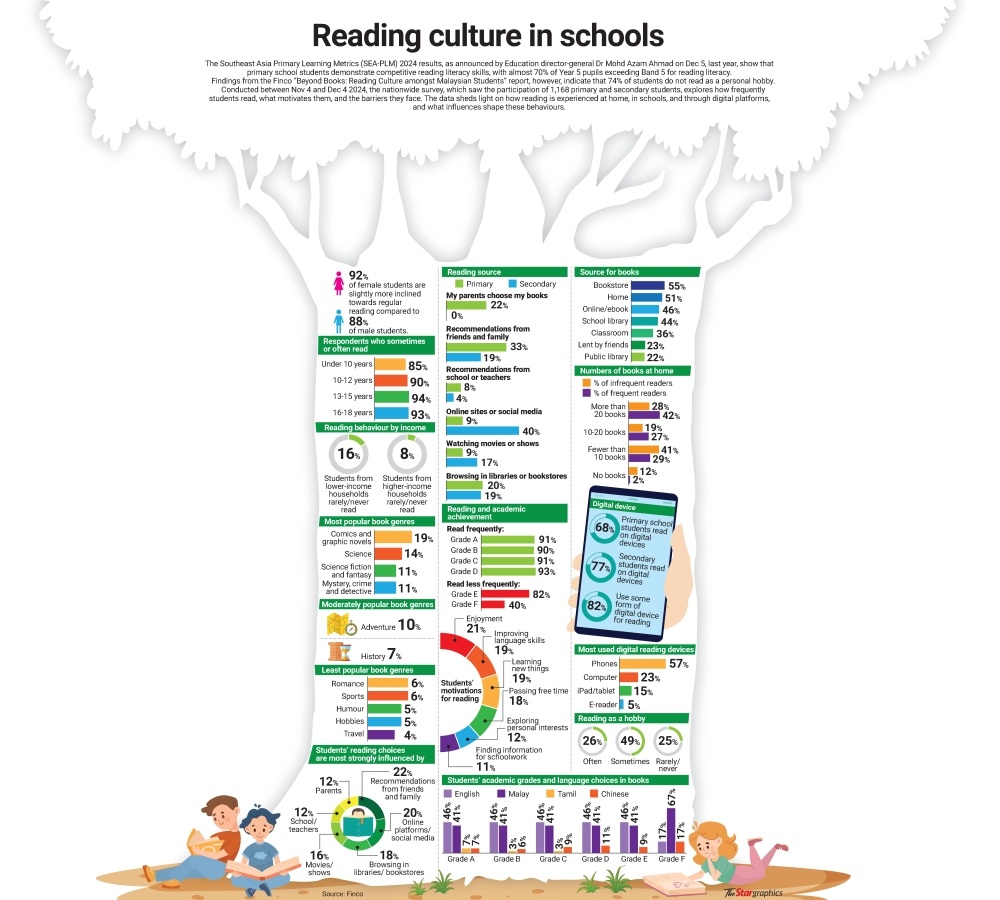
Regionally, Malaysian students, compared with their peers, are starting from a position of strength when it comes to reading habits, yet a recent Financial Industry Collective Outreach (Finco) report revealed that 74% of students do not read as a personal hobby (see infographic).
Self-motivated reading, said Taylor’s College School of Diploma and Professional Studies programme director Nurul Iman Arshad, is important to sustain a lifelong interest in reading.
The lack of self-initiated engagement, she added, highlights the importance of helping children transition from reading as a school requirement to reading as a lifelong habit.
“Children who are habitual readers and are motivated to read will develop a broader knowledge base and language skills without the need for external rewards,” Nurul Iman, who heads the school’s diploma in early childhood education programme, told StarEdu.

While literacy skills and interest in reading are critical for academic success, it is equally important for children to develop the ability to read independently and comprehend texts on their own, she noted.
“Literacy skills also support effective communication among community members, particularly for children growing up in the digital age, where online interactions increasingly replace face-to-face communication,” she explained.
Literacy strategies
Nurul Iman recommended that teachers in early childhood classrooms integrate literacy across subjects by linking reading with science, technology, engineering and mathematics, as well as social-emotional learning.
“This approach helps students see reading as a tool for inquiry and self-expression,” she said.
She also said parents play a key role in nurturing self-motivated readers by encouraging children’s interests, such as providing picture books on topics they enjoy or borrowing books from libraries based on their preferred genres.
“This stands in contrast to reliance on worksheets or prescribed texts in the syllabus, which may feel disconnected from children’s immediate environment and interests,” she said.
Beyond access
According to the Finco Beyond Books: Reading Culture amongst Malaysian Students report, students from lower-income households are twice as likely to read infrequently compared with their peers from higher-income households; 82% of students with a Grade E and 40% of students with a Grade F read less frequently; and nearly 41% of those surveyed have fewer than 10 books at home, and these students tend to be infrequent readers.
Nonetheless, parents can still foster deeper engagement by modelling reading behaviour and establishing structured routines, even with limited resources, said Nurul Iman.
A reading culture grows through shared practice, structure and engagement, not just access to books, she added.
“Teachers should also play their part by designing literacy lessons that are engaging, meaningful and developmentally appropriate for young children,” she said.
She added that expanding access to culturally relevant and interest-driven reading materials can make reading more enjoyable, particularly for students from lower-income backgrounds.
Schools should adopt an asset-based approach to build literacy skills for students who speak languages other than English or Bahasa Malaysia at home, she said, adding that this includes making cross-linguistic connections and maintaining the home language as a resource rather than a barrier to overcome.
Stressing that increasing access to reading materials alone is not enough to foster meaningful reading habits, Sunway University Centre of English Language Studies head Assoc Prof Dr Nicholas Lee Boon Kheng said before adolescence, parents and teachers play a larger role as role models in shaping a child’s behaviour and, by extension, their reading experiences and habits.

He emphasised the need to educate parents on the importance of reading to and with their children.
“There can be targeted programmes that provide lower-income families with both reading materials and awareness of the effects of reading activities with their children.
“This is necessary to equip children with the ability to read and learn on their own, as a love of reading builds traits like curiosity and enhances imagination, while serving as a precursor to lifelong learning,” he said, citing Yayasan Generasi Gemilang’s Kita Main programme as an example.
“These kinds of initiatives yield long-term results, thus requiring sustained effort in terms of scope and, more importantly, time,” he concluded.
Making it interesting
These days, kids are surrounded by smartphones, social media and video games, so reading long texts can feel slow or boring in comparison. To make reading more appealing, schools and parents could integrate digital storytelling, book apps, or even let kids create short videos about books they enjoy. Making it interactive might spark interest. -Subanan Gajendran, 25
As children, we read for fun because our parents encouraged it. Parents today are busy working or don’t read much themselves, so kids don’t have anyone to emulate. Reading with your child even for 15 to 20 minutes a day could inspire them to do the same. -Ashvini Poobalan, 25
Schools focus a lot on testing and syllabus coverage, so kids often associate reading with work rather than enjoyment. To fix this, I’d suggest more time in the school schedule for free reading, book clubs, or discussions where kids can pick what they want to read. If it feels social and low-pressure, it becomes a hobby rather than a chore. -Karen Tay Swee Ping, 25
Arresting the decline
Malaysia must sharpen talent and, within the teaching system, train children to read more, says Prime Minister Datuk Seri Anwar Ibrahim.
Speaking at the launch of the National Education Plan 2026-2035 on Jan 20, he said experts and educators worldwide agree that the culture of reading, or the culture of Iqra’ (read or recite), is increasingly fading.
“We have a problem now – not just us, but the whole world.
“The interest in reading has significantly declined,” he said, adding that reading should not be limited to textbooks alone, but should also include selected books and novels.
Echoing this, Education Minister Fadhlina Sidek explained that under the Malaysia Education Blueprint (RPM) 2026-2035, the government has set mandatory targets to address fundamental issues, including closing learning gaps and ensuring students master literacy and numeracy by the end of Level One.
“From the aspect of quality, the Programme for International Student Assessment 2022 shows that our reading literacy score stands at 388, compared with the international average of 476,” she said.
Based on these findings, Fadhlina said, the ministry had conducted a comprehensive analysis of data from international and national studies, as well as reports and recommendations submitted by the public during engagement sessions.
“As a result of this analysis, the ministry developed the framework for the RPM 2026-2035, with the aim of producing well-rounded individuals who are ethical, knowledgeable, skilled, resilient and confident, grounded in the National Education Philosophy,” she added.