
ACCESS to globally recognised degrees at lower costs is a major draw for international students to Malaysia, say stakeholders.
Malaysian Association of Private Colleges and Universities president Datuk Parmjit Singh said tuition fees and living costs are typically about a third of those in top western destinations such as the United Kingdom, United States and Australia.
He added that Malaysia maintains highly competitive academic standards through an internationally benchmarked accreditation framework managed by the Malaysian Qualifications Agency.

He also cited Malaysia’s liveability, noting that Kuala Lumpur was ranked 12th globally in the Quacquarelli Symonds (QS) Best Student Cities Rankings 2026.
Parmjit was commenting on The Global Student Flows: Malaysia, a QS report published on Jan 13, which highlights Malaysia’s growing appeal due to affordability, cultural diversity, and a strong transnational education (TNE) ecosystem.
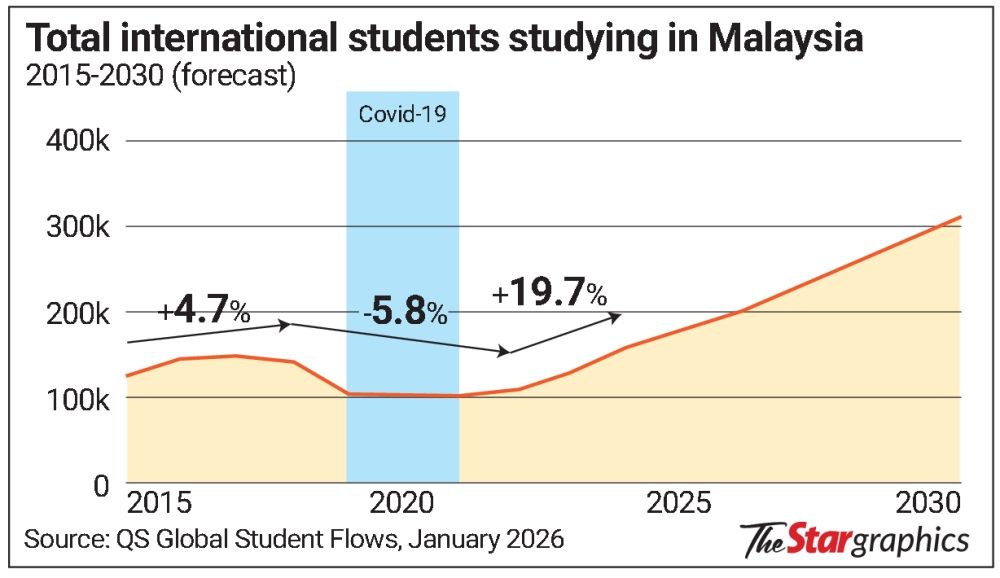
The report projects international student numbers to grow by 8.5% annually, reaching about 260,000 by 2030.
It notes that demand is partly driven by the “Big Four” destinations – Australia, the UK, the US and Canada – becoming more restrictive through tighter visa rules, lower approval rates and student caps.
Vice Chancellors’ Council for Private Universities chairman Prof Mushtak Al-Atabi said Malaysia, by contrast, has kept a relatively open and predictable pathway into higher education.
“For students and their parents planning several years ahead, that sense of stability is very important,” he said.
Malaysia also offers recognised international degrees at far more manageable costs than cities such as London, Sydney or Toronto, he added.
“Our TNE ecosystem is a big part of this. Branch campuses and collaborative programmes allow students to earn UK, Australian or Japanese degrees closer to home, with lower living costs and stronger family support,” said Prof Mushtak, who is also Heriot-Watt University Malaysia provost and chief executive officer.

“English is widely used in teaching, visa processes have become more efficient and student support systems are clearer than before.
“Students often tell me they find Malaysia less intimidating than western destinations,” he said.
According to the QS report, South Asia, East Asia and South-East Asia will remain Malaysia’s strongest source regions, with annual inbound growth exceeding 3% to 5% through 2030.
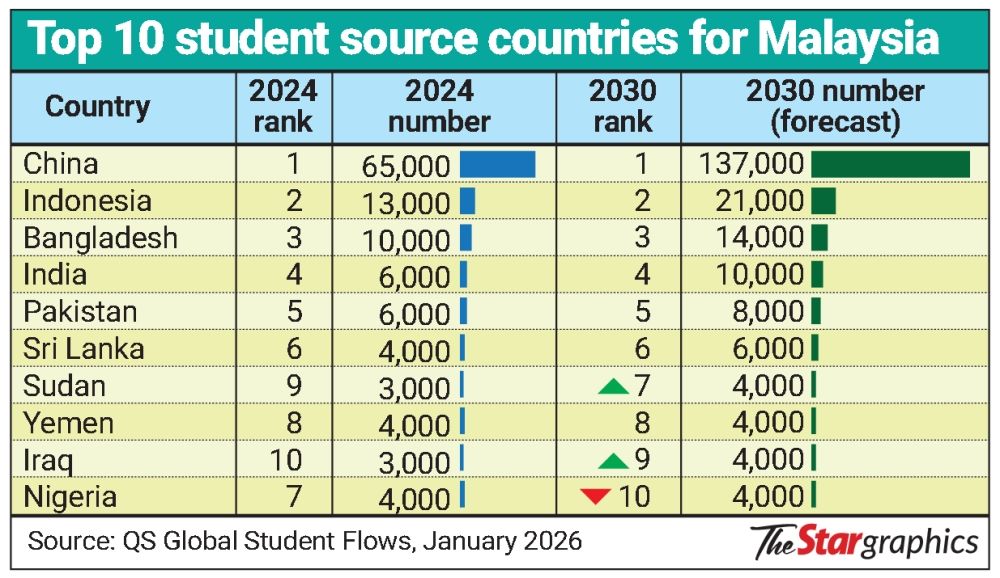
In 2024, about 40% of international students came from China, with numbers rising over 30% annually over the past five years to 65,000.
Emerging markets such as Indonesia, Pakistan, Bangladesh and India are expected to grow steadily (see infographic), while enrolments from the Middle East and North Africa are projected to increase by more than 3% annually.
These trends are driven by Malaysia’s combination of quality education, lower tuition fees, foreign branch campuses, Muslim-friendly environment and geographic proximity.
Teh, who is also APU registrar, said students from Asia, Africa and the Middle East are often looking for access, affordability and upward mobility.
“For many of them, studying in Malaysia is a clear step up academically, internationally and professionally compared with options at home, but without the very high costs of studying in traditional western destinations,” he added.
Keeping growth momentum
value-driven global education strategies must be in place if Malaysia hopes to realise the 8.5% international student growth projection by Quacquarelli Symonds (QS).
This, says Malaysian Association of Private Colleges and Universities president Datuk Parmjit Singh, requires a concerted “all-of-country” effort.
“For instance, there is a need to extend the Graduate Pass to all international students regardless of source country, enabling these graduates to serve in Malaysia for at least two years.
“Currently, this is only available selectively to students from 32 countries for one year,” he said.
For the country to attract a total of 260,000 international students by 2030, institutions need to improve academic and employer recognition to remain competitive,
The Global Student Flows: Malaysia, published by QS on Jan 13, read.
“They also must align curricula with future-focused industry needs, strengthen industry partnerships, and demonstrate strong graduate employment outcomes.
“To stay competitive, Malaysian institutions must maintain their differentiators, especially affordability, while diversifying and expanding international enrolments.
“As Malaysia emerges as a major study destination, universities must plan for a range of scenarios to be agile, adaptable, and enable growth,” it adds.
Vice Chancellors’ Council for Private Universities chairman Prof Mushtak Al-Atabi said students want to know whether a university is respected by employers, academics and even their peers, and whether graduates from a particular programme are actually getting good jobs.
“If we take the recent analysis seriously, we have to accept that reputation and graduate outcomes are now the real tests for our system.
“Looking ahead, I would like to see our policy framework evolve to reflect new realities, especially hybrid and transnational models of learning,” he said.
Diverse perspectives enrich unis
International students bring diverse perspectives from their cultural backgrounds. This enriches class discussions and the overall student experience, as they interact with peers and build international networks while at university. We have a team that travels the world to promote Malaysian education, working with Malaysian embassies and high commissions, meeting potential students and their families, and participating in education fairs. Our international offices in our Malaysian institutions support students to ensure a good experience that they can share back home.
Sunway Education Group chief executive officer Prof Datuk Dr Elizabeth Lee
International students are essential to the quality and relevance of a modern university. Their presence enriches learning by bringing diverse perspectives into the classroom, strengthening critical thinking, cultural intelligence and global awareness among all students. Beyond campus, they contribute to Malaysia’s talent pipeline and global reputation, often becoming long-term partners, collaborators and ambassadors for the country. Attracting international students is not about short-term numbers, but also about building a globally competitive institution anchored in the region. We offer internationally recognised Monash degrees that are accredited in both Australia and Malaysia, delivered at strong value compared with traditional study destinations.
Monash University Malaysia president and pro-vice-chancellor Emerita Prof Datuk Dr Adeeba Kamarulzaman
International students create a dynamic and globally relevant learning environment. Beyond campus, a strong international student community strengthens Malaysia’s soft diplomacy and regional ties. Daily interactions foster intercultural understanding, empathy and global awareness among local students. These informal experiences are as impactful as formal coursework in preparing graduates for multicultural workplaces. International students also add to the country’s intellectual capital. UM treats them as ethical co-builders of the future.
Universiti Malaya (UM) vice-chancellor Prof Datuk Seri Dr Noor Azuan Abu Osman