LANGUAGES are not only tools of communication but also carriers of culture, values and identity.
Recognising this, the Education Ministry says it remains committed to heritage preservation.
In a statement to StarEdu, the ministry acknowledged the richness of Malaysia’s linguistic and cultural diversity, noting that community dialects constitute an integral part of the nation’s heritage and identity.
“While Bahasa Malaysia (BM) remains the national language and the primary medium of unity, the ministry regards the learning of community dialects as a meaningful way to preserve cultural roots, foster intergenerational bonds and enhance appreciation of Malaysia’s multicultural heritage.
“In line with this, all language subjects, namely Malay, English, Tamil and Mandarin, incorporate significant elements of heritage and literature related to their native speakers within the curriculum,” it said.
It added that three indigenous languages have also been introduced into the mainstream school system: Iban in Sarawak, Kadazandusun in Sabah, and Semai in the Orang Asli communities of Perak and Pahang.
“The curriculum for these subjects places strong emphasis on sustaining the language and safeguarding the heritage, literature and indigenous knowledge of the Iban, Kadazandusun and Semai peoples,” it said.
While noting that schools play an important complementary role in preserving Malaysia’s dialect heritage, the ministry said families and communities, as the natural custodians of dialects, carry the primary responsibility for ensuring their transmission across generations.
“Schools can play a supportive role by creating structured opportunities through awareness programmes, co-curricular activities and engagement with local communities. This shared responsibility helps ensure that dialects are not only maintained within the family environment but also valued in the wider educational and societal context, thereby enriching Malaysia’s multicultural identity,” it said.
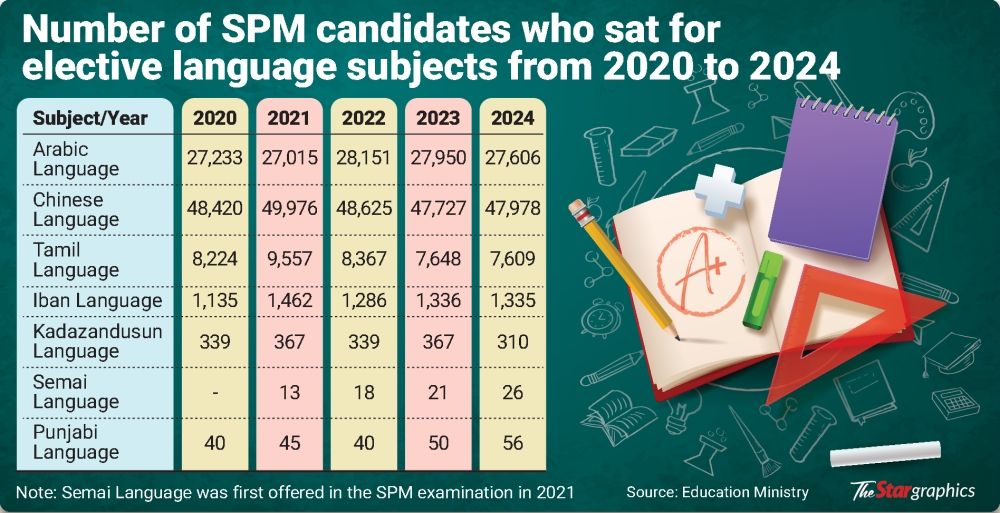
The ministry added that it continuously monitors and records data on the registration of elective language subjects for the Sijil Pelajaran Malaysia (SPM) examination each year.
“Over the past five years (2020 to 2024), the number of candidates taking elective language subjects has shown a consistent trend (see infographic),” it highlighted.
The ministry also said it determines which languages are offered as elective subjects based on several key considerations, including community demand, availability of qualified teachers, curriculum and language corpus readiness, and the contribution of the subject to Malaysia’s cultural and linguistic diversity.
“Elective language offerings are also guided by consultations with stakeholders such as state education departments, community representatives and subject experts. These key considerations are important to ensure the sustainability of the implementation of the electives offered,” it said.
Citing multilingualism as both a strength and a responsibility, the ministry emphasised that the nation’s education system must carefully balance the promotion of multiple languages with considerations of policy feasibility, curriculum space and the availability of qualified teachers.
“BM continues to serve as the national language and a unifying force, while English strengthens global competitiveness.
“Other languages, including Tamil, Mandarin and indigenous languages, are supported to ensure Malaysia’s rich cultural and linguistic heritage is preserved,” it said.
The ministry underscored that striking this balance requires ongoing dialogue with stakeholders, evidence-based planning, and continuous monitoring so that multilingualism remains sustainable and meaningful for future generations. — By ROWENA CHUA