
Several serious cases of misconduct involving underage students have led the Education Ministry to announce a review of student discipline regulations which include caning, suspension and expulsion.
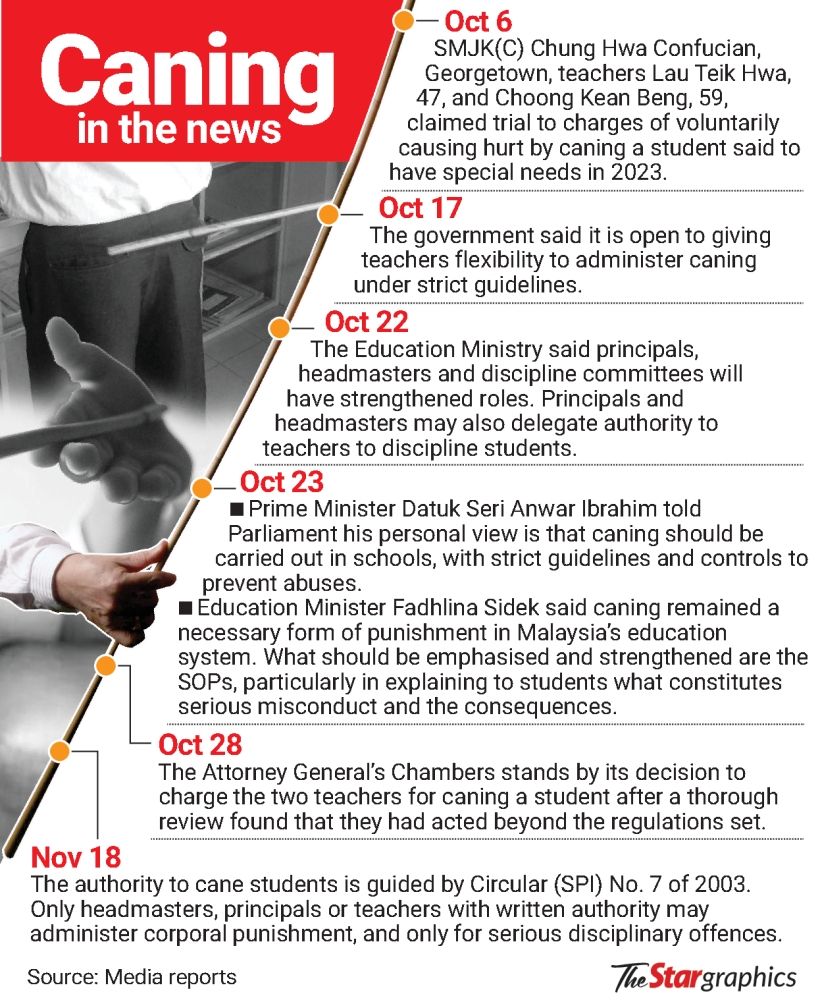
Last month alone, crimes including murder, gang rape, statutory rape, distribution of pornographic materials, and bullying incidents went viral on social media – the nation was shocked, leading to passionate debates about the merits of corporal punishment in schools.
Caning, said Dr Hazri Jamil, Professor in Curriculum Studies and Education Policy at Universiti Sains Malaysia School of Educational Studies, has been significantly restricted to align with child protection policies and global best practices.
“The focus has shifted to counselling and restorative discipline rather than the punitive measures adopted in previous years.
“Fear may produce compliance but not genuine respect.
“Respect should stem from trust, fairness, and positive relationships, not intimidation,” he said.
Assistant Prof Dr Zaida Mustafa, education department head of UCSI University’s Faculty of Social Sciences and Liberal Arts, said there is increased awareness and legal action from parents, making schools and the Education Ministry risk-averse when it comes to any form of corporal punishment.
“Plus, the use of fear is highly ineffective at producing genuine, lasting respect; it produces compliance and fear itself,” she opined.
Zaida does not believe in the proverb ‘spare the rod and spoil the child’.
“The uptick in discipline cases is not because we are not caning kids - it’s the lack of training for teachers in effective non-punitive discipline.
“Many teachers rely on fear because they were never taught effective restorative justice, or positive classroom management techniques in their pre-service training.
“Investing in this psychological and practical training is far more effective than debating the use of corporal punishment,” she stressed.
Taylor’s University School of Liberal Arts and Sciences senior lecturer and registered clinical psychologist Dr Sam Jeng Mun explained that when a child is disciplined through fear, their brain activates its fight-or-flight response.
“In previous generations, children were often raised under fear-based discipline, where obedience to authority was reinforced through punishments, shame, or anger.
“They comply to avoid pain or threat, not because they understand right and wrong.
“As a result, fear may create obedience, but it does not foster genuine respect for authority,” she said.
She suggested a combination of positive and negative reinforcement be used instead as it has been shown to improve a child’s behaviour.
“It is especially effective for older children who can understand the cause-and-effect relationship between their behaviour and the outcomes,” said Sam.
She said positive reinforcement technique, where desired behaviours are encouraged through praise or acknowledgement, can promote positive actions.
While negative reinforcement involves removing something unpleasant to strengthen a desired behaviour.
“For example, if a child consistently completes their homework on time, the parent may stop nagging,” she said.
Malaysian Mental Health Association president and consultant psychiatrist Datuk Dr Andrew Mohanraj said children today are growing up in complex social and digital environments, often struggling with family stress, academic pressure, social media influence, and emotional distress.
Instead of punitive measures, he suggested schools focus on strengthening their mental health and counselling support systems.
Counsellors or trained teachers who can identify early signs of distress, behavioural issues, or potential violence are needed, he added.
He said parents play a crucial role in shaping a child’s values, behaviour, and emotional control.
“It is neither fair nor realistic to expect teachers to shoulder the full responsibility for children’s conduct when parental guidance, consistency, and communication are the foundations of good discipline,” he said.
“True discipline involves guiding young people to understand the consequences of their actions and to develop internal self-control, empathy, and moral reasoning.
“A safe and compassionate school is one where discipline is firm but fair, and where emotional well-being is prioritised alongside academic achievement,” he said.