
TO build a resilient and adaptable skills system, societies must take a purposeful approach to lifelong learning – one that prepares individuals not only for meaningful work but also for active citizenship.
This question of purpose, said South-East Asian Ministers of Education Organisation (SEAMEO) Secretariat director Datuk Dr Habibah Abdul Rahim, has never been more urgent as nations confront the evolving future of work.
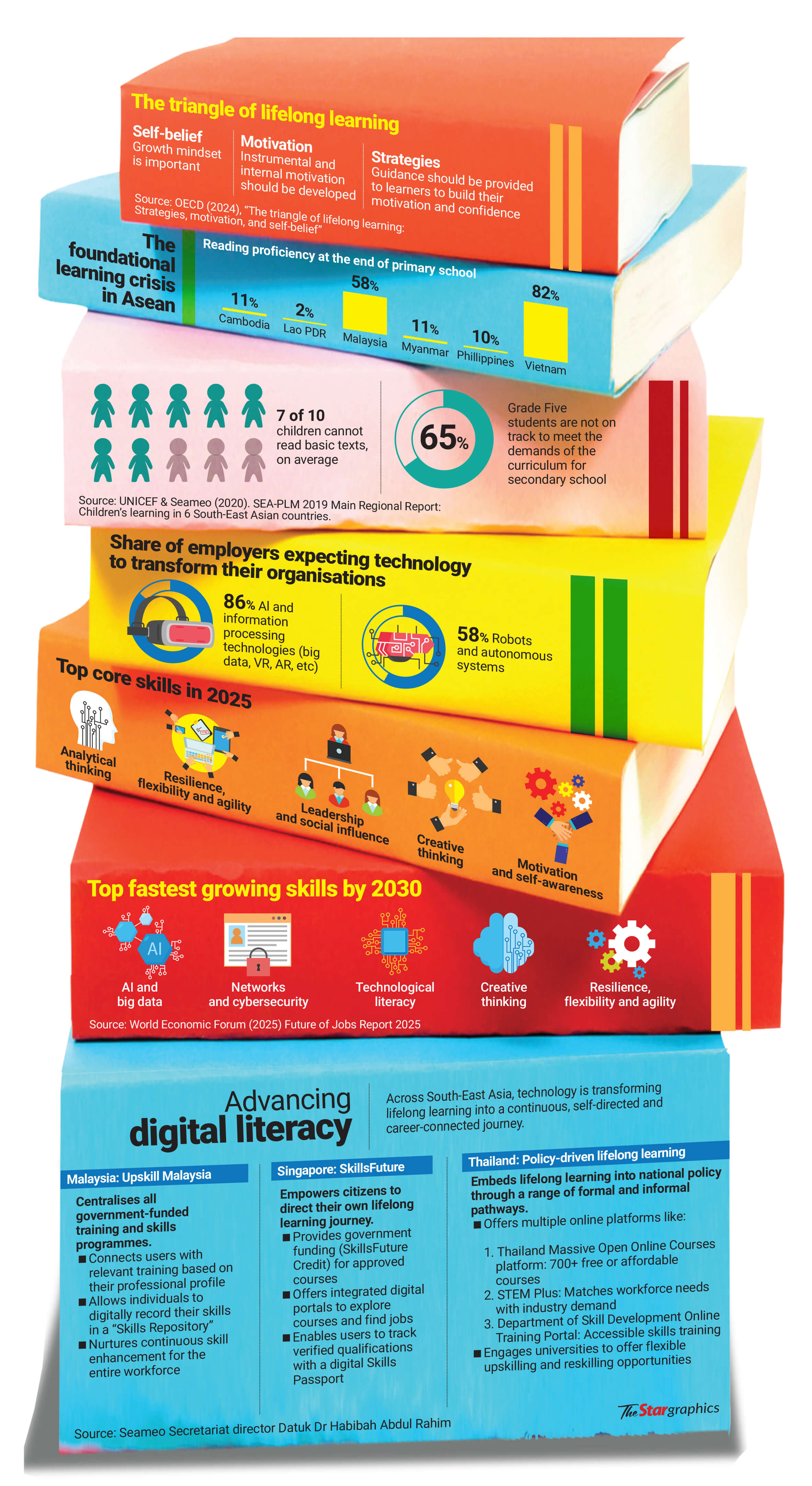
The report projects that by 2030, demand for skills related to AI and big data will increase by 88%, followed closely by rising needs in networks, cybersecurity and technological literacy.
“However, even today, many adults lack the skills to manage complex digital information,” she said, noting that rapid technological shifts require individuals to constantly learn, unlearn and relearn.
She emphasised that greater attention must be given to lifelong learning, citing the same report’s findings that around 40% of current worker skills will be transformed or rendered obsolete between 2025 and 2030.
“Lifelong learning is crucial not only to help people transition into new jobs, but also to enable ageing populations to continue contributing meaningfully beyond traditional retirement age,” the former Education Ministry director-general said.
Habibah believes that lifelong learning must begin internally, from the learner’s own perspective.
She referred to the Organisation for Economic Co-operation and Development (OECD)’s Programme for International Student Assessment (PISA) framework, which describes a “triangle of lifelong learning” built on self-belief, motivation and strategies (see infographic).
Self-belief, in particular, nurtures a growth mindset – the conviction that intelligence and skills can be developed through effort.
Fixing the basics
Habibah, however, cautioned that lifelong learning cannot flourish without first addressing the gaps in foundational education, which remain a major challenge across South-East Asia.
With 34 years of experience in the Education Ministry, she said it is unrealistic to expect the young to thrive in future-ready skill areas when many continue to struggle with basic reading and numeracy.
Poor literacy, she explained, often sets off a domino effect – one that hinders long-term education outcomes and workforce participation, creating disadvantages that last a lifetime.
“It often begins with weak literacy, leading to social impacts such as low self-esteem and feelings of inferiority. This in turn contributes to poor academic performance, higher dropout rates, unemployment, and limited access to decent livelihoods – ultimately affecting community participation and decision-making,” she said.
Findings from the South-East Asia Primary Learning Metrics (SEA-PLM) reinforce this concern (see infographic).
“In its first cycle (2019), a huge proportion of Grade Five students across South-East Asia had not yet mastered foundational skills. On average, seven in 10 Grade Five learners could not read basic texts, with similar results in mathematics. About 65% of students were not on track to meet secondary school curriculum demands,” she shared.
This, Habibah added, underscores the crucial role of teachers – the link that connects learning to purpose.
As both the PISA and SEA-PLM reports recommend, teachers must be supported through positive school environments and quality training to build the self-belief and motivation learners need to succeed.
Innovative systems
Beyond strengthening the foundations of education, Habibah also emphasised the need to expand learning opportunities across a lifetime through innovative tools such as micro-credentials.
“These credentials have standalone value, but can also be stacked or combined with traditional degrees, allowing for the formal recognition of prior and experiential learning,” she said.
She noted that this trend is gaining traction across the region.
“In Malaysia, for instance, national guidelines for good practices in micro-credentials are being developed to address key challenges such as quality assurance and cross-border recognition,” she said.
But technology and tools alone, Habibah stressed, are not enough.
Education systems must also champion inclusivity, ensuring that no learner is left behind in the pursuit of skills and opportunities.
“We must adopt targeted policies to support our most vulnerable learners, who are disproportionately affected by skills challenges.
“This includes people with disabilities, those from low-income households in remote rural areas, ethnic and cultural minorities, and workers in the informal sector,” she said.
She further called for the creation of responsive education systems that can adapt to the needs of learners, economies and the wider world.
“To be responsive to learners, we must build integrated information systems that allow us to use data for early proactive support, which is a challenge given the data gaps that still exist in our region,” she said.
Citing the Langkawi Joint Statement on Asean Out-of-School Children and Youth, she added that it calls for leveraging AI-powered predictive analytics to identify at-risk children and design targeted interventions guided by strong data privacy and ethical standards.
On June 19, Asean Education Ministers convened in Langkawi to address educational challenges affecting out-of-school children and youth.
Their statement reaffirms the region’s commitment to closing education gaps through inclusive policies, technology-enabled learning solutions, stronger data systems, flexible learning pathways, and regional cooperation.
“To be responsive to our economies, we must close the skills gap by better aligning education with the demands of a changing labour market.
”This requires us to regularly conduct skills assessment and anticipation exercises, as countries like Malaysia and Singapore are already doing, to identify skills shortages and surpluses,” she said.
Flexible pathways
Extending this vision further, Habibah underscored the importance of creating flexible pathways that open doors to opportunity and connect learning with real-world purpose.
She explained that redefining these pathways means providing alternative routes to education and opportunity – and several successful models within the region already demonstrate this.
Among them are the Alternative Learning System (ALS) in the Philippines, the “Paket” Programmes in Indonesia, and the Equivalency Programme (EP) in Laos, each helping to reshape access to education.
EPs are alternative education systems equivalent to formal schooling not only in curriculum and certification but also in policy support, delivery methods, staff training, and continuous monitoring and evaluation.
“In the Philippines, the ALS provides a second-chance education for out-of-school youth and adults through flexible learning and continuing education programmes with opportunities for equivalency to various modalities,” Habibah shared.
In Indonesia, she noted, the “Paket” A, B and C programmes serve as primary, junior secondary and senior secondary equivalents.
“Built on flexible learning strategies, they offer flexible entry and exit points, community-based group learning, and diverse learning modes – all of which help reengage dropouts, especially from rural and low-income backgrounds,” Habibah explained.
“Similarly, Laos’s EPs help learners strengthen reading, writing and mathematics skills. Evaluation studies show that participants gain self-confidence and feel more integrated into society,” she added.
Many graduates, she said, go on to pursue higher education, a powerful testament to the transformative potential of lifelong learning.
Note: Habibah was a speaker at Bett Asia 2025, an education technology leadership conference and expo held in Kuala Lumpur from Oct 1 to 2. Themed “Better education, globally”, the event featured over 70 expert speakers and an expo hall showcasing the latest advancements in edtech. The programme covered a wide range of topics, from K-12 to higher education, and explored key opportunities to enhance education systems and improve student outcomes across Asia.