Fadhlina: Many teachers struggling with grief and self-blame, which can manifest in classrooms
The Education Ministry has introduced early psychosocial support for teachers and students following the tragic death of a 16-year-old student at a school in Bandar Utama, says Fadhlina Sidek.
The Education Minister noted that many teachers are struggling with grief and self-blame, which could have a wider impact on the school community if left unaddressed.
“When teachers start blaming themselves, it takes a heavy emotional toll. Without proper psychosocial support, it could deeply affect the school’s overall morale and functioning,” she said in a special media briefing with senior editors in Putrajaya on Oct 23.
“Teacher trauma can manifest in the classroom and affect their ability to teach effectively. Ultimately, we too, are affected by this trauma.”
She stressed the importance of teacher care and support training, noting that affected teachers still require ongoing psychosocial assistance.
“On the first day, we deployed 50 psychosocial experts solely to support the school.
“By the second and third days, attendance was only around 200 students out of over 1,000 – but now we’re seeing more than 800 students returning to school,” she said, attributing the recovery to early intervention measures.
Fadhlina added that the ministry has revamped its teacher care and support training approach to better prepare educators and school staff to respond effectively during crises.
“It is no longer just a fire drill – it is a comprehensive training that equips teachers to act, barricade, and call in emergency situations,” she said.
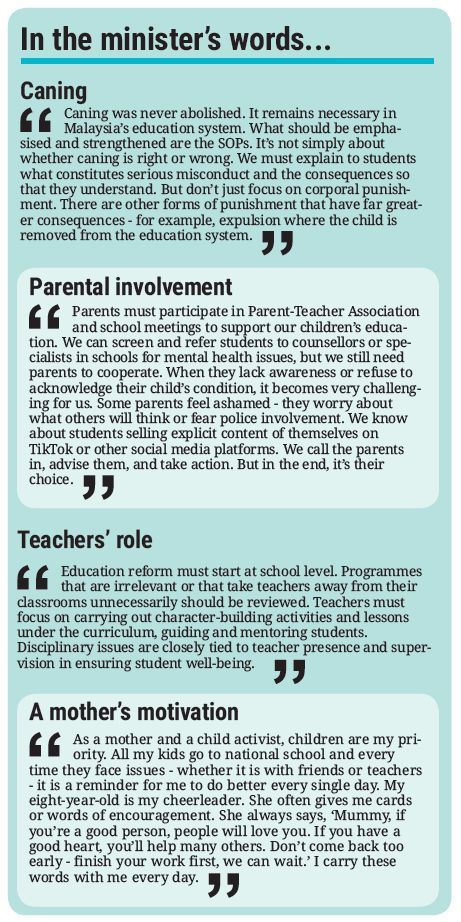
Teacher care and support is one of the five key pillars under the Education Ministry’s immediate reform framework.
On Oct 22, a 14-year-old male student was charged at the Magistrate’s Court with the murder of a Form Four student at a school in Bandar Utama on Oct 14.
Fadhlina shared how during a recent visit to SMK Bandar Utama 4, she was asked deep, emotional questions that shows how hard the students are struggling to make sense of what happened.
“Questions ranged from those who wanted to know whether there will be professionals coming to help them cope, to what the inside of a courtroom looks like because their peer was being brought there to be charged.
“It made me realise how important it is to pay attention to the concerns, wants and needs of our students.
“Without counsellors to guide them, they’re left to process these thoughts on their own,” she said, adding that the ministry’s education reform includes amplifying the ‘student voice’.
“During my time, we couldn’t speak up - we didn’t have a ‘student voice’.
“If we said too much at home, our mothers would scold us or even hit us - that was how it was. But now things are different. We have to listen to our children so that they can help shape their school environment,” she said.