It’s not just about the money — tangible success of Budget 2026 will depend on important factors like effective planning and implementation as well as public engagement and collaboration, stakeholders say.
A budget should not merely be a list of allocations — it should be presented as a roadmap for national progress, said UCSI University Tan Sri Omar Centre for Science, Technology and Innovation Policy Prof Datuk Dr Ahmad Ibrahim.

To better engage the public, the Budget should be structured around national challenges rather than ministries, he added.
“For instance, framing the narrative under themes such as ‘securing our food bowl,’ ‘winning the tech race’, and ‘building climate-ready cities’ can help Malaysians clearly see how various initiatives — whether in agriculture, research and development, or infrastructure — work together to address shared goals.
“Each major allocation should also come with a simple, relatable translation. Instead of highlighting figures, the focus should be on impact,” he said, adding that such an approach would make the Budget more personal, immediate, and relevant — transforming it from a technical document into a story of how Malaysia is preparing its people for the future.
While the decisive push towards high-growth, high-value sectors such as artificial intelligence (AI), renewable energy, semiconductors, and green industries in Budget 2026 highlights the importance of effective implementation to ensure the investments deliver tangible results, University of Nottingham Malaysia vice provost of research and knowledge exchange Prof Dr Shahir Liew said there must be continuous, sustained dialogue between the government, industry, and academia, for these policies to be effective.

“This is to ensure academic research that is not only theoretically sound but also market-relevant and aligned with industry needs, with the potential to inform future government policies with real-time research and data.
“Success will depend on allocations being matched by execution, collaboration, and innovation.

“These investments are crucial for supporting Malaysia’s transition into high-value sectors, balancing a simultaneous drive for both world-class education quality and the development of a skilled talent pipeline,” he said, adding that the country’s vision to compete at the frontier of AI, digitalisation, renewable energy, and advanced manufacturing is ambitious and necessary.
Delivering on this vision will require ensuring that investments are translated into outcomes that raise productivity and global competitiveness, he stressed.
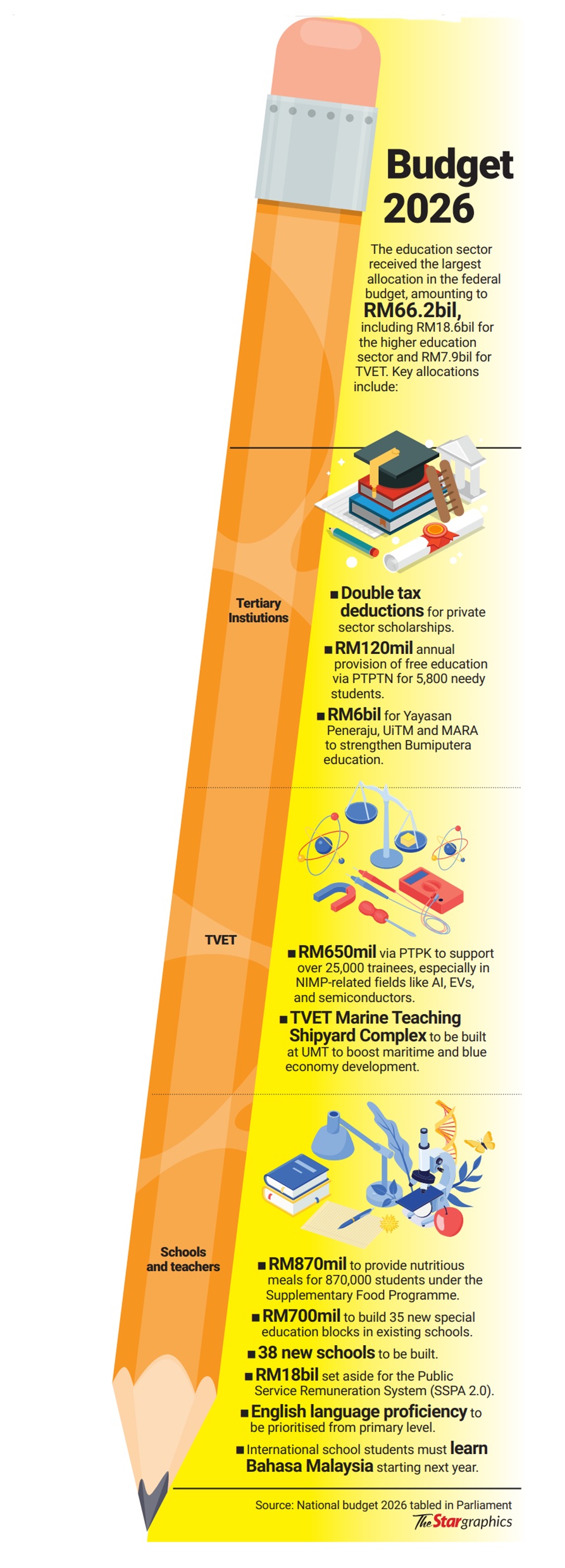
Budget 2026, he noted, reinforces the importance of human capital development by emphasising the need for a future-ready workforce through education, science, technology, engineering and mathematics (STEM), and TVET.
“Funding must be strategically channelled into research with real-world applications, frameworks that enable commercialisation, and ecosystems that bring government, academia, and industry together,” he said.