MANY young Malaysians have grown up believing that postgraduate qualifications guarantee an advantage in the job market.
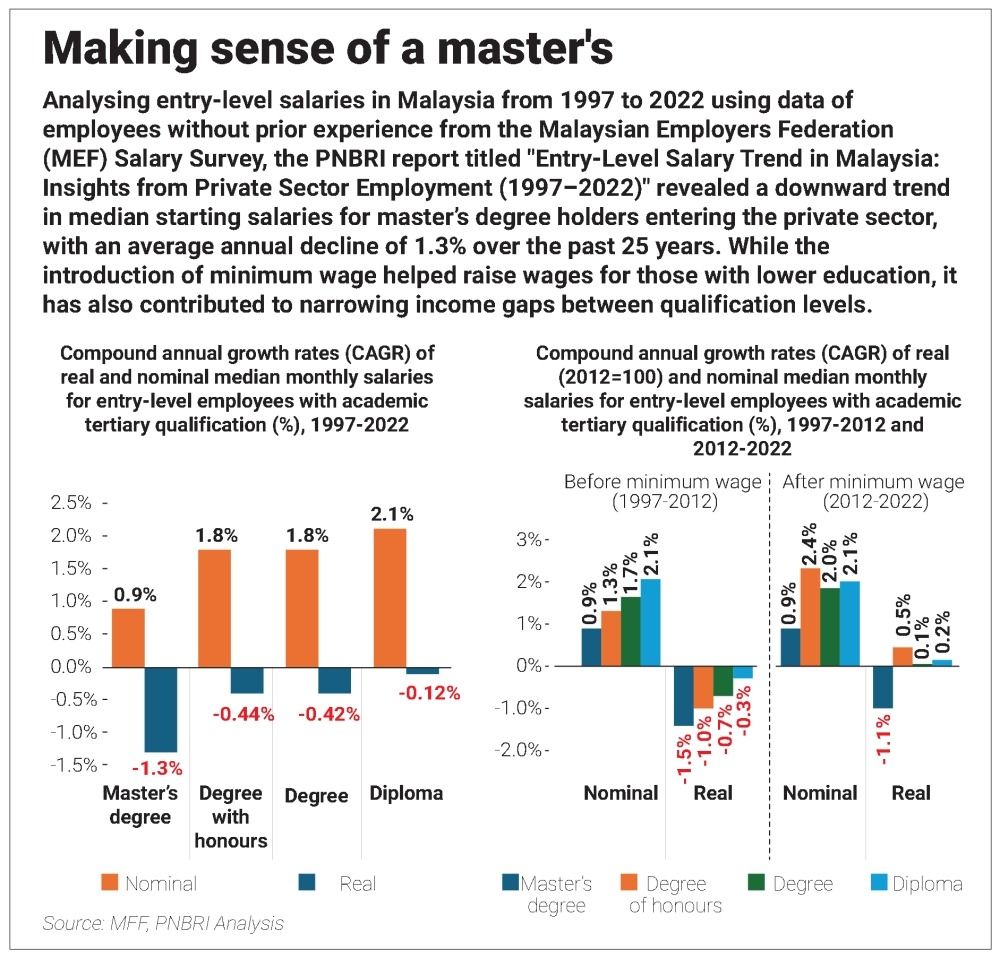
However, a 2025 report by PNB Research Institute (PNBRI) found that although graduates of higher qualifications have been earning more in absolute terms year upon year, the growth of the entry-level salaries has been slower – especially for master’s degree holders (see infographic).
Although the numbers indicate slower growth in starting pay, students should view advanced qualifications as part of a broader strategy for career growth that offers opportunities for advancement rather than a guaranteed salary advantage, education experts advise.

Sunway University School of Education dean Prof Malissa Maria Mahmud said abandoning postgraduate education altogether is not the solution; instead, the challenge lies in rethinking its role and relevance in equipping graduates with the right skills.
“Postgraduate studies must be repositioned as a strategic platform for resilience, leadership, and professional reinvention.
“Employers today are not hiring degrees. They are hiring individuals who can create value in complex, ambiguous environments.
“The premium is on those who can lead cross-sector projects, integrate digital capabilities with human insight, and solve problems that do not yet have clear answers,” she said.

Prof Malissa, who is also the university’s head of the centre for professional and continuing education, said this is why applied learning is no longer optional.
Industry partnerships, internships, and real-world consultancy projects must sit at the heart of postgraduate education, not at its margins, she stressed.
“Across Malaysian universities, there is a visible shift towards this model where institutions are embedding market relevance into academic learning, recognising that tomorrow’s leaders will need more than theory to navigate disruption and drive progress,” she said.

Echoing this, Monash University Malaysia vice president (Education) Prof Stephen Boyle said one of the key non-monetary advantages of postgraduate education, particularly in research-intensive programmes, is the opportunity to acquire a wide range of soft skills.
Such skills – crucial in today’s world – include the ability to appraise issues critically, enhanced self-confidence, and the ability to learn and pursue new ideas throughout life.
“Students also form professional relationships with peers, mentors and industry leaders that often lead to new opportunities,” he said.
Undertaking postgraduate study, he added, is not only a means to increasing one’s income; it offers a chance to learn, assume new leadership roles, and make a transformative change in the world.
“For some, the most rewarding aspect is learning advanced problem-solving and communication skills in their field of interest, as well as building lifelong networks.
“These postgraduate programmes stimulate self-directed learning, creativity, and motivate civic engagement, which helps graduates address the multifaceted challenges of the world,” he said.

Review wage policies
While the government’s minimum wage initiatives are commendable, Universiti Sains Malaysia (USM) deputy vice-chancellor (Academic & International) Prof Datuk Dr Narimah Samat said these must be complemented by broader upward wage adjustments across all education levels, and supported by policies that address existing limitations.
She said policymakers should refine wage-related measures, such as minimum wage standards, living wage benchmarks, and wage bargaining mechanisms, to more effectively promote both equity and employability, particularly for entry-level postgraduates and youth.
Giving entry-level workers and young employees more opportunities to take part in formal negotiations between employers and workers’ representatives, like unions or collective agreements, could be a way to improve their pay and working conditions.
“At the same time, clear salary floors should be set for postgraduates to ensure their qualifications are properly recognised in wage structures.
“Industries could also be encouraged through incentives to absorb master’s graduates into key sectors such as research and development, high technology, and the green economy,” she said, adding that promoting wage transparency and strengthening collective bargaining are also critical to prevent underemployment.
These measures, she said, should be paired with employability programmes so that advanced qualifications translate to both fair pay and sustainable careers.
She, however, urged students not to lose sight on the real benefit of postgraduate studies – namely, the flexibility it accords and the global opportunities it opens up.
“Increasingly, the real value lies in career flexibility, global competitiveness and professional networking, which can open pathways beyond Malaysia.
“Many of these graduates go on to secure salaries of up to RM10,000, thus focusing solely on starting salaries may give a misleading picture of ‘success’,” she said, adding that success should also consider career stability, employability resilience, and contribution to innovation or national priorities.
Malaysian Employers Federation (MEF) president Datuk Dr Syed Hussain Syed Husman said frequent and steep hikes have compressed wage differentials between unskilled and skilled workers.
“When the base wage rises without corresponding productivity gains, pay structures flatten, career progression slows, and innovation is eroded,” he said, citing cases of micro, small and medium enterprises (MSMEs) struggling to maintain pay hierarchies and turning to automation or outsourcing instead of new hires.
Although Malaysia’s minimum wage reforms have promoted social equity, it also highlights a systemic truth – that qualifications alone no longer command the premium they once did, said Prof Malissa.
“Universities cannot respond to this with cosmetic tweaks. The system must evolve.
“Curricula must embed entrepreneurial thinking, interdisciplinary problem-solving, and the capacity to navigate volatility,” she said.
She added that a master’s degree remains a powerful tool, but only when pursued with purpose.
“Students must approach postgraduate study not as a credential, but as a transformation.
“It is about preparing graduates to lead in sectors that do not yet exist, using technologies that have not yet been invented, to solve problems that no single discipline can address alone,” she said.
Skills define salaries
Concurring, Syed Hussain said academic credentials alone no longer guarantee salary premiums as employers today place greater value on job readiness, adaptability, digital competencies, and relevant work experience.
To address this, he proposed reforms to postgraduate curricula through stronger industry alignment, embedding real-world problem-solving, digital fluency and leadership modules into master’s courses.
MEF, he said, advocates for the introduction of mandatory industrial attachments, research-commercialisation exposure, and micro-credentials in master’s programmes to boost employability and value proposition of the degree holder.
“Employers need the freedom to design performance-based salary structures that reward actual productivity and marketable skills, whether the candidate has a diploma or postgraduate qualification,” he said, adding that transparent postgraduate tracer studies with industry-linked salary benchmarks would help recalibrate both graduate and employer expectations.
He also stressed that stagnant entry-level salaries were not solely the result of employer reluctance, but reflected mismatches between graduate output and industry needs.
“Employers are more willing to pay premiums when postgraduates arrive with targeted competencies – whether in data analytics, compliance, or digital marketing,” he said, adding that MEF has ongoing partnerships with universities, HRD Corp and massive open online course providers to integrate such training for its members.
Looking ahead, he said Malaysian employers must reform traditional pay models to remain competitive and retain talent.
“Younger employees expect faster progression, pay transparency, and rewards based on impact, not tenure.
“Reform is not just about raising wages; it’s about making pay smarter, fairer, and aligned with performance and business value,” he said.
Failure to act, he warned, would see Malaysia continue losing postgraduate talent to neighbouring countries and the Organisation for Economic Co-operation and Development (OECD) economies offering better wage incentives and clearer career paths.
“If we do not link postgraduate education to market value, Malaysia risks becoming a low-value, low-wage economy despite high educational attainment.
“The private sector will struggle to retain high-performing talent, and national productivity will suffer from underutilised skills,” he said.
Reality of business
While large employers such as multinational corporations and government-linked companies operate within structured compensation frameworks that offer clearer progression, Syed Hussain noted that 98% of Malaysian employers are MSMEs, where salary levels are often market-driven and constrained by affordability.
“In MSMEs, postgraduate qualifications alone do not guarantee higher pay unless they directly contribute to business growth or specialised expertise.
“So, salary reforms must distinguish between the realities of large corporations and smaller enterprises,” he said.
The focus, he added, must be on equipping graduates with industry-relevant skills, entrepreneurial mindsets, and innovation capacity so that employers, big or small, can justify paying them more.
Ultimately, compensation practices are rooted in value creation, not just credentials, he said.
“Employers, whether large or small, pay for performance, responsibilities and results, not solely for academic qualifications.
“A master’s degree may enhance employability but does not guarantee premium salary levels unless it directly translates into higher organisational value,” he said, adding that sectoral shifts driven by rapid digitalisation, AI integration, and automation have also altered employer expectations.
“Today, demand is higher for practical skills, adaptability and innovation rather than traditional academic credentials.
“Postgraduates who can demonstrate these attributes will remain competitive, but those relying only on their degree may struggle to command higher entry salaries,” he said.