Besides strengthening academia-industry collaboration, broader systemic challenges must be addressed for Malaysia to develop a workforce capable of supporting sustainable, inclusive and innovative urban development, say stakeholders.
Construction Industry Development Board (CIDB) Malaysia chief executive Zainora Zainal said Malaysia’s efforts are hindered by structural and operational issues.
These include skills mismatches and fragmented training, low adoption of sustainability and digital competencies, limited industry involvement in talent development, underrepresentation of vulnerable groups, and weak integration of urban sustainability into technical and vocational education and training (TVET) as well as tertiary curricula, she noted.
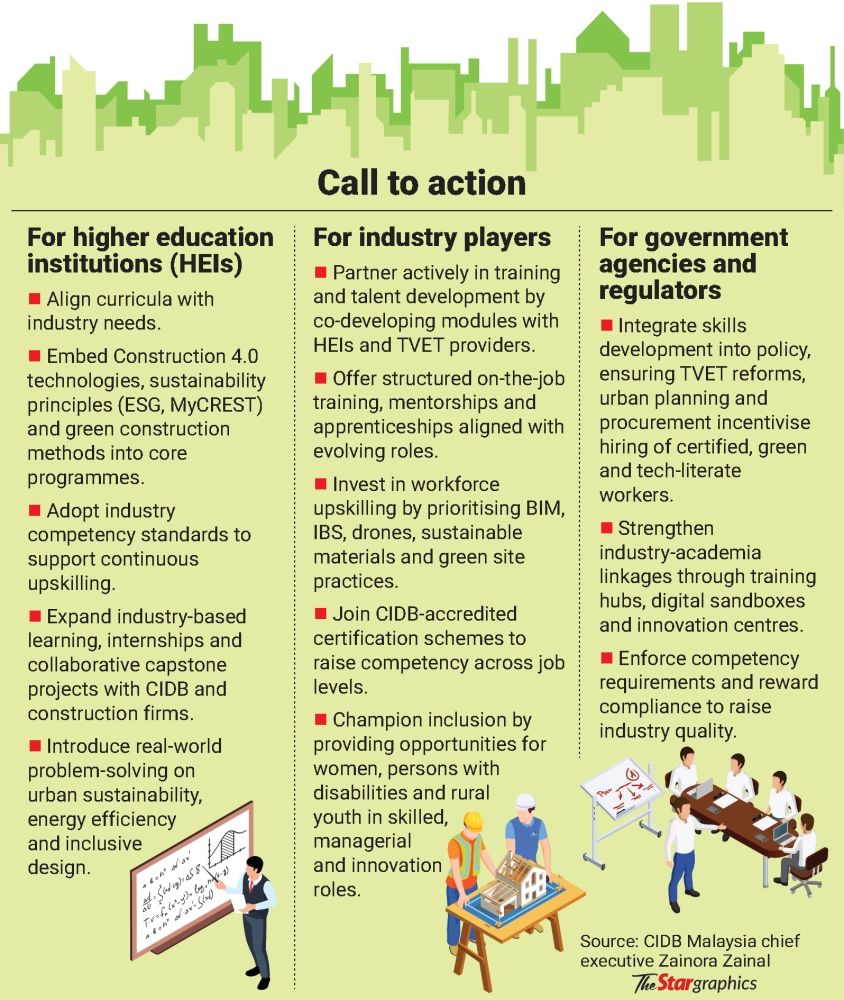
She proposed a multipronged approach involving higher education institutions (HEIs), industry players, and government agencies and regulators to overcome these challenges (see infographic).
Expanding on the issue, Malaysian Institute of Architects (PAM) president Adrianta Aziz said fragmented cross-disciplinary collaboration, uneven access to high-quality training outside urban centres, and a shortage of professionals trained in inclusive design and climate adaptation strategies are concerns that need to be addressed.
He proposed establishing a national skills framework for sustainable urban development.
“Incentivise green and inclusive design skills through grants and recognition programmes. Encourage the co-development of curricula between academia, industry, and professional bodies. And improve digital and language literacy across all levels of the workforce to empower broader participation,” he said.
Another key challenge, said Think City managing director Datuk Hamdan Abdul Majeed, is the need to develop solutions that are locally relevant.
“While concepts and frameworks from elsewhere can be helpful, they often need to be adapted to Malaysia’s specific social, environmental and governance contexts. Without this, urban interventions may fall short in terms of impact or long-term sustainability,” he said.
He also stressed the importance of supporting platforms for learning and exchange that bring together professionals, policymakers and communities.
“There is a tendency for urban issues to be addressed within disciplinary or institutional silos.
“This can make it harder to tackle complex, interconnected challenges such as housing, mobility and public health,” he said.
According to Taylor’s University School of Architecture, Building and Design head Assoc Prof Dr Camelia Kusumo from the Faculty of Innovation & Technology, demand for sustainability professionals in the construction industry is low, as sustainable practices are not yet mandatory in Malaysia.
“The industry often prioritises cost-efficiency over sustainability. While Malaysia has introduced commendable sustainability policies for the built environment, enforcement remains weak. As a result, many industry players view sustainability as an unnecessary cost,” she said.
She also asserted that training green building professionals requires additional investment, particularly in digital tools.
“Providing incentives or subsidies could help attract more young people to acquire these essentials skills and build national capacity in this crucial area,” she said. — By ROWENA CHUA