MODERN living has seen vast progress since yesteryear, but for urban development to further evolve, cities must be built on the pillars of sustainability, inclusivity and innovation.
It is a vision Malaysia aims to advance through its leadership as president of the United Nations Human Settlements Programme (UN-Habitat) General Assembly for the 2025 to 2029 term.
The push for greener, more inclusive urban development also aligns with the 13th Malaysia Plan’s emphasis on sustainable cities and resilient infrastructure for 2026 to 2030.
To achieve the New Urban Agenda, stakeholders say the country’s built environment professionals, such as architects and engineers, must be equipped with the values and skills to design urban spaces that serve both people and the planet.

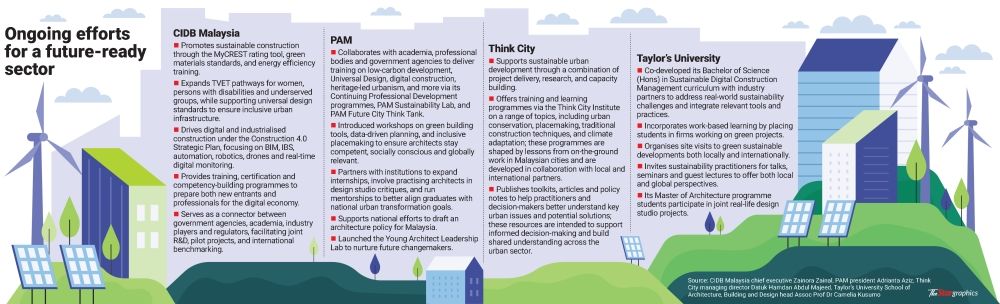
Construction Industry Development Board (CIDB) Malaysia chief executive Zainora Zainal said the most in-demand green construction skills include the supervision and management of personnel in sustainable practices, the installation and maintenance of solar photovoltaic systems, and environmental management.
“High-demand innovative skills include proficiency in Building Information Modelling (BIM), the Industrialised Building System (IBS), and construction technology and automation.
“There is also growing demand for expertise in drone mapping, robotic surveying, 3D printing, and automation in project monitoring,” she told StarEdu.
She added that inclusive construction skills are also crucial to ensure projects, sites and systems are accessible, diverse and equitable – both in terms of who works in construction and who benefits from the built environment.
Weighing in, Malaysian Institute of Architects (PAM) president Adrianta Aziz, who is also an adjunct professor at Universiti Tun Hussein Onn Malaysia, said the demand is no longer solely for iconic buildings, but for thoughtful, responsible design that improves quality of life while minimising environmental impact.
“Skills in climate-responsive design, passive environmental control strategies, digital tools, as well as stakeholder engagement, are increasingly essential.
“Architects must also embrace regenerative practices – designing not just to do less harm, but also to heal and enhance the environment and social fabric,” he said.
Think City managing director Datuk Hamdan Abdul Majeed said Malaysia’s increasing focus on designing more inclusive and liveable urban spaces requires building the capacity of local authorities and practitioners in areas such as placemaking and community engagement, as well as ensuring that public spaces are well activated and maintained over time.
“These are not just technical skills, but also involve understanding how to work with different stakeholders, navigate competing interests, and support the long-term use and care of shared spaces,” he said.

He also pointed to the growing need to respond to the impacts of climate change, which are already affecting urban areas in the form of higher temperatures, flash flooding and infrastructure stress.
“Public spaces can play a role in supporting adaptation efforts, particularly through the integration of nature-based solutions such as shading, green infrastructure, and improved surface permeability.
“Understanding how to apply these strategies in a way that fits the local context is becoming an increasingly important skill for those working in the built environment,” he said.
Adding to the discourse, Taylor’s University School of Architecture, Building and Design head Assoc Prof Dr Camelia Kusumo from the Faculty of Innovation & Technology stressed the need for compassionate and well-rounded architects who can design beautiful spaces while addressing the needs of both people and the planet.
“Malaysian architects should possess soft skills that enable them to be resilient, adaptable and empathetic towards communities and the environment,” she said.
Fixing training gaps
While graduates from engineering, architecture and built environment programmes have strong theoretical foundations, many remain underprepared in key areas, said Zainora.
These include hands-on technical competency, exposure to industry tools, soft skills, knowledge of sustainability frameworks such as the Malaysian Carbon Reduction and Environmental Sustainability Tool (MyCREST) or environmental, social and governance (ESG) criteria, as well as awareness of current industry regulations and compliance procedures, she noted.
To bridge the gap between academia and industry, she stressed the need for stronger collaboration.
“Embed CIDB-certified modules into university curricula.
“Expand structured industrial placements or live construction projects under industry supervision.
“Develop joint training programmes with CIDB, Akademi Binaan Malaysia and other industry partners,” she said.
Zainora also recommended integrating industry standards into higher education learning outcomes, prioritising digital construction, sustainability and resilience as core modules in competency training, and cultivating critical soft skills.
Agreeing, Adrianta noted that gaps remain in real-world exposure, project delivery readiness, and interdisciplinary collaboration.
“We advocate for curriculum enhancements that embed sustainability, governance, digital construction and stakeholder engagement from the outset,” he said.
Citing the limited opportunities students often have to apply their theoretical knowledge in real-world urban settings, Hamdan suggested that higher education institutions (HEIs) strengthen their programmes through more structured placements, applied studios, and partnerships with government or industry.
“These experiences can help graduates better understand the social, regulatory and environmental dimensions of urban work, and build confidence in navigating them,” he said.
“The ability to work with communities, manage complexity, and respond to changing conditions is often developed through hands-on experience,” he added.
Camelia, meanwhile, noted a shortage of graduates with green building expertise.
“This knowledge is essential to navigate the complexities of sustainable construction, including design, material selection and building management,” she said.
This is not confined to Malaysia as there remains a lack of specialised expertise in sustainable urban development across Asia, she added.
To address this, Camelia called for aligning educational curricula with sustainable construction frameworks.
“Programmes should offer a comprehensive green building curriculum that equips students with practical skills in areas such as energy efficiency, water conservation and material selection,” she said.
‘Rethink our communities’

With Johor Baru rapidly urbanising, many roadside lots and dilapidated shops in areas like Plentong have been left to collect weeds or become informal dumping grounds, overlooked in favour of new malls and high-rises.
Instead, these spaces could be reimagined as micro pocket parks where the ageing population can exercise safely, rest during errands, or simply enjoy fresh air.
These low-cost shaded parks could include slip-resistant walking paths, ramps with handrails, and water fountains and greenery to reduce heat. They could also serve as community spaces for activities such as tai chi. Maintenance could be supported by the city council, with student volunteer groups helping to foster intergenerational bonds.
Pocket parks are environmentally friendly, socially inclusive and economically sustainable. A smart city is one that ensures elders aren’t left behind, and that everyone feels welcomed and supported. I hope to one day join those who are making an effort in doing so.
Tina Low, 15

An efficient drainage system and sustainable urban planning are essential for reducing disasters such as flash floods and landslides. Earlier this year, Miri, Sarawak, experienced continuous heavy rain that coincided with the King Tide, causing a sudden surge of water that overwhelmed outdated drainage systems. Immediate maintenance and upgrades are needed to make cities inclusive, safe, resilient and sustainable, in line with Sustainable Development Goal 11: Sustainable Cities and Communities.
Mirza Irdina, 19

One way to improve sustainability in my city, Kota Kinabalu, is through strategic rainwater use. Heavy downpours often cause flooding, but rain should be seen as a resource, not just a threat.
With better drainage and rainwater harvesting – permeable pavements, storage tanks, even small-scale hydro systems – we could transform flood risks into opportunities for clean water supply and renewable energy.
This matters to me because I’ve experienced the devastation of flooding. It doesn’t just disrupt traffic – it destroys homes and endangers vulnerable communities. Turning that challenge into a solution reflects the essence of SDG 11.
Fiona Flonika Joshman, 22

Batu Pahat, Johor, is my home – but floods threaten it constantly. After days of rain, or even a sudden downpour, roads vanish. My school has flooded, and relatives have suffered losses.
The causes are well known: clogged drains, silted rivers, unchecked development, tidal backflow. Yet year after year, upgrades are delayed, and the same areas flood again.
We need resilient infrastructure, preventive planning, and real preparedness. Our systems are outdated and reactive. Climate change is already here, and we are falling behind.
Green infrastructure such as retention ponds, permeable surfaces and urban trees can help. So can early warning systems and emergency plans that protect the vulnerable.
A sustainable city must protect its people and property before the next storm hits.
Isabel Lim, 14