Zambry: Overseas experience can benefit country
MALAYSIA can benefit from young talents going abroad to gain knowledge and experience – if we can get them to return and contribute to nation-building.
While acknowledging that the loss of talent is a long-standing issue in the country, Higher Education Minister Datuk Seri Dr Zambry Abdul Kadir believes it can be turned into a positive.
“We can’t stop people from leaving for greener pastures, (so) we have to look at it (brain drain) differently.
“We’re trying to approach things from another perspective – from brain drain to brain gain.
“Meaning, let those who study abroad get experience there, and after a while, encourage them to come back,” he said, adding that one of the main reasons talent leave is the higher salaries offered abroad.
Speaking at the “In Person With Doc Zam” Q&A session at Universiti Malaya (UM) on July 17, he said every ministry must work together to address the issue.
Initiatives like Talent Corporation Malaysia Bhd (TalentCorp), he added, can help bring Malaysian professionals home.
Zambry also addressed the broader challenges facing graduates post-Covid-19.
“It is not just post-pandemic; it’s also the era of artificial intelligence (AI) and the new digital economy.
“For example, at the World Economic Forum last January, it was predicted that while about 79 million new jobs will be created, some 40 million existing jobs will disappear,” he said.
To tackle this, the ministry is focusing on preparing students for new and emerging industries through the Malaysia Education Blueprint (Higher Education) 2025–2035.
“We’re prioritising science, technology, engineering and mathematics (STEM) and encouraging students to pursue science and technology.
“(But) students should not be ashamed of studying fields like agriculture, because food security is a first priority for all civilisations,” he said, adding that there is a surge in interest in technical and vocational education and training (TVET).
Last year, there were 140,000 enrolments in TVET; this year, the number has jumped to 200,000, he shared.
Learning without walls
The approach to higher education is undergoing major changes, with a focus on application-based learning and real industry experience, Zambry said.
“We’re moving towards a learning model where students are not confined to the campus all the time. It could be two years on campus, and another two years in industry.
“This is a new model that is more realistic and high-impact,” he said, adding that this approach aligns with the increasingly dynamic and complex job market.
Students can no longer rely solely on traditional lectures particularly with the rise of the digital economy, he said, adding that they must be bold enough to ask questions, challenge ideas, and sharpen their critical thinking skills.
Citing Japan’s Kosen institution system, he said it is renowned for producing engineers through a technical education approach that balances professional competence with social responsibility.
“What is the ultimate goal for humans? We work on this Earth. And who lives on this Earth? People. So, who does an engineer serve? Society. That is another dimension of an engineer,” he said.
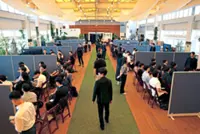
The event, which was live-streamed, saw over 3,000 foundation students from UM, Universiti Kebangsaan Malaysia, Universiti Putra Malaysia, Universiti Sains Islam Malaysia and Universiti Teknologi Mara in attendance.
During the session, Zambry fielded questions on student involvement in education policy, freedom of expression, youth political awareness, and quotas in critical fields such as medicine.
He reminded students to stay vigilant about fake information, especially false content produced by AI.
“Nowadays, AI can create images that look very real. But when you check, the person might not even exist.
“That’s why we need to have a critical mind. When you see something, ask first – is this true?” he stressed.
Also present were Higher Education secretary-general Datuk Dr Anesee Ibrahim, director-general Prof Datuk Dr Azlinda Azman, and UM vice-chancellor Prof Datuk Seri Dr Noor Azuan Abu Osman.