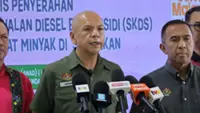
KOTA KINABALU: Discussions about a merger between Sabah’s two non-Muslim native parties are progressing at the grassroots level, says Sabah STAR president Datuk Seri Dr Jeffrey Kitingan.
Efforts have already begun in Tambunan, marking a significant step towards uniting multiracial native-based parties.
“We have started combining Parti Bersatu Sabah (PBS) and Sabah STAR leadership in Tambunan, with me heading the division and Tambunan PBS division chief Datuk Daniel Kinsik as deputy,” Kitingan said.
The move has sparked discussions on political realignment in Sabah, with leaders positioning it as an effort to strengthen Sabah’s autonomy and influence in national politics.
Merger talks - which have gained traction in recent months - aim to consolidate Sabah-based parties into a single entity, reducing political fragmentation and enhancing bargaining power at the federal level.
Marking its 40th anniversary on March 5, PBS stands as Sabah’s oldest multiracial party, while STAR, founded in 2016, has quickly gained traction with notable electoral successes.
Although taking a cautious stance, PBS acting president Datuk Seri Dr Joachim Gunsalam acknowledged the electoral pact between both parties, formalised through a Memorandum of Understanding (MoU).
He added that the partnership with Sabah STAR strengthens the Gabungan Rakyat Sabah (GRS) government and does not threaten other allies, particularly with the state election expected by September this year.
Kitingan said the merger is part of a broader strategy to solidify Sabah’s political leverage.
“For over five decades, Sabah had little influence. Only when we became kingmakers in the federal government did we gain a voice. We must continue using this advantage while the opportunity remains,” he said.
In December last year, PBS information chief Datuk Joniston Bangkuai announced that the party had formed a committee, comprising party leaders and several lawyers, led by Tawau MP Datuk Lo Su Fui, to study the proposed merger with Sabah STAR.
Kitingan outlined a phased approach, beginning with the integration of both parties’ supreme councils, with him serving as pro tem president.
Full integration is expected within a year, followed by leadership elections in accordance with the party constitution. He is widely seen as the frontrunner to lead the merged entity.
The merger has received strong backing, including from Kitingan’s elder brother, Tan Sri Joseph Pairin Kitingan, PBS’ founder and current premier advisor.
Pairin initiated a meeting at his Tambunan residence last December to discuss the plan, advocating for a united front among Sabah-based parties.
“The meeting was attended by PBS acting president, secretary-general Datuk Julita Majungki, Datuk Lo (Su Fui), and Sabah STAR secretary-general Datuk Edward Linggu. My brother (Pairin) was among the first to propose the merger and urged that it be completed as soon as possible,” Kitingan said.
When asked whether the merger would mean the end of PBS as Sabah’s oldest local party, Kitingan said the plan is to merge their names into Parti Bersatu Sabah Tanah Airku (PBSTar), preserving their identity while moving forward as a single entity.
“When someone dies, they go to heaven. But to go to heaven, you must die first. However, no one wants to die, yet everyone wants to go to heaven,” he said, stressing the need for common ground between the two parties to ensure mutual satisfaction.
Reflecting on PBS’ origins, Kitingan revealed that he played a role in its formation, assisting his brother in overcoming political hurdles in the early days.
“My brother wanted to form PBS but faced political obstacles. It was either December 1984 or January 1985, and I was still studying in the US. I was organising a student programme and invited then-deputy prime minister Tan Sri Musa Hitam as the guest of honour.
"As home minister, Tan Sri Musa had the authority to approve the party’s registration. I called my brother to come to Boston and meet him. Though he had never been to the US before, he came anyway.
"I arranged their meeting, and later, Tan Sri Musa acted fairly. He signed and endorsed the request, ensuring the registration moved forward. By the time my brother returned to Sabah, the party registration was ready,” Kitingan recalled.
He hopes to finalise the merger before the state election due by September this year.
Other allies in the GRS coalition, including the Sabah Progressive Party (SAPP) and United Sabah National Organisation (Usno), have expressed interest in joining the alliance.
Meanwhile, the United Progressive Kinabalu Organisation (Upko) has shown willingness to collaborate, though discussions are still in early stages.
Once Sabah’s dominant native-based party, PBS nurtured a generation of Kadazandusun Murut (KDM) leaders, including Kitingan himself.
However, its narrow victory in the 1994 election triggered political strife and defections, giving rise to splinter parties that fractured KDM political loyalties.
If the merger proceeds, PBSTar will become Sabah’s largest multiracial native-based political party in the state.
Together, PBS and Sabah STAR hold 13 state seats, with PBS holding seven - Kiulu, Kundasang, Lumadan, Matunggong, Tamparuli, Tandek, and Telupid, and Sabah STAR holding six - Bingkor, Liawan, Paginatan, Sook, Tambunan, and Tulid.