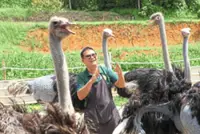
For Chea Ong Seng, taking over an ostrich farm was a chance to combine his love of animals with his passion for ecotourism.
Despite not having prior knowledge on ostrich handling, Chea, 47, decided to take on the challenge in Desaru.
“I have 12 years’ experience working as a farmer, an ecotourism tour guide and earthworm farming consultant.
“When I met an ostrich farm owner who wanted to let his business go, I knew it was an opportunity for me to try something new and create a platform to share the joys of being with nature while promoting ecotourism,” he told StarMetro.
Chea, from Kota Tinggi, Johor, said the animals were relocated from the original site to his farm in Desaru, where they share space with rabbits and ducks.
Beginning operations in January last year, Chea said he initially relied on guidance from the previous owner, but was still learning primarily through hands-on experience.
“Initially, there were 30 ostriches, but some died because they could not adapt to the new environment and ecosystem.
“Now, the situation is stable and I am focusing on keeping the remaining 20 birds healthy.”
Chea described breeding and daily care of ostriches as challenging, with the herbivores fed grass and blended feed twice daily.
Each ostrich consumes about 1kg per feeding, bringing his farm’s monthly feed costs to between RM4,000 and RM5,000.
“Each ostrich at my farm weighs 120kg to 125kg and their eggs, known for being the largest in the world, weighs 8.2kg to 8.6kg each,” he explained.
However, Chea said breeding remained a struggle.
“Although the ostriches continue laying, many eggs fail,” he said, adding that issues included nutrition.
“I must always ensure the birds are healthy, properly fed and their environment is suitable.
“When an ostrich falls sick, it is especially difficult because Malaysia has no specialists.”
Unlike in China and Vietnam where ostriches are bred for meat, ostrich farming in Malaysia is mostly for education and tourism.
Chea said the farm had seen a steady stream of visitors in the past year, with international volunteers arriving to learn about these giant birds.
“They come from France, the US, China, the Netherlands, Bahrain, Spain and Germany for working holidays to learn more about ostriches.
“My long-term plan is to increase the ostrich population and focus on educational experiences,” he said.
Chea said he had also received positive feedback from parents, as they preferred to have their children engage with nature rather than being glued to electronic gadgets.