



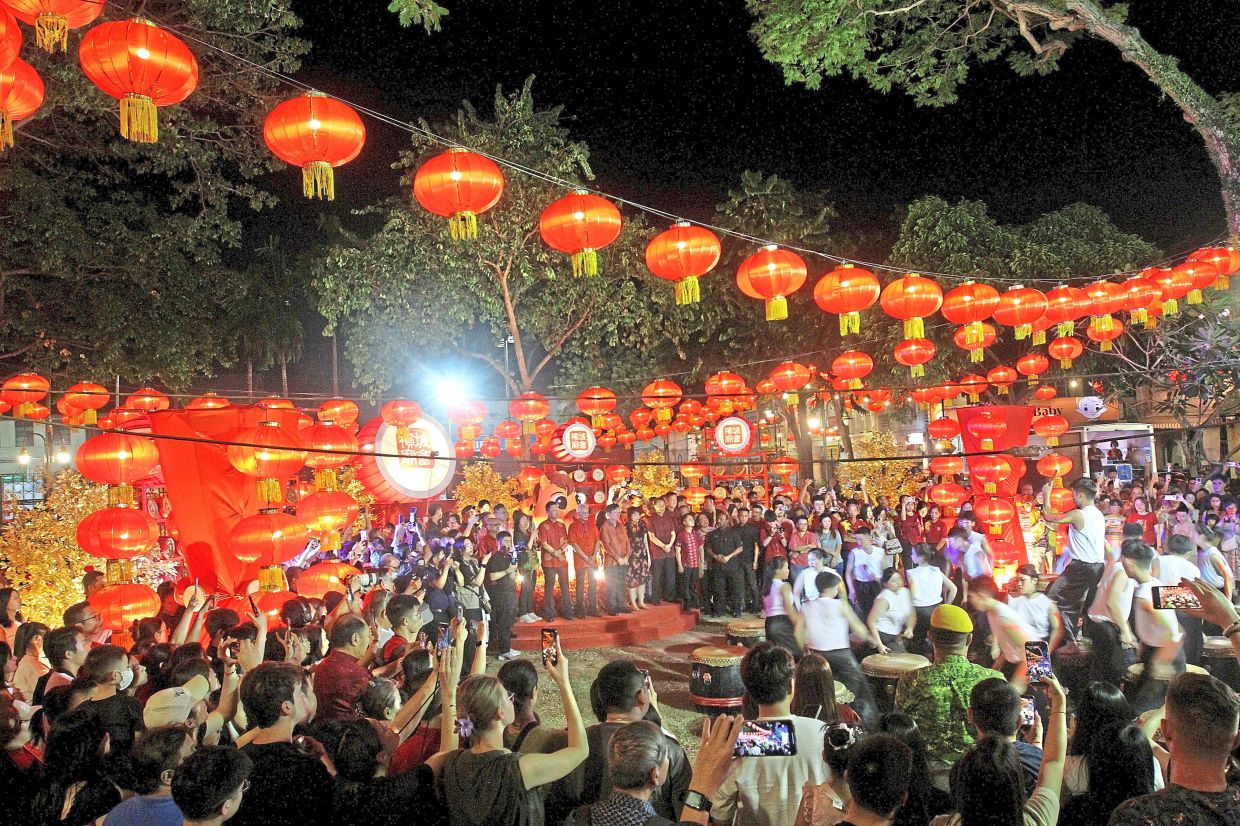
MULTIPLE spotlights bathed a cheerful horse installation in radiant light to herald the start of Penang’s Chinese New Year celebrations.

It grabbed all the attention when it was unveiled in a ceremony at Armenian Park in George Town, with crowds queuing up for selfies.
Complementing the 1.5m-tall equine centrepiece are six golden trees with fluttering leaves shimmering in the breeze.
Around it are five giant drums inscribed with auspicious greetings.
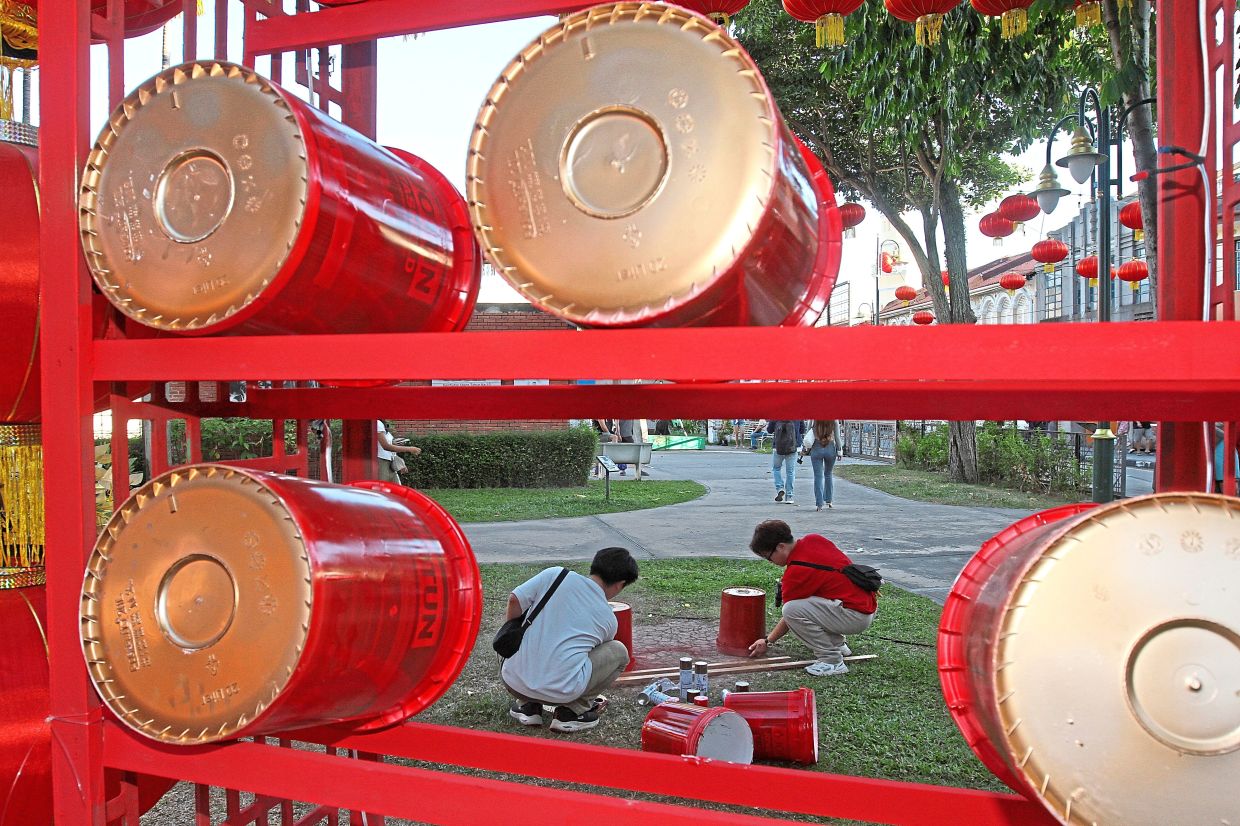
Meanwhile, 48 smaller ones, repurposed from old paint buckets, reverberated when performers struck them as part of the opening ceremony.
Several hundred red lanterns, strung up on giant columns and across the inner city garden, add a classic touch.
One visitor, German tourist Emma Waldschmidt, reflected on the rich symbolism as she surveyed the vibrant scene.
“Walking around, you really get a sense of tradition and community. Every detail feels alive with meaning. It is like stepping into a living celebration of culture,” said the school teacher.
The event also featured a preview of this year’s Miaohui activities, with 10 hands-on workshops at the nearby Acheh Street Youth Centre giving the public a taste of what to expect.
It included one highlighting the cultural and historical significance of incense, overseen by incense maker Ken Wong.
He taught visitors how to make incense strings for the home and briefed curious parties on how the material spread across greater Asia via ancient trade routes.
“People mostly associate incense with rituals and prayers but its uses go beyond that.
“It can also be used to relieve stress, calm the mind and refresh a space,” said Wong.
Facilitator Yeoh Hui Yee, who has been a Miaohui volunteer for the past two years, described the annual event as a good platform for younger generations to learn about cultural heritage.
“To be able to convey information to the public, we also have to learn it ourselves.
“And through that, I discovered many things I didn’t know,” said Yeoh, an accounting analyst by profession.
There were also booths that allowed visitors to create herbal pouches and try delicacies such as Hakka lei cha.
These drew the interest of Indian expatriate Krishnakumar Iyer, a technical support director with an American multinational corporation.
“I enjoy learning about history and tradition, so when a colleague told me there is a mini event here, I just have to come.
“These crafts hold deep significance for communities.
“Throughout history, people spent a lot of time and effort perfecting them,” he noted.
This year’s Miaohui, themed “The Journey of Decoding” and coinciding with the fifth day of Chinese New Year, will feature 30 such activities.
Event master planner Chong Jian Mei said visitors would get to delve into family surnames, street names and cultural foods such as rice cakes and tea.
Other booths will highlight crafts and art forms such as lion dance, dragon dance, paper cutting, ink printing, embroidery, Chingay, traditional rhymes, games, riddles and costumes.
Many allow visitors to take home personalised souvenirs to foster a deeper understanding and connection with the traditions experienced.
Ancestral halls such as Sun Wui Wui Koon, Kar Yin Fee Kon, Penang Tsen Lung Fui Kon, Kwangtung and Tengchow Association, Chin Si Toong Soo, Koo Saing Wooi Koon, Penang Teochew Association and Leong San Tong Khoo Kongsi are also opening their doors to the public.
There will be 17 stage performances with festivities spread across 12 streets in the heritage zone: Armenian Street, Acheh Street, Cannon Street, Soo Hong Lane, King Street, Bishop Street, Beach Street, Penang Street, Church Street, Chulia Street, Pitt Street and China Street.
In a display of the state’s diversity and unity, it has drawn participation from other communities, including the Arulmigu Sri Maha Mariamman Temple, for the first time in Miaohui’s history.
The Miaohui has come a long way since it was initiated in 1999 by local arts and culture enthusiasts as a way to preserve, celebrate and spur interest.
Now in its 27th year, it has grown into the state’s biggest Chinese New Year carnival.
Most notably, it involves grassroots community groups, youths and students, keeping the knowledge transfer authentic.
Penang Chief Minister Chow Kon Yeow commended this legacy of cultural seed-planting and urged the public to appreciate its wonders.
“From ancestral hall architecture and plaques to couplets and traditional skills, each element carries the wisdom of those before us.
“Through this journey, we are reminded of the depth, beauty and enduring charm of cultural heritage,” Chow said at the lighting-up ceremony.
The Miaohui is organised by Penang Chinese Clan Council (PCCC) in collaboration with the Penang Cultural Inheritors Society.
The full line-up of activities will be revealed in coming weeks so follow www.facebook.com/pgcny or www.instagram.com/penangmiaohui for updates.
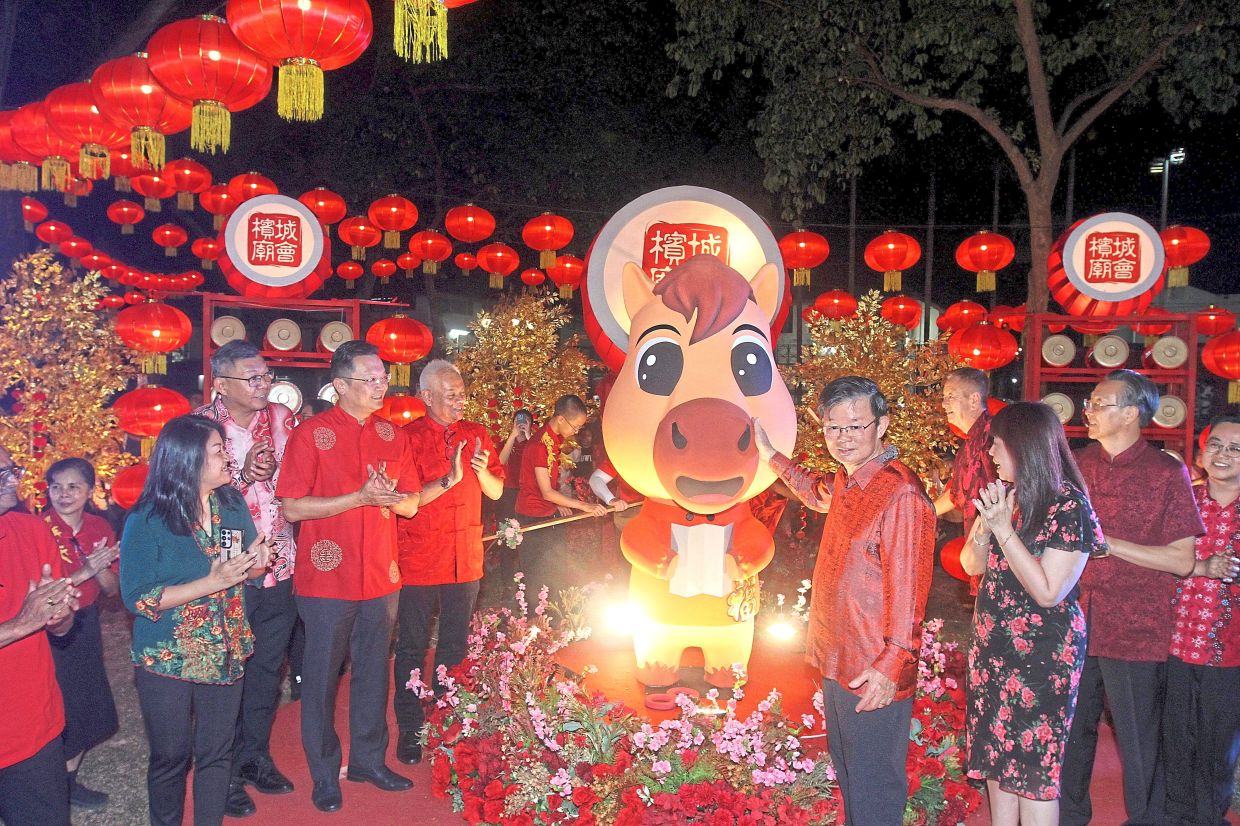


Chow (fifth from right) and other state and community leaders posing with Xiao Jun, the official horse mascot of Chinese New Year and Miaohui 2026. — Photos: LIM BENG TATT/The Star
Performances and activities during the lighting-up ceremony drawing a crowd of locals and tourists.
A visitor taking a closer look at the activities to be featured in Miaohui 2026.
Volunteers turning discarded paint buckets into drums forming part of the Armenian Park decorations for CNY.
Visitors making mini incense coils during the Miaohui 2026 preview at Acheh Street Youth Centre.
Miaohui 2026 event volunteers arranging riddles lanterns outside the Acheh Street Youth Centre to welcome visitors to the preview of activities. — LIM BENG TATT/The Star
Visitor Krishnakumar Iyer showing the little herbal sachet he made during the preview workshops. — LIM BENG TATT/The Star
Tourists posing with Xiao Jun, the official horse mascot for this year's Chinese New Year and Miaohui 2026 event. — LIM BENG TATT/The Star
