
TYPICALLY parks, residential roads and gyms are places where people exercise.
Retired motivational speaker David Goh’s exercise routine initially began in his garden.
Then it took him from Mont Kiara to Jalan Ipoh on foot.
His proudest achievement was clocking one million steps within 85 days.
These days, the father-of-three is still fulfilling his walking goals, not on the streets, but in malls.
The reason for this change came after cancer treatments affected his balance and Goh’s wife Judy Tang felt walking on the streets was no longer safe.
“After my health storm, I developed a deep fear of falling,” said Goh.
“Simple movements around our unit, walks by the poolside, even short strolls began to feel troubling and uncertain. I felt hesitant and anxious,” he said.

However, Goh, 72, still wanted to exercise.
While grocery shopping with his wife, Goh figured that he could safely walk in malls.
“There is security, the temperature is controlled and the floors are even.
“There are also handrails, seating areas and access to help if needed.
“Along the way, there are cafes for rest and attractive shop displays to keep the mind engaged.
“These simple pleasures make me enjoy going for walks in malls,” he said.
Goh’s daily aim is 10,000 steps.
He usually goes to two malls daily to fulfil his walking goals, clocking about 5,000 steps at each location.
He said local parks were not as convenient because restrooms were usually located too far apart.
“At my age, a weak bladder can be an issue,” said Goh, noting that the one setback to walking in malls was having to pay for parking.
But he feels it is worth paying for access to security, convenience and a cool environment without having to worry about bad weather.
Author and mother-of-two, Suganthi Suparmaniam, 43, is also into mall-walking.
“You can only go to a park in the evenings or mornings, otherwise it will be too hot.
“In the mall, there is air-conditioning and you can go there at any time of the day.
“The attractive shop displays also keep you engrossed so you don’t feel like you are exercising.
“My preference for mall-walking started when my daughters were still young.
“Floor surfaces in malls are not abrasive so if they fell down, they would not get hurt.”
Suganthi often goes mall-walking with her daughters Aarthi and Shrruti on her days off, typically clocking 5,000 steps in three hours.
Places to burn calories
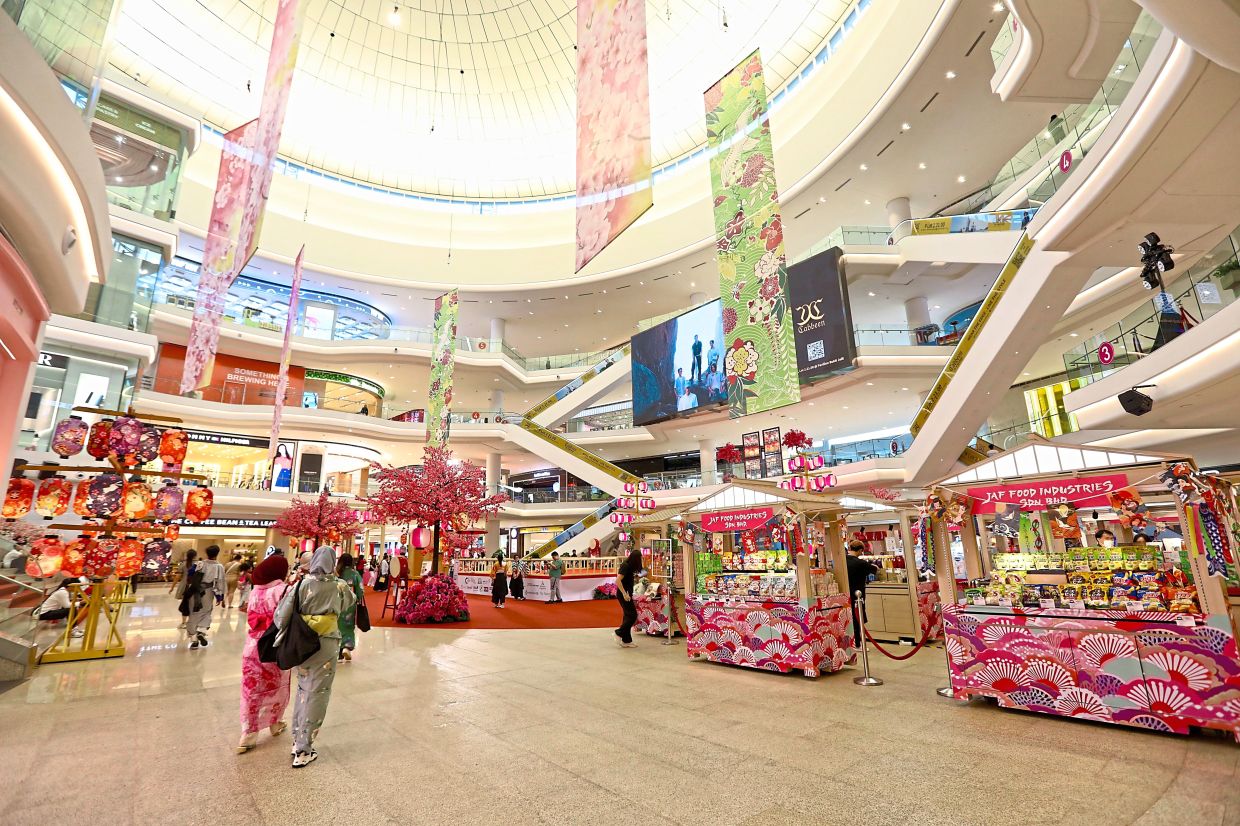
Shopping centres are no longer just retail spaces.
They double as places to burn calories, according to a post by Public Health Malaysia, a social media page with 1.5 million followers.
The post attracted 1,200 comments. Among them was one by netizen Zaidi Juara who said the best way to “mall walk” was to refrain from making any stops.
“Make sure you focus on walking quickly, even if you hear your wife or child calling because there will be bills that need to be paid,” he quipped.
Another netizen, Norzita Yunus said she had a friend who made it a point to clock in 10,000 steps daily at a large mall.
“She always gets someone to drop her off at the entrance to save on parking fees.
“Within a few months, she became slim.
“The extra perk is she knows where every store is and has become the shopping centre’s unofficial walking directory, giving strangers directions when they ask,” said Norzita.
The emergence of mega malls, some of which can be as large as 500,000sqm, approximately about 73 football fields, fuels the mall-walking trend.
According to a Tourism Malaysia report, from just some 100 malls in the late 1980s, the number has increased over three-fold to some 360 malls today.
Warga Biz, a digital business and lifestyle platform, said there were 179 malls in the Klang Valley, adding that if one were to visit one mall per week, it would take 3.5 years to explore them all.

Mall-walking challenges
Last September, Aeon Mall co-chief operating officer Munirah Azmi said the retail group held a mall-walking challenge for 20 days whereby shoppers had to complete 10,000 steps a day for a chance to redeem mystery gifts.
“The idea came about during discussions with the Health Ministry for its Wellness Month programme.
“We suggested mall-walking, which could be implemented nationwide in all our malls in 27 locations.”
In total, 4,181 participants took part in the nationwide campaign.

Munirah added that the aim of the competition was to encourage the public to take regular walks as a simple and accessible form of exercise.
Last June, Pavilion Bukit Jalil hosted its “Mega Shopping Walk” event where shoppers who completed 10,000 steps within the mall were given the chance to win up to RM100,000 worth of prizes.
The 46-day promotion attracted 1,775 participants.
The team rolled out a second series featuring the same challenge last October, which went on until the end of the year.

Pavilion Real Estate Investment Trust asset manager (retail) Datuk Joyce Yap Soh Ching said a significant rise in visitor numbers was observed during the campaign period.
“Participants made trips to complete their steps, which translated into more frequent visits and longer dwell times.
“This afforded opportunities for wellness-themed merchandising,” she said.
“It also worked to strengthen brand connection as the initiative attracted diverse shopper segments and created a positive community experience.
“As voucher redemption was included in our campaign, participants were motivated to make purchases during their visits,” she added.
Yap said many participants reported social benefits by walking with friends or family, and even developed a routine that continued beyond the reward period.

What exercise experts say
In terms of how effective mall-walking is as a form of exercise, gym owner and fitness trainer Terry Gallyot, who has been bodybuilding for 40 years, said the impact would not be much on overall fitness.
“For a proper workout, you need to increase your heart rate by at least 50% to 60%.

“Strolling in a mall will not achieve that because there will be moments when you will stop and look at things before continuing to walk again.”
As for shedding calories, Gallyot said it would be best to refrain from sugary drinks like boba teas while mall-walking, as those amounted to thrice the amount of calories that could be burnt by walking.
Asia College of Exercise Medicine chief executive officer Dr Lee Chee Pheng, who has a doctorate in sports science, said walking in malls was perfect for those who seldom exercise and did not like outdoor activities because of bad weather, traffic or other safety risks.
“However, if you want six-pack abs, mall walking will not give you that,” he pointed out.
Lee said there was no scientific evidence backing the 10,000 steps benchmark, which was often used by the public as a daily fitness goal.
“For the old and unfit, or those with arthritis, hip and lower back pain, if they are pushed to achieve the 10,000 steps, they are going to have a lot of problems.”
For those new to exercise, Lee’s advice is to start off with casual walking.
“Later, you can move on to brisk walking as a way to increase the heart rate.
“For added intensity, if you are in a mall that has staircases, give the elevator a miss,” said Lee.