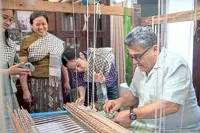
FOR weaving course participant Nasuha Mohd Ali, learning Kain Benang Johor is not just about mastering a new skill but preserving a fading legacy for future generations.
Her journey into traditional weaving began after she came across an advertisement on social media for the “Perintis Johor Kursus Asas Tenunan” (Johor Heritage Basic Weaving Course).
“I’ve always been interested in traditional weaving since I was young, especially after watching documentaries about it.
“So when I saw the advertisement, I decided to try my luck,” she told StarMetro.
Nasuha, who is from Kota Tinggi, said candidates had to go through interviews and practical tests.
“We were given threads and basic guidance, then assessed based on our workmanship and understanding.
“Many did not pass the selection process because it required patience and precision.”
She noted that Kain Benang Johor had distinct characteristics that set it apart from other woven textiles.
“Our motifs are straight and diamond-shaped, unlike songket which uses large gold motifs.
“That is the uniqueness of Kain Benang Johor.”
Nasuha was among the 10 who took part in the Legacy Johor project, an initiative launched by Yayasan Johor Corporation (JCorp) in collaboration with Johor Heritage Foundation, which aimed to revive and preserve Kain Benang Johor as a symbol of the state’s identity.
Another participant, Aslam Muhammad Yusof, from Pasir Gudang, said he wanted to revive the state’s traditional art.
“I have a diploma in architecture but my interest has always leaned towards fine and traditional arts.
“I saw this programme as a chance to preserve Johor’s identity while building a meaningful career.”
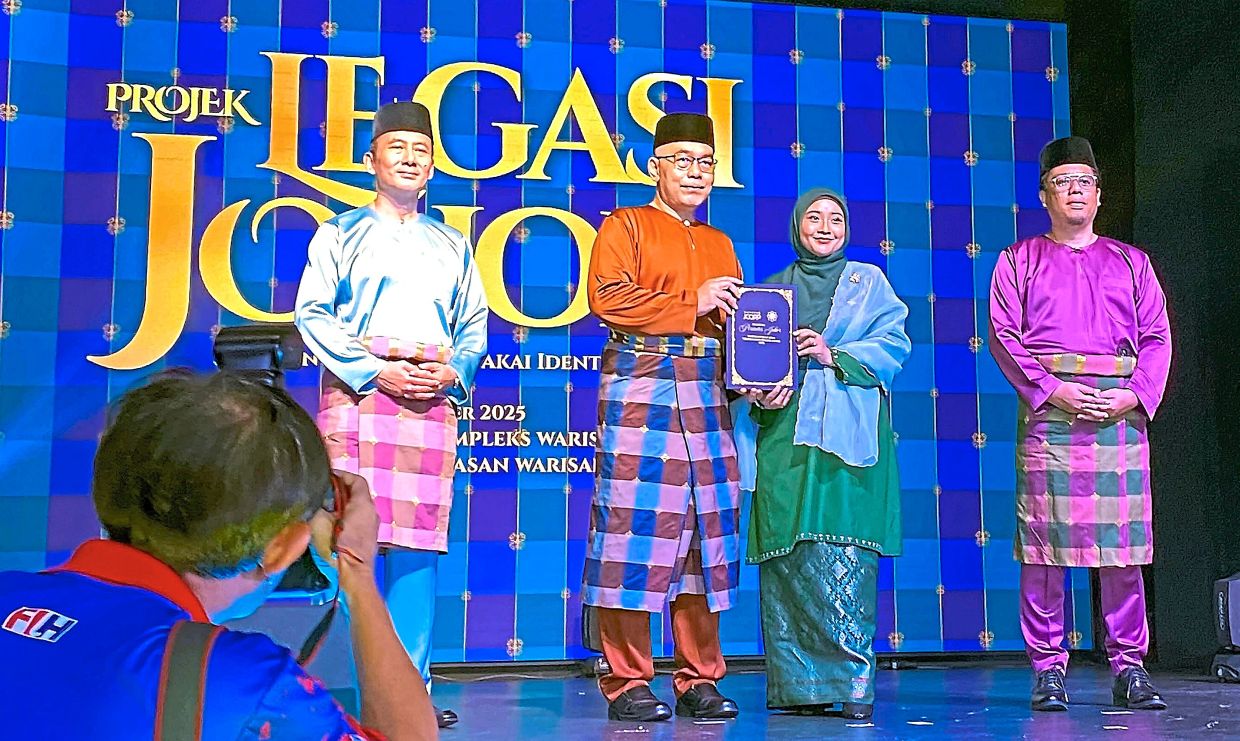
Aslam said the six-month course, which began on Oct 15 and ends on April 15 next year, showed participants the entire weaving process from dyeing and threading to producing finished fabrics and products.
“Unlike songket, Kain Benang Johor does not rely solely on gold threads.
“We can use nylon, metallic or even pineapple fibre, which allows us to create various products like bags, purses and home decorations,” he said.
Noor Amira Hamzah said weaving was one of the most challenging crafts she had ever learned.
“Each fabric takes between two to three weeks to complete and requires patience at every stage, from dyeing to drying and threading.
“It makes you appreciate how skilled our past weavers were,” said Amira, who is also a sewing instructor.
“I hope to further improve my skills and one day open a centre so more people can learn this craft,” she said.
Yayasan JCorp chairman Rozaini Mohd Sani said the initiative reflected the shared commitment of both organisations to safeguard Johor’s heritage.
He said the programme fell under Yayasan JCorp’s Arts, Culture and Heritage focus area and supported the Visit Johor 2026 campaign by promoting the state’s traditional craftsmanship.
“With the theme ‘Woven with Legacy, Worn with Identity’, this programme enables participants to become custodians of Johor’s heritage,” he said.
Rozaini added that Yayasan JCorp had sponsored five complete weaving looms and processing equipment.
He added that five outstanding participants would be selected to pursue advanced training at the National Craft Institute and might be offered full-time positions with Johor Heritage Foundation upon completion of the programme.
Each participant was given a monthly allowance of RM1,000 under the programme.