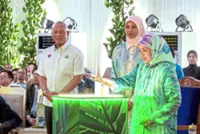
JOHOR is positioning itself as a frontrunner in Malaysia’s climate governance landscape with the launch of its Johor Green Development Policy 2030 by Her Majesty Raja Zarith Sofiah, Queen of Malaysia.
Johor Sustainability Centre (JSC) executive chairman Datuk Hasni Mohammad said the state was taking a proactive stance to ensure it was not merely reacting to national policy but shaping its own long-term environmental direction.
“Initiatives such as the Johor Green Development Policy 2030, JSC and the Raja Zarith Sofiah Learning Centre will form the backbone of a coordinated statewide approach that anticipates future legislative requirements.”
“All these are necessary, given the urgency of climate challenges affecting water security, agriculture, infrastructure resilience and vulnerable communities across the state,” he said.
Hasni said the Federal Government was expected to table the National Climate Change Bill in Parliament next year.
“Johor is not waiting for national directives. We are preparing ourselves to be fully aligned and ready for the Climate Change Bill when it arrives,” said Hasni, who is also Benut assemblyman and Simpang Renggam MP.
The Bill, widely expected to introduce mandatory adaptation plans, emissions reporting frameworks and governance structures, will mark Malaysia’s first legislative framework on climate action.
Hasni said Johor’s newly launched policies would seamlessly complement these national requirements, making it one of the first states to launch a structured climate management system.
He said the Johor Green Development Council, established after last year’s Asia-Pacific Climate Week, provided the institutional anchor needed to coordinate various government agencies, local authorities and private-sector partners.
Hasni added that the state had also mandated Permodalan Darul Ta’zim (PDT) to lead Johor’s environmental, social and governance (ESG) pillars, making it one of the few states to formally assign a government-linked company to champion ESG implementation.
“This ensures that our sustainability agenda is not just policy on paper but is backed by a robust governance mechanism.
“Johor has also been active internationally, sending official delegations to the United Nations Climate Change Conference (COP) events in Dubai in 2023 and Baku in 2024, and has had discussions with Stanford University to collaborate on climate and sustainability frameworks.”
Hasni said state officials recently met Stanford University’s Centre for Human Rights and International Justice founding director Prof David Cohen to outline cooperation proposals that will strengthen Johor’s readiness for the upcoming climate legislation.
“These engagements show that Johor wants to benchmark its progress against global standards.”
Hasni added that the policy launch also highlighted the role of Her Majesty who had been a vocal advocate for stronger climate action and stressed Malaysia’s “prime duty” to address environmental threats in her keynote address at the University of Oxford last year.
“Her Majesty decreed that climate change and environmental degradation posed severe risks to livelihoods and infrastructure, especially in rural and low-income communities,” he said.
“The Raja Zarith Sofiah Learning Centre, built with low-carbon technology from Takasago Construction and supported by Saitama City Hall, has earned the top-tier S-Rank under Japan’s Comprehensive Assessment System for Built Environment Efficiency (Casbee) green building assessment.”
He hoped the centre would become a pilot project that could be expanded to public housing nationwide in the future.
Hasni said the Johor Green Development Policy 2030, developed under the mandate given to PDT in November last year, serves as a strategic action plan supporting the state’s flagship “Johor Green Deal”.
The plan was prepared in collaboration with Institut Sultan Iskandar Universiti Teknologi Malaysia.
Meanwhile, Hasni said JSC would serve as the main catalyst to translate policies into actionable programmes, ensuring the Johor Green Development Policy remained aligned with the upcoming National Climate Change Bill.
He added that being structurally prepared ahead of the Bill would allow Johor to implement targeted, community-based and scientifically informed climate strategies without delay, once national requirements come into force.
“This is how Johor intends to lead – not by waiting, but by acting,” said Hasni.
The Raja Zarith Sofiah Learning Centre is located at Taman Plentong Utama in Masai, while the JSC is located at the Tunku Mahkota Ismail Youth Centre in Hutan Bandar Johor Baru, Kolam Ayer, Johor Baru.