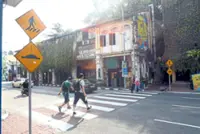
Despite the availability of zebra crossings, many pedestrians cross roads wherever they please.
To address this issue, a team of professors and students from Universiti Malaya (UM) has created two eye-catching, three-dimensional zebra crossings.
One crossing features a conventional 3D-style design, while the other boasts a batik-inspired 3D pattern.
Dr Suhana Koting, a senior lecturer from UM Faculty of Engineering’s Department of Civil Engineering, said the project stemmed from the Impact-Oriented Interdisciplinary Research Grant Programme (IIRG), awarded to a multidisciplinary team from UM in 2020–2021.
“The idea came about as we wondered why people avoided the safer option, which is the zebra crossing.
“Through interviews, we found that drivers often failed to stop at the crossings and pedestrians felt the crossings were ineffective, dull and even invisible,” she said.
The project was part of a case study on active transportation and walkability in Kampung Kerinchi, Kuala Lumpur.
Suhana said the project was led by Dr Yong Adilah Shamsul Harumain and Dr Nur Aulia Rosni from the Department of Urban and Regional Planning, along with herself and a group of students.
She added that the team’s research focused on understanding people’s walking behaviour, the psychology of crossing and how design could make road safety both functional and engaging.
As the project evolved, the Faculty of Engineering’s Deputy Dean of Development, Assoc Prof Dr Nasrul Anuar Abd Razak, saw an opportunity to bring the concept to life within the campus itself.
Suhana said, “Both designs are meant to slow down vehicles and improve driver awareness.
“The conventional 3D design may give a stronger visual cue to drivers, especially in low light, because of its high contrast.
“The batik version, though slightly more complex in colour, is still effective due to its three-dimensional depth and vivid patterning.”
The 3D crossings have become more than a safety measure, they are now part of the faculty’s visual identity, she said.
Students, visitors and staff frequently stop to take photos, turning the crossing into a small landmark.
The vibrant colours add warmth to the built environment, balancing the concrete tones of surrounding buildings.
“The project also encourages walkability on campus, reminding pedestrians to use designated safe routes.
“This subtle behavioural shift contributes to safer and more orderly movement across the faculty grounds,” she said.
“In a broader sense, the installation demonstrates how a university can be a living laboratory, where research findings directly improve campus life.”
Suhana added that if a simple crossing could make people smile, slow down and appreciate their surroundings, then it has achieved more than safety.
“We’ve built a connection,” she said.
The project’s journey – from a research grant on walkability in Kampung Kerinchi to a vibrant installation at the Faculty of Engineering – demonstrates how academic research can generate real-world impact.
It also shows that Malaysia’s cultural heritage, when creatively reinterpreted, can strengthen public spaces and bring people together. – By SHEILA SRI PRIYA