
A TOTAL of 205 local integrated circuit (IC) engineers have been hired so far to work at the first Malaysia Semiconductor IC Design Park, says Selangor investment, trade and mobility committee chairman Ng Sze Han.
“We are expecting to hire 400 more IC engineers next year at the park located in Puchong.
“The starting salary for degree holders ranges from RM5,000 to RM6,000, while those with a master’s degree will start from RM7,000,” said Ng.
The park in Puchong was launched in August 2024, while the second of its kind in Cyberjaya was launched earlier this month by Prime Minister Datuk Seri Anwar Ibrahim.
Ng was speaking at an IC Park showcase organised by Selangor Information Technology and Digital Economy Corporation (Sidec) at Bangunan Sultan Salahuddin Abdul Aziz Shah in Shah Alam.
Also present was Sidec chief executive officer Yong Kai Ping.
“The progress demonstrated by the IC Design Park’s industry partners and Sidec’s startup alumni reflects the strong momentum behind Selangor’s technology ambitions,” said Ng.
“We are proud to see how far our ecosystem has come, with Malaysian engineers now developing advanced chips, artificial intelligence (AI) systems, Internet of Things (IoT) technologies and climate-tech solutions.”
While the progress was encouraging, he said Selangor intended to continue its efforts by focusing on strengthening design capabilities, deepening industry collaboration and creating more high-value opportunities for local talent.
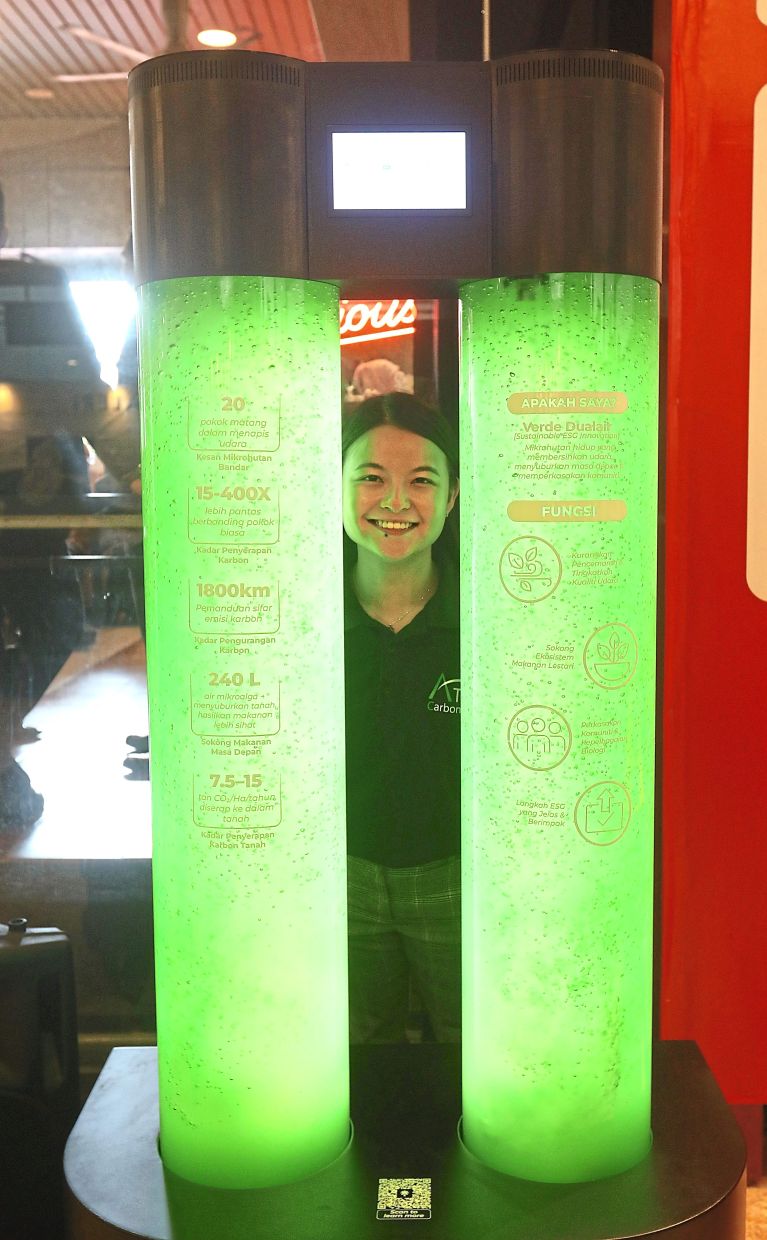
One of the highlights at the showcase was the display of the Verde Dualair system by local company Atoz Carbon Cycle.
The company described Verde Dualair as a nature-based “living microforest” air system that uses microalgae biotechnology to improve indoor air quality while contributing to circular carbon reduction.
“This system, also called the ‘Green Lung’, consists of millions of microalgae invisible to the naked eye,” said Atoz Carbon Cycle chief ecosystem officer Jean Tan.
“The two cylinders that power this system can function like 20 trees to conduct the photosynthesis process.”
Tan, who introduced the product to visitors at the showcase, said the innovation could help tackle climate change by reducing carbon dioxide, a major contributor to greenhouse gases.
“It also supports food security by promoting healthier crop growth through more fertile soil,” she said.
Other featured local-made tech included an edge video-processing chip for surveillance applications; a drone designed for monitoring, photography, emergency response and industrial use; and embedded IoT systems in products or solutions such as wearable health analytics, water quality monitoring and rugged industrial sensors for oil and gas environments.