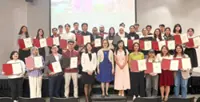
AROUND 1,000 guests attended Taiwan’s 114th national day reception, hosted by the Taipei Economic and Cultural Office in Malaysia.
Its representative Phoebe Yeh said over 460,000 Malaysians visited Taiwan last year, placing Malaysia among the top Asean countries for visitor numbers.
She added that approximately 390,000 Taiwanese travellers visited Malaysia during the same period.
Yeh said statistics showed that Malaysia had overtaken Thailand to become the most popular destination for international tourists in South-East Asia.
She also expressed her best wishes for the success of the country’s Visit Malaysia 2026 campaign.
During the reception held in Kuala Lumpur, Yeh said educational, cultural and people-to-people exchanges between Taiwan and Malaysia continued to flourish.
According to her, Malaysia was currently Taiwan’s third largest source of international students, with nearly 10,000 Malaysian students pursuing education there.
Additionally, about 130,000 Malaysian alumni of Taiwanese institutions had returned home and were contributing to various sectors, forming a powerful bridge of friendship between the two sides.
On trade relations, Yeh said Taiwan had become Malaysia’s fourth largest trading partner in 2024, while Malaysia ranked as Taiwan’s seventh largest.
She said bilateral trade reached a record high of US$39.1bil (RM163.3bil).
“Total trade from January to July 2025 stood at US$31.5bil (RM131.5bil), representing a 35% increase compared to the same period last year.”
She added that Taiwan was Malaysia’s eighth largest source of investment, with cumulative investments reaching US$16.1bil (RM67.2bil).
Moving forward, Yeh said Taiwan would continue to advance its Digital New Southbound Policy, leveraging its digital capabilities and soft power as a platform for deeper cooperation with Malaysia.
Reflecting on this year, Yeh said Taiwan’s ranking among global leaders in competitiveness, healthcare, information and communication technology and the circular economy has been consistent despite global turbulence.
She said Taiwan’s most dynamic industries included semiconductors, artificial intelligence, biotechnology, smart healthcare, smart agriculture and green energy.