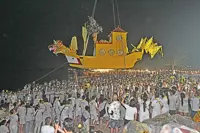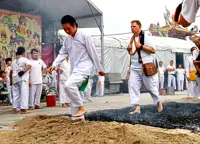
THE Nine Emperor Gods Festival, an occasion when devotees observe a vegetarian diet, has attracted crowds to stalls selling food for religious purification purposes.
Indicated through the colour yellow, the stalls lining streets and set up in open spaces, offer an array of meal options during the nine-day festival.
At Taman Lip Sin, stalls enjoy brisk business as thousands come for the vegetarian fare at lunchtime.
Evelyn Tan, who has been observing the festival’s vegetarian diet since childhood, said it was a form of offering to the gods and for purifying the mind and body.
“My observance lasts 10 days, starting from the eve of the festival,” she said.
The accountant, in her 30s, said vegetarian food tended to cost more during this period.
“Vegetarian meals usually cost about 20% more and prices slowly increase towards the end of the festival,” said Tan.
“But it’s only once a year, so I don’t mind paying a little more.
“Preparing vegetarian meals at home could cost even more, because we have to use dedicated utensils and ingredients.”
In nearby Sungai Nibong, behind the bus terminal and near the Pesta Pulau Pinang site, a new open-air food area has appeared with 19 vegetarian stalls.
This is the first time the site, which has more parking space, is being used for the festival, said site organiser Soo Lay Ying.
“With ample space, we can keep operating costs low.
“Each stall pays just RM1,000 for rent, so the hawkers are able to sell food at affordable prices.
“To attract more visitors, we are even offering chee cheong fun with peanut butter sauce at a non-profit price of RM2.50,” said Soo, 44.
However, business seems to be relatively slow as the site is tucked away from the main road, Jalan Sultan Azlan Shah.
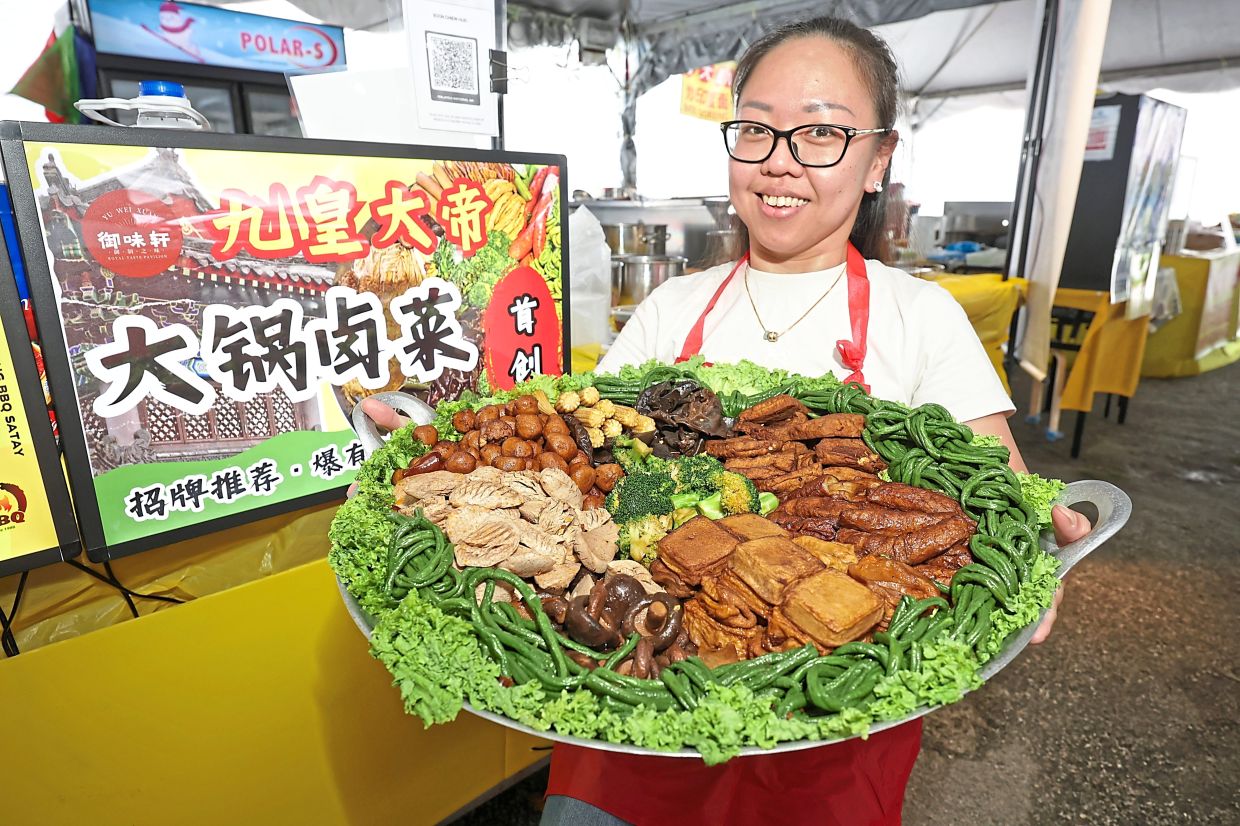
Hawker Boon Chiew Huey, 37, sells vegetarian braised vegetables, which originates from China but tweaked to suit the festival.
“We’ve substituted the meat and added more vegetables.
“It is time consuming, taking about three hours to cook, and the ingredients are more expensive,” said Boon.
“This is my first time selling it and if it does well, I hope to expand into a shop,” she said.
Temples across Penang will come alive with rituals, prayers and processions during the festival that ends on Oct 29.
Observed by Taoists, it honours the nine sons of Dou Mu Yuan Jun (Goddess of the North Star) who is said to oversee the Book of Life and Death.
Devotees believe the deities come via water, so there are symbolic processions to the rivers and sea to welcome them, and for cleansing.