Penang folk celebrate Deepavali with time-honoured recipes, spiritual reflection
DEEPAVALI is a time for love, laughter and togetherness.
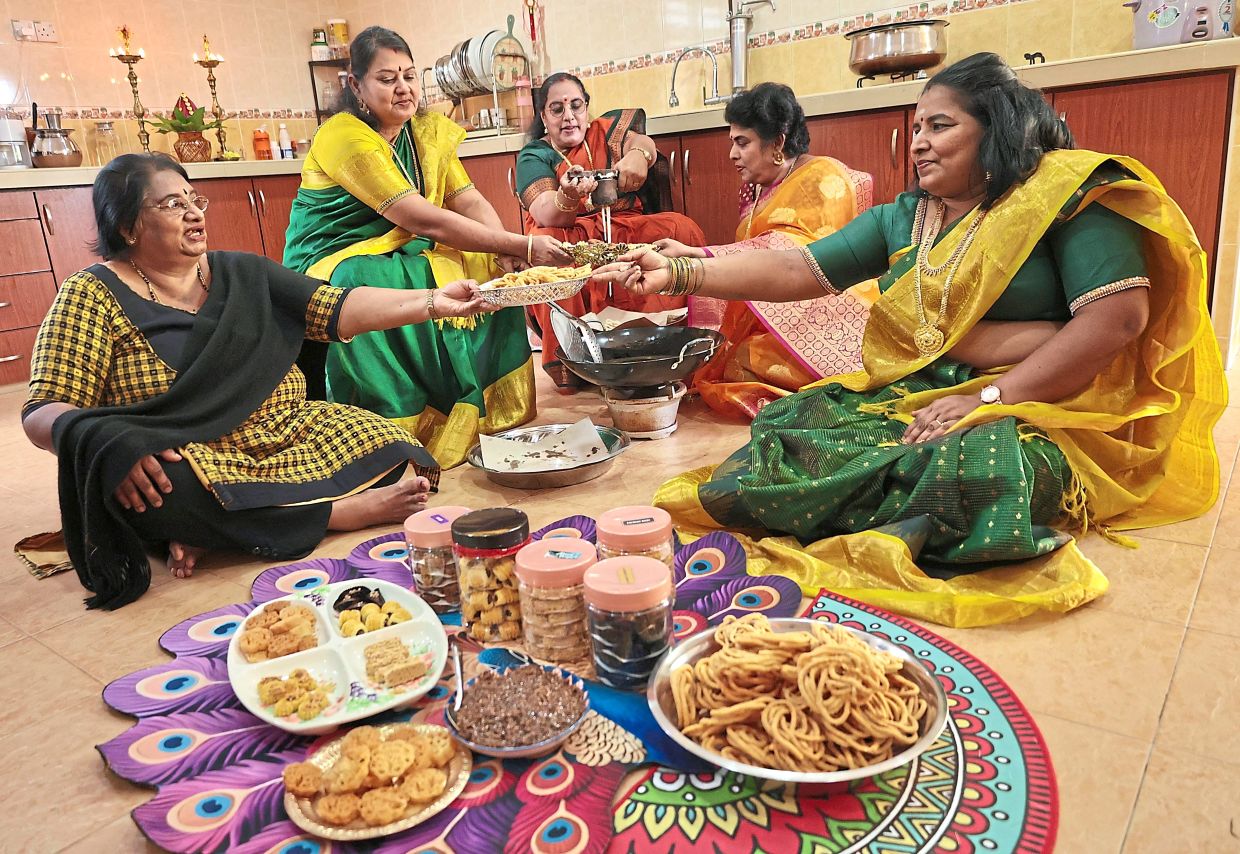
For five sisters in Sungai Ara, Penang, gathering ahead of the celebration has been a cherished tradition for over two decades.
Each year, they set aside three days to be with one another during the festive season.
Their gathering spot is usually the warm, familiar kitchen of R. Angelai’s home.
With Angelai, 61, at the kitchen table are R. Malligah, 67, R. Saraspathi, 63, R. Kaliyama, 59, and R. Manjula, 55, their hands busy creating traditional snacks they have been making since childhood.
Angelai recalls how it all began out of practicality.
“What started as a way to share the workload turned into something we eagerly look forward to every year,” she said.
Malligah said the Deepavali kitchen session had become part of their family identity.
“No matter how busy we are, we block out a few days before the festival to do this together.
“This is the one time we can all sit down, talk and work side by side,” she added.
Splitting tasks
Each sister takes charge of one traditional item.
For Malligah, it is the murukku.
“You must get the texture of the dough right – too soft and it absorbs oil, too stiff and it breaks.
“After years of doing this, I can tell by touch,” she said.
Saraspathi focuses on nei urundai, delicate ghee balls that crumble at the slightest pressure.
“The key is patience. You have to roast the flour until it is aromatic, then blend in the ghee little by little.
“I learnt it by watching our mother,” she said.
Manjula often helps with athirsam, a jaggery-based fried sweet that requires precision.
“It looks simple, but it is actually one of the most difficult.
“If the dough is too wet, it bursts; if too dry, it turns hard.
“It takes years to get the timing right,” she explained.
Kaliyama, a hospital chef, said festive cooking was a different experience.
“At work, I follow recipes. But here, everything is by instinct.
“We go by colour, texture and smell.
“There are no measuring spoons in this kitchen,” she said.
Angelai, who prepares the achi murukku, keeps their mother’s method alive – mixing the dough by hand and using only home-ground flour.
“When I see the spirals drop into the oil, it reminds me of our childhood,” she said.
The sisters also make voma podi, a light, crispy snack flavoured with cumin and a hint of spice.
“It is the easiest to prepare, and always the first to finish.
“The children like it because it’s crunchy and goes with everything,” said Saraspathi.
Malligah, who once catered for weddings and temple events, said the Deepavali session carried a more personal meaning.
“Those days, I cooked in large quantities for customers.
“Now, it’s just for family.
“The satisfaction is different when it’s done with your own sisters,” she said.
Malligah said their rhythm in the kitchen had become second nature.
“One mixes, one fries, one packs. Nobody needs to say who does what.
“We have done this for so long that it just flows,” she said.
Angelai said they no longer made the huge quantities they once did.
“We do just enough for everyone to take home.
“Each of us gets our share and a few jars go to the next generation,” she said.
Tradition lives on
The sisters agree that the time together keeps their bond strong.
Manjula said they often talked about old times.
“Even if we disagree, by the end of the day, everything is settled,” she quipped.
For Saraspathi, the sessions are also a time to pass down small but valuable lessons.
“Our children watch, but they do not always take part.
“They say they are too busy with work or their children. We understand, but these things need time and patience.
“Once you stop doing them, the tradition fades,” she said.
She added: “We continue because someone has to.
“If we do not, there will come a Deepavali where no one makes these things at home anymore.”
Angelai said they always began the day with a small prayer.
“It is our way of giving thanks for being together and having the strength to do this every year.
“We hope our children will one day take over the task.
“We do not expect them to spend whole days cooking like we do, but maybe they can make one or two things so that the tradition continues.
“It is tiring sometimes, but when we look at the jars at the end of the day, we feel proud,” she said.
Kaliyama said it was also their way of honouring their late mother.
“We remember her in the recipes. She never used written notes; everything was by experience,” she said.
Kaliyama added that even after all these years, the process still held meaning.
The sisters usually take three days to complete their work – one day for mixing and shaping, the second for frying and the third for packing.
Saraspathi said everything was planned in advance, with each sister bringing something such as sugar, flour or containers.
“By the end of the day, we have everything ready.
“Deepavali is more than just lighting lamps and wearing new clothes.
“For us, the celebration begins when the first batch of murukku comes out of the oil.
“That is when we know it is festival time,” said Saraspathi.
Malligah said the atmosphere during their sessions was always light.
“There is no pressure to be perfect. If something goes wrong, we just start over.
“The joy is in doing it together.
“Even the simplest things bring back memories of our childhood home,” she said.
Malligah said that even if one day they could no longer gather the same way, the memories would remain.
“We have photos and stories from every Deepavali.
“Even if we cannot make the snacks anymore, we will still talk about how we used to.
“Every batch of murukku is a reminder that we are still together.
“That is what Deepavali means to us,” she reiterated.
Grateful for guidance
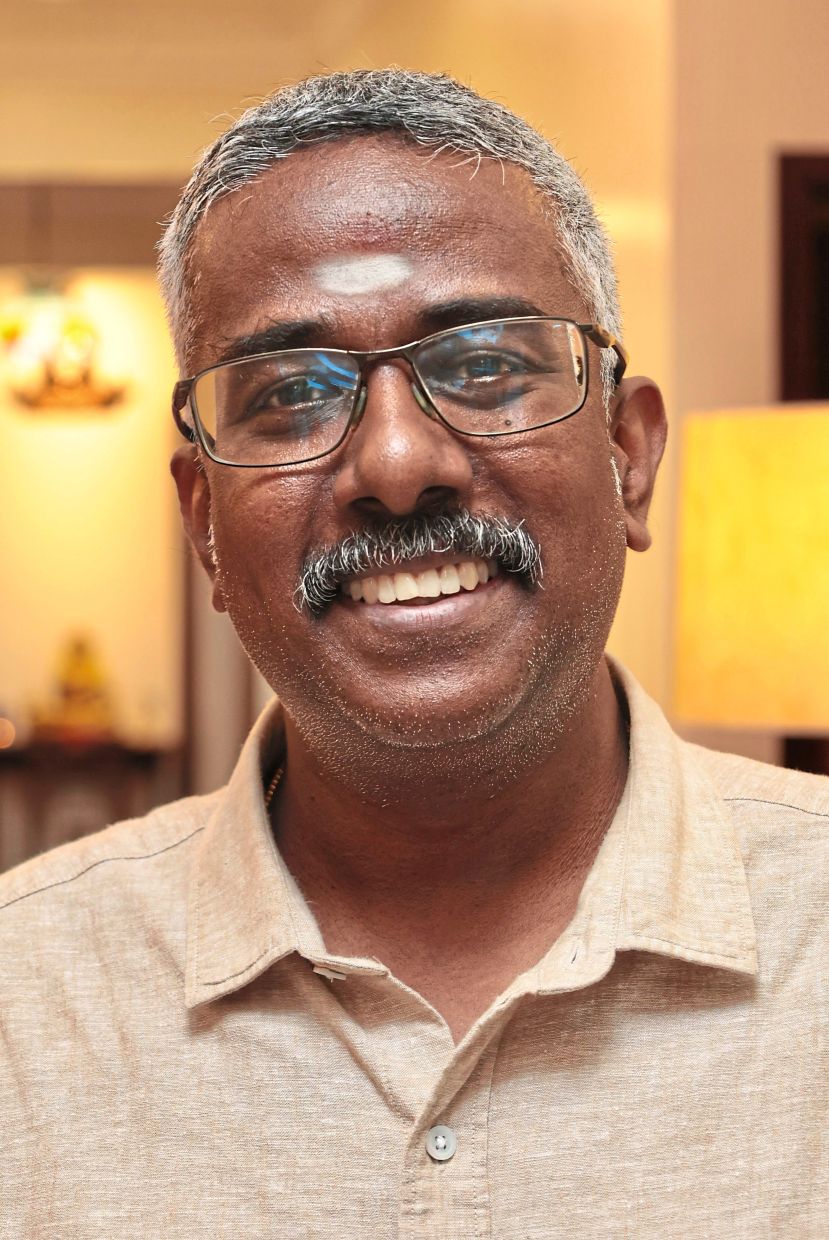
For lawyer K. Kumarathiraviam, playing host to his family at his home in Jalan Utama, George Town, during Deepavali has always been meaningful.
But for the past two years, it has held extra significance.
He was appointed secretary of the Arulmigu Sri Balathan-dayuthapani Waterfall Hilltop Temple in Penang two years ago, and became deputy chairman early this year.
And just two weeks ago, he was entrusted with the chairmanship.
His house is less than 1km from the temple.
“Taking on this responsibility has made this Deepavali special,” he said.
“It feels like a blessing that came at the right time.
“A chance to serve and give back to the community that shaped me,” he said.
Originally from Paya Terubong, Kumarathiraviam, 47, described the appointment as life coming full circle.
“I always wanted to live close enough to hear the temple bells.
“When that wish came true and I was later entrusted with the chairmanship, I saw it not just as an honour, but a calling.
“Every morning when I hear the first chime, I remind myself that leadership here means service,” he said.
He recalled that the move to his current home in 2012 felt divinely guided.
“I had long admired this house but never thought I could afford it.
“When the loan was approved, everything fell into place so smoothly that I took it as a sign; like divine grace at work,” said Kumarathiraviam.
His new role has made this Deepavali more contemplative than any before.
“It teaches humility.
“It is not about titles or recognition but ensuring that every devotee who climbs the hill leaves feeling peaceful and cared for.”
For him, the celebration does not begin with lights or sweets but with introspection.
“We light the lamp to remove darkness from our hearts.
“After everything that has happened this year, I see it as a reminder to start afresh, with gratitude and a sense of duty,” he said.
This year, Kumarathiraviam said his thoughts centred on continuity and giving back.
“When I was younger, Deepavali was all about new clothes and sweets.
“Now it is about giving to family, community and anyone who seeks help.
“Blessings truly multiply when shared.
“It is a reminder to keep kindness and faith alive in our hearts and to be thankful for the chance to begin again each year,” he said.
Kumarathiraviam’s brother-in-law B. Venugopal, a senior lecturer, said the family’s Deepavali always began with early morning prayers at the hilltop temple.
“It has been our routine for years,” he said.
“We wake early, offer thanks and begin the day quietly.
“No lavish feasts; just faith and togetherness.”
For Venugopal, peace itself is the greatest gift.
“In today’s world, finding calm is a blessing. Deepavali gives us that pause and space to be truly thankful,” he added.