

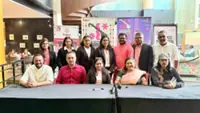
AS THE sounds of Indian classical music fill the air this festive season, a new generation of women is stepping forward to carry its traditions into the future.
Through rhythm, melody and devotion, they are redefining what it means to perform at auspicious occasions such as Deepavali and other celebrations.
Among them are musicians like Ahgelya Mohan, Dr Radheni Ramesh and Sivashankari Yomarakuro who blend discipline with creativity and heritage with heart.
Drumming up change
For 21-year-old Ahgelya, the steady rhythm of the tabla carries more than music.
In a field traditionally dominated by men, she has made the percussion instrument her own, driven by a deep love for the sound.
“Growing up, I was inspired when my brothers used to play,” she said.
Without formal lessons, Ahgelya taught herself to play the instrument from the age of six, through observation and practice.
When she first began performing in public, the reactions were immediate.
“People were very surprised as they did not expect a girl to play like that,” she said, adding that every performance motivated her to keep improving.
Ahgelya often blends classical and contemporary sounds, including English and Hindi songs.
“People find it very interesting when they hear fusion performances. It shows that the tabla can fit into any kind of music.”
She creates her own arrangements by listening closely to songs and matching rhythms to the melody.
“There’s no music sheet, so I listen to how the beats go, then I find where the tabla fits in.”
Balancing her musical journey with studies takes careful planning.
Ahgelya recently completed her diploma in international business and is now pursuing a degree in logistics.
“Weekdays are for studies and work, while weekends are set aside for performances and practice.
“I still make sure to play a little every night, even if it is just for a few minutes.”
While still searching for a formal teacher to guide her next stage, Ahgelya continues to perform independently and hopes to take her music further.
“I hope my performances will reach audiences around the world,” she said, adding that her dream was to perform in India one day.
Above all, she hopes her journey inspires other women to follow their passion without fear or limitation.
Blending old and new
Dr Radheni, 26, is hoping to bridge generations and genres with the veena.
She first began learning the traditional Indian chordophone instrument at the age of 11, inspired by her mother.
“My mum picked up the instrument when she was in university.
“She didn’t continue, but my parents wanted me to take up music. Once I started, I really loved the sound that came from it.”
That early fascination has turned into a lifelong pursuit.
Dr Radheni began learning the veena since 2009, first at a music school in Klang and now continuing her lessons online with a teacher based in India.
“At first, I thought learning online would not be effective.
“However, since I already had my basics, it turned out to be quite good.
Her twice-weekly online classes has helped her refine her technique and expand her musical expression.
“I felt stagnant and I wanted to diversify the way I play. That was when I started exploring fusion music.”
Dr Radheni began performing at temple events during her teenage years.
“Later on, I started performing during at-home prayer sessions and small celebrations.
“From there, it grew into full-fledged performances.”
Today, her performances have reached new spaces, from cultural events to cafes.
One of her recent shows was at a local event called Beats and Bru.
Ahgelya was also a performer during the event.
“It was a pop-style atmosphere, so I was nervous at first,” said Dr Radheni.
“But once I started playing my fusion set, people really enjoyed it.
“It was different from the usual energy, more of an attentive, quiet appreciation, but very encouraging,” she said.
Her fusion style combines classical Carnatic melodies with modern arrangements and familiar tunes from Indian cinema.
The mix has helped introduce the veena to audiences who might not have encountered it before.
“Many people come up to me after performances, saying it was their first time seeing a veena and are naturally curious about it,” said the musician.
Balancing her musical journey with her professional life has been challenging.
A veterinarian, Dr Radheni currently does house calls as part of her work.
“It is flexible, which helps as I can arrange my schedule and it lets me balance my work and my music,” she said.
Her performances, whether devotional or contemporary, share the same purpose – to keep the veena alive.
“For the young ones, I hope it inspires them to try something new.
“For the older generation, it’s a way to continue enjoying the Carnatic tradition.
“I just want to bring the veena to life, in every way I can,” Dr Radheni added.
Becoming a student again
Although only four months into her musical journey, 42-year-old Sivashankari said learning the violin again had become a meaningful part of her week.
She had first picked up the veena at 16, encouraged by her mother, but stopped playing as other responsibilities took over.
“Even during that time, learning to play the violin was always at the back of my mind,” she said.
When her son’s school started offering violin classes earlier this year, she enrolled him and later decided to join as well.
“My mum gifted me this violin and asked me to participate too. Now my son and I go to classes together every Sunday.”
Learning again after many years has been both challenging and rewarding, Sivashankari said.
“Compared to the veena, I find the violin tough because it does not have frets (a raised portion on the neck of a stringed instrument, that extends generally across the full width of the neck).
“But, the music teacher makes it interesting by including devotional and songs from movies, not only syllabus pieces.”
Four months in, she can already play short pieces and recently took part in a mini performance.
Outside of class, Sivashankari manages government grants and is also pursuing a Doctorate in Business Administration.
She tries to practise the instrument several times a week and describes playing as a focused, calming time.
Learning alongside her 10-year-old son has added a new layer to their relationship, she said.
“We challenge each other and he picks up my mistakes, and I pick up his.
“When it is music time, we are more like classmates.”
For Sivashankari, taking up the violin is not about mastery or performance, but balance.
“It is something for myself. It helps me manage work stress and gives me that space to focus on something different,” she said.


