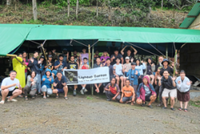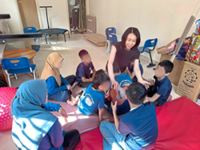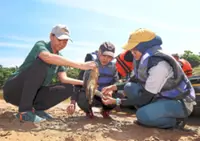
IN THE remote village of Kampung Sinaron Tengah in Sook, Sabah, a group of women are sowing seeds of change.
The village, located about an hour’s drive from Sook town and nearly two hours from main town Keningau, faces challenges due to its remote setting.
Villagers have limited access to basic groceries, while jobs are scarce.
Most families rely heavily on their own crops as a food source, with livelihood options remaining restricted.
After discussions with village heads from surrounding areas, the non-governmental organisation Women of Will (WOW) chose Sinaron Tengah for its project site, as the village has sufficient number of potential farmers keen to learn organic farming and generate income through sustainable agriculture.
A total 25 women farmers from B40 households have come together under the project by WOW, supported through the Star Social Impact Grant (SSIG).
The participants, aged between 20 and 60, come from diverse backgrounds.
While most are married, more than half do not have a stable source of household income.
On average, each household supports seven dependants on just RM1,050 a month.
Traditionally, rural women in Sabah face numerous barriers – from limited job opportunities and lack of access to training to entrenched gender roles that confine them to unpaid domestic work.
According to the Statistics Department, Sabah recorded the highest poverty rate in Malaysia at 19.7% in 2022, with women in rural areas often the most affected.
Recognising this gap, WOW, which focuses on empowering women in low-income communities, launched a 12-month organic farming initiative last November to equip rural women with practical skills for sustainable livelihoods.
The project, Empowering B40 Women Farmers in Sabah, was made possible with a RM50,000 grant under the SSIG programme, an initiative by Star Foundation, the charitable arm of Star Media Group.
WOW programme director Kanegeisuwaran Nagamuthu, better known as Prabu, said the initiative was built around upskilling in organic farming, creating income-generating opportunities, and community development.
“So far, we are seeing small but encouraging gains. Some participants have started earning RM20 to RM30 from selling produce.
“With ongoing support and proper tools, we anticipate their income will gradually increase over the coming months,” said Kanegeisuwaran.
The women mainly cultivate vegetables and chillies as primary crops.
Excess produce is typically sold to neighbours, friends and at roadside stalls, providing supplementary income.
With shared land, farming tools and training in chemical-free cultivation, yields have improved and participants are now dedicating more time to farming as a viable source of income.
Each participant was selected based on household income, farming background and family circumstances.
They also received RM400 worth of farming tools, including watering cans, hoes, machetes and a mini cultivator.
To date, the women have completed four training sessions and two rounds of coaching, covering key areas such as land preparation, composting, organic fertiliser production and financial management.
Participant Janet Jamain said the hands-on training had been both valuable and practical.
“It gave us useful knowledge on farming and fertiliser-making that will benefit housewives like us in the long run.”
Before joining the programme, many of the women had no access to larger plots of land, limiting their ability to grow beyond subsistence crops.
Karmela Toting said, “The course is well-structured and clear. It has broadened our understanding of organic farming and how to apply it effectively.”
Balancing farm work with family responsibilities remains a challenge.
Some women, especially mothers with small children, often bring their babies along to training sessions.
Others rise early to prepare meals before heading to the fields, still carrying the burden of caregiving while pursuing their farming goals.
The programme will continue with additional training sessions and culminate in a graduation ceremony in October.
Founded in 2016, WOW has empowered over 2,700 women across 40 underprivileged communities in the Klang Valley, Kedah and Sabah through training, coaching and access to micro-business capital.
Now in its fifth year, the SSIG Programme supports impactful initiatives in five core areas: environmental protection, community development, education, access to basic needs and infrastructure, as well as health and well-being.
To date, the grant programme has disbursed RM714,000 to fund 15 social projects across Malaysia, improving lives and promoting sustainability nationwide.